4BI1
Coordination & Response
Structures and Functions in Living Organisms · 7 question types
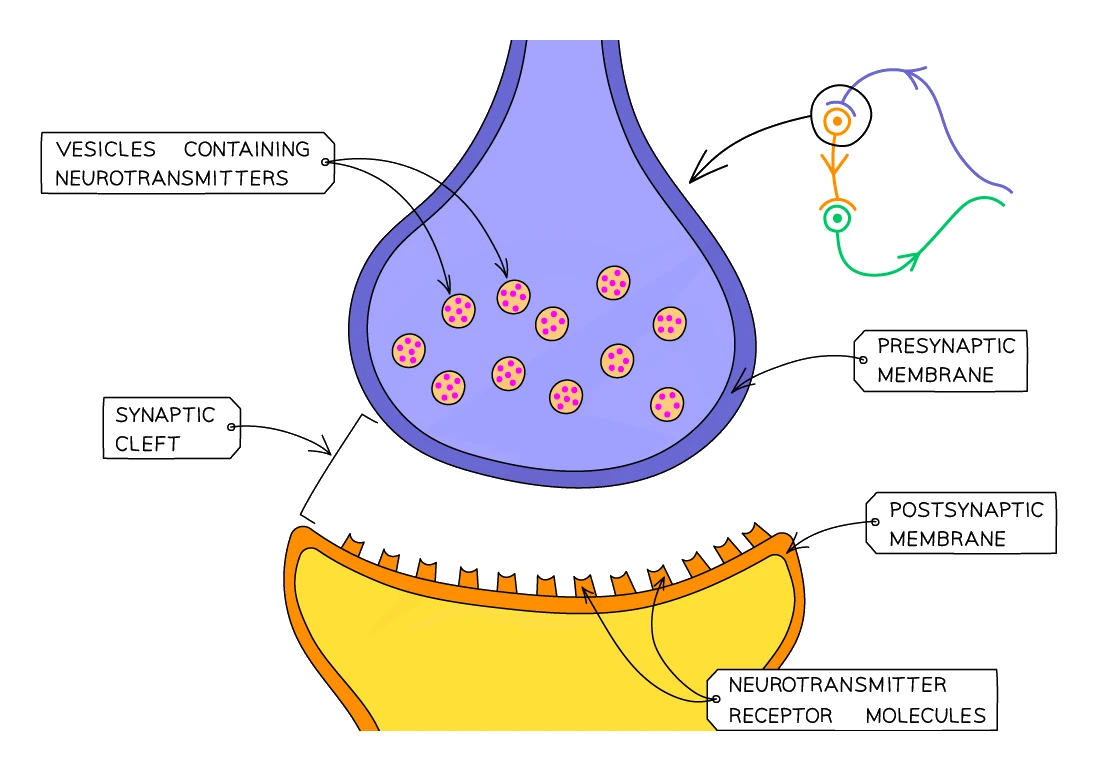
Neurones are not actually connected to each other. A tiny gap, called a , sits between the end of one neurone and the start of the next. The electrical impulse cannot jump across this gap; instead, the message has to be turned into a chemical signal for the crossing.
How a synapse works
- An electrical impulse travels along the first neurone and arrives at the end of it (called the presynaptic terminal).
- The arrival of the impulse triggers the release of neurotransmitter molecules stored in tiny sacs in the end of the neurone. The neurotransmitters spill out into the synaptic gap.
- The neurotransmitters diffuse across the gap to the next neurone.
- They bind to receptor proteins on the membrane of the next neurone.
- This triggers a new electrical impulse in the next neurone, which then carries the signal onwards.
- The neurotransmitter is quickly broken down or reabsorbed so the signal does not last forever.
Why synapses are useful
- One-way only. Neurotransmitter is released only on one side of the synapse and detected only on the other, so signals can only pass in one direction. This stops signals bouncing back and getting tangled.
- Signal modulation. Synapses can amplify, dampen or block a signal. Many drugs (and some natural processes) work by changing what happens at a synapse.
Exam tip
How an impulse crosses a synapse
Describing how an impulse passes across a synapse comes up (2 marks), so you need to know a neurotransmitter is released into the synapse, then diffuses across and binds to receptors on the next neurone. The impulse does not "jump" the gap — the crossing is chemical.