Coordination & Response
Structures and Functions in Living Organisms · 7 question types
Plants cannot move from place to place, but they can change their orientation by growing one way rather than another. A directional growth response in a plant is called a tropism.
A tropism is named after the stimulus it responds to:
- Phototropism is a response to light. Shoots show positive (grow towards the light); roots show negative phototropism (grow away from light).
- Geotropism (also called gravitropism) is a response to gravity. Roots show positive geotropism (grow downwards, in the direction of gravity, anchoring the plant and reaching water); shoots show negative geotropism (grow upwards, against gravity, lifting the leaves towards the sky).
| Plant part | Phototropism | Geotropism |
|---|---|---|
| Shoots | Positive (towards light) | Negative (away from gravity, i.e. upwards) |
| Roots | Negative (away from light) | Positive (with gravity, i.e. downwards) |
The plant's behaviour makes biological sense: shoots find light for photosynthesis; roots find soil for water and minerals.
Auxin: the plant hormone behind tropisms
Plants control directional growth using plant , the most important of which is .
How auxin causes phototropism in a shoot:
- Auxin is made in the tip of the shoot and diffuses down to the region just behind the tip.
- In normal even lighting, auxin spreads equally through the shoot and the cells on all sides elongate at the same rate, so the shoot grows straight up.
- When light shines on the shoot from one side, auxin moves to the shaded side of the shoot, away from the light.
- The cells on the shaded side receive more auxin and so elongate more than the cells on the lit side.
- The unequal elongation makes the shoot bend towards the light.
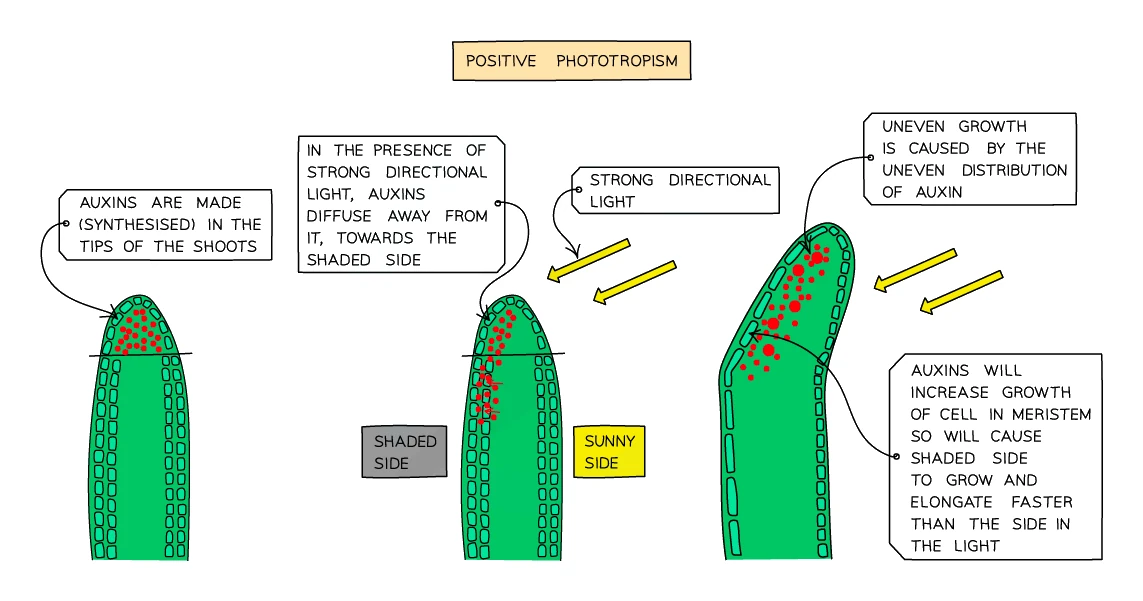
Important: auxin causes existing cells to elongate, not to divide. The number of cells does not change; they just get longer on one side than the other.
How auxin causes geotropism in a root:
- Auxin in roots collects on the lower side of a horizontal root (due to gravity).
- In roots, high auxin concentration slows cell elongation (unlike in shoots where it speeds it up).
- The cells on the upper side therefore elongate more than the cells on the lower side, and the root bends downwards.
So auxin works in opposite directions in shoots and roots, even though the chemical itself is the same. This nicely explains why shoots curl up towards the sun while roots curl down into the soil.
Practical uses of plant hormones
The discovery of how auxin works has led to several useful agricultural applications:
- Selective weedkillers (herbicides) that contain synthetic auxin-like chemicals make broad-leaved weeds grow uncontrollably until they die. Cereal crops (which have narrow leaves) are mostly unaffected, so farmers can spray a whole field and kill only the weeds.
- Rooting powders for cuttings contain auxin. Dipping the cut end of a stem cutting in rooting powder encourages new roots to grow, which makes propagating plants from cuttings much more reliable.
- Fruit ripening hormones (especially ethene) are used commercially to ripen fruit on demand, so that bananas and tomatoes can be shipped green and ripened just before sale.