Coordination & Response
Structures and Functions in Living Organisms
The eye is a sense organ that detects the stimulus of light. It contains light-sensitive receptor cells, plus a sophisticated lens system that focuses light onto those cells.
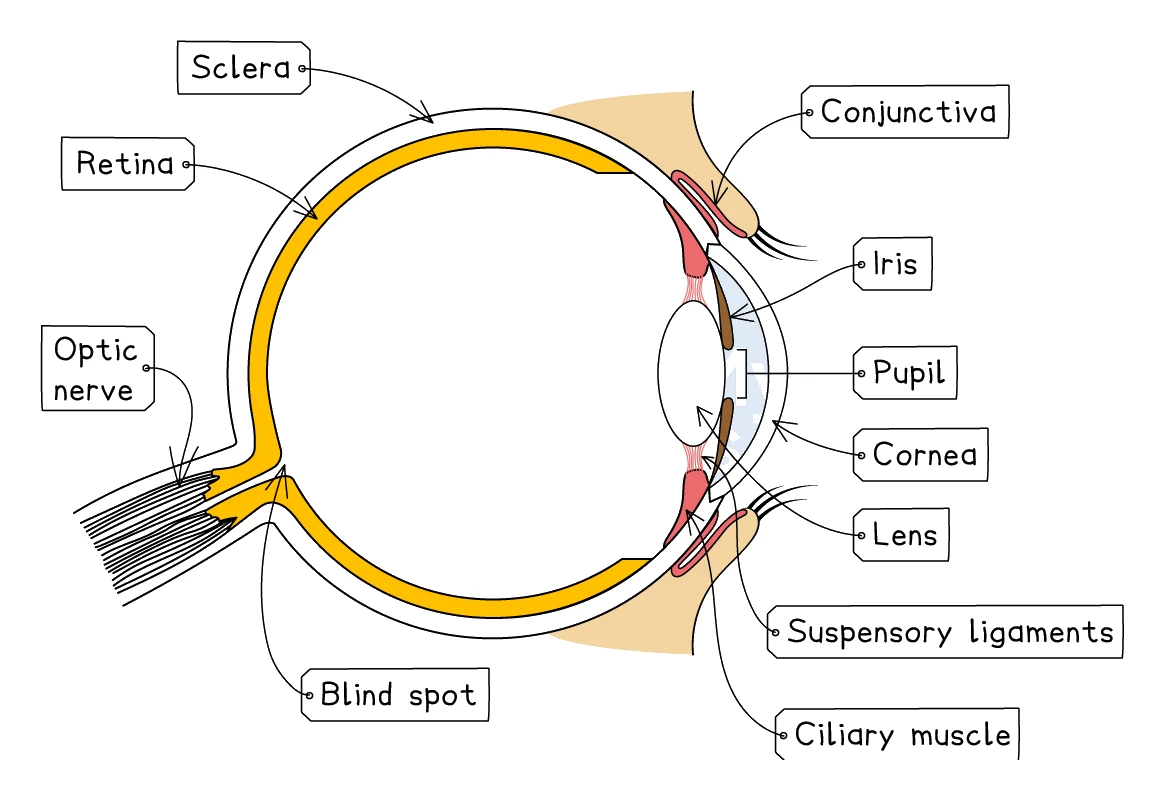
The main structures of the eye
| Structure | What it does |
|---|---|
| Cornea | A see-through, dome-shaped tissue at the very front of the eyeball. Refracts (bends) light as it enters, doing most of the focusing |
| Sclera | The tough white outer wall of the eyeball. Keeps the eye's shape; provides attachment for the muscles that move the eye |
| Conjunctiva | A thin transparent membrane covering the front of the eye; keeps it moist and protected |
| Iris | The coloured ring of muscle that controls how much light enters by changing the size of the pupil |
| Pupil | The black hole in the centre of the iris; the opening that lets light in (the pupil itself is just space; it looks black because the inside of the eye is dark) |
| Lens | A clear flexible disc that fine-focuses the light onto the retina. Can change shape to focus on near or far objects |
| Ciliary muscle | A ring of muscle that surrounds the lens. Changing its tension changes the shape of the lens |
| Suspensory ligaments | Strong fibres that connect the lens to the ciliary muscle |
| Retina | The light-sensitive layer at the back of the eye. Contains rod cells (for dim light, no colour) and cone cells (for colour) |
| Fovea | A patch of retina directly opposite the lens, packed with cone cells. Gives the sharpest, most detailed colour vision |
| Optic nerve | Carries impulses from the retina to the brain |
| Blind spot | The point where the optic nerve leaves the retina. No receptor cells here, so any image falling on this spot is not seen |
Common exam question
Identifying the parts of the eye on a diagram
Question: On a labelled section through the eye, name a structure, or choose which structures refract light, which controls the light reaching the retina and which holds the light-sensitive cells (1 mark each).
Set in 3 of the 23 papers. The cornea and the lens both refract light onto the retina; the iris controls how much light reaches it; the retina holds the light-sensitive cells; the coloured ring round the pupil is the iris. Know the diagram well enough to tell retina, conjunctiva and lens apart when all three are offered.
The question can move on to a cataract, a cloudy or opaque lens: say that less light passes through it (refraction is affected) to the retina's photoreceptors, so fewer impulses reach the brain and the image is dim or blurred. "Poor vision" alone is ignored. Once the cloudy lens is removed, the person needs glasses, contact lenses or an artificial lens; laser surgery is ignored.
Accommodation: focusing on near and far objects
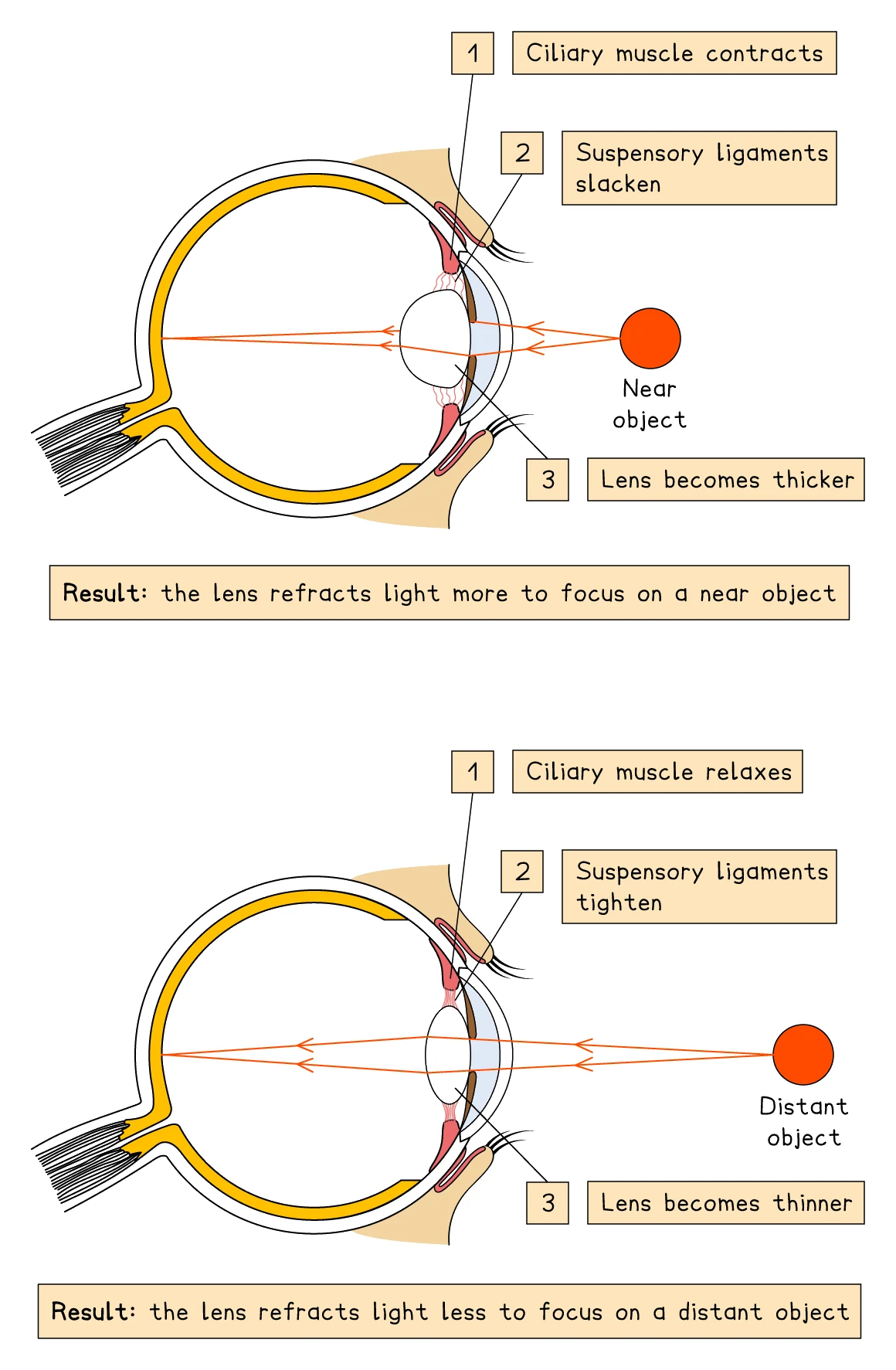
The eye uses two parts to focus light: the cornea does most of the bending, and the lens does the fine-tuning. The lens can change shape, which lets the eye focus on objects at different distances. This is called .
Looking at a near object (e.g. reading a book):
- The ciliary muscle contracts, so the ring of muscle becomes smaller in diameter
- This slackens the suspensory ligaments
- The lens, no longer pulled tight, becomes fatter and more rounded
- A fatter lens refracts (bends) the light more, focusing the light from the close object onto the retina
Looking at a far object (e.g. a tree on a distant hill):
- The ciliary muscle relaxes, so the ring of muscle becomes wider in diameter
- This pulls the suspensory ligaments tight
- The taut ligaments pull on the lens, making it thinner and flatter
- A thinner lens refracts the light less, which is enough for the parallel rays of light from the distant object to focus on the retina
A common mistake: people sometimes write that "the suspensory ligaments contract". They don't, because they are ligaments, not muscles. The right words are tighten or slacken.
| Near object | Distant object | |
|---|---|---|
| Ciliary muscle | Contracts | Relaxes |
| Suspensory ligaments | Slack | Taut |
| Lens shape | Fat / rounded | Thin / flat |
| Light refraction | More | Less |
Common exam question
Focusing on a near object
Question: Describe the changes in the eye, or how the ciliary muscle and the suspensory ligaments control the shape of the lens, when it focuses on a near object (3–4 marks).
Asked in 2 of the 23 papers, one mark per step, so give the whole chain in order: the ciliary muscles contract; the suspensory ligaments slacken, their tension reduced; the lens becomes thicker, fatter, more rounded or more convex; so it refracts light more. Naming the process, accommodation, was a fifth point in one scheme.
Both schemes ignore "the suspensory ligaments relax": ligaments are not muscles, so write slacken, loosen or lose tension, and never call them a suspensory muscle. When the two structures are lettered on a diagram, say which letter is the ciliary muscle and which the ligaments before describing what each does.
The pupil reflex: responding to light intensity
The amount of light reaching the retina is controlled by the size of the pupil. The iris changes the pupil size automatically through a reflex, protecting the retina from too much light and helping with vision in dim light.
The iris contains two sets of muscles, working as antagonistic pairs:
- Circular muscles run around the pupil. When they contract, the pupil constricts (narrows).
- Radial muscles run from the centre outwards like spokes on a wheel. When they contract, the pupil dilates (widens).
In bright light:
- Photoreceptors detect high light intensity
- The circular muscles contract, the radial muscles relax
- The pupil constricts (becomes smaller)
- Less light enters the eye, protecting the retina from damage
In dim light:
- Photoreceptors detect low light intensity
- The circular muscles relax, the radial muscles contract
- The pupil dilates (becomes larger)
- More light enters the eye, improving vision
| Bright light | Dim light | |
|---|---|---|
| Circular muscles | Contract | Relax |
| Radial muscles | Relax | Contract |
| Pupil size | Narrow | Wide |
| Light entering | Less | More |
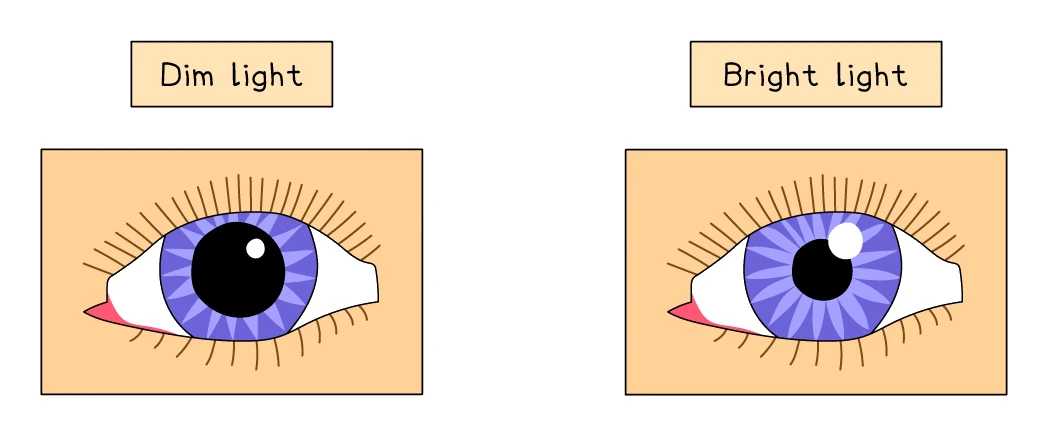
The pupil reflex is automatic; you do not consciously control it. It is a classic example of a reflex action coordinated by the brain (specifically, by the brain stem) rather than by the spinal cord.
Common exam question
How the iris controls the light entering the eye
Question: Explain the changes in the iris when a person moves from dim light into bright light, or how an iris that lets light pass through it affects vision (2–3 marks).
Asked in 2 of the 23 papers. Moving into bright light, the circular muscles contract and the radial muscles relax, so the pupil constricts and less light reaches the retina. Any two of those three points score, so name both sets of muscles and say what the pupil does. Write circular, not ciliary: the ciliary muscle changes the lens, and the scheme ignores it here.
An iris with no pigment, as in a pink-eyed albino animal, does not block light, so changing the pupil has little effect and the iris cannot regulate the light entering the eye; too much light falls on the retina, giving poor vision or damaging it. "The iris lets light through" repeats the question and does not score on its own.