Momentum
Forces & Motion
The design idea
- The force a passenger feels in a crash equals their , F = Δp / t
- For a given change of momentum (e.g. going from 25 m/s to rest at the same mass), the only thing engineers can change is the time taken to make that change
- Longer → smaller force, and every modern road-safety feature uses this trick
Safety features in vehicles
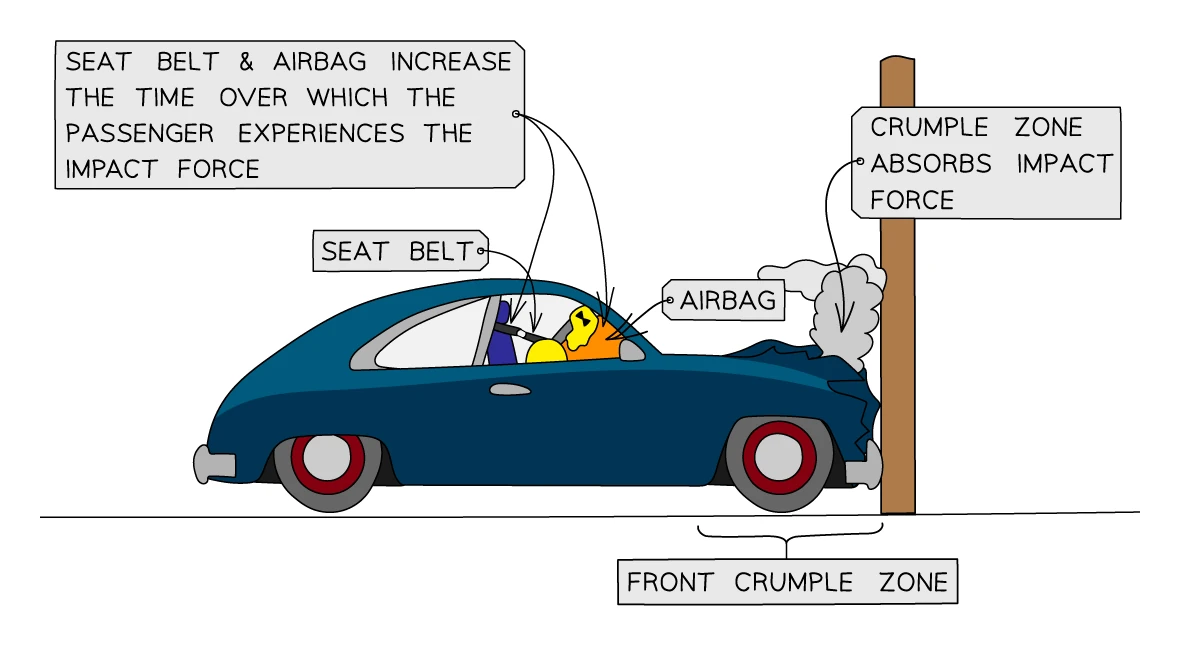
- Crumple zones: areas at the front and rear of a car designed to deform plastically in a collision rather than rebound. They lengthen the time it takes for the car (and hence the passenger compartment) to come to a halt, lowering the peak force on the occupants. This is why an apparently "small" bump can still leave the bonnet visibly crushed, because the crumple zone is meant to do that
- Seat belts: designed to stretch slightly under the loading of a collision. Stretching keeps the passenger fixed to the seat but lets their body decelerate over a longer time and a few extra centimetres of travel, so the force on the chest is reduced. They also prevent secondary collisions of the passenger with the dashboard or windscreen
- Airbags: gas-filled cushions that inflate within milliseconds of a sensor detecting an impact. The passenger's head and chest strike the airbag rather than the steering wheel or dashboard, and the airbag squashes down over many centimetres, again lengthening the contact time and so reducing the impact force
- Headrests: limit how far the head can snap backwards in a rear-end collision, cushioning the head-and-neck momentum swing and so reducing the chance of whiplash injury
Common exam question
Explaining how a safety feature reduces the force
Question: Use ideas about momentum to explain how an airbag or crumple zone reduces the force in a collision, or why an egg is less likely to break on a thick carpet than on a hard floor (2–3 marks).
Asked in 3 of the 24 papers. The marks are a chain: the feature increases the time taken to stop; the change in momentum is the same; so the rate of change of momentum is smaller and, since force equals change in momentum divided by time, the force is smaller. A 2-mark version wants the longer time and the smaller rate of change of momentum; quoting the equation with a statement that the change in momentum is constant also earns that second mark, and "smaller deceleration" is accepted for it.
"It absorbs the impact", "it absorbs the force" and anything about energy are ignored, as is calling the floor hard or soft: answer in terms of momentum and time.
Safety surfaces beyond cars
- Bicycle helmets: the polystyrene foam liner is designed to crush on impact, extending the time over which the head's momentum drops to zero
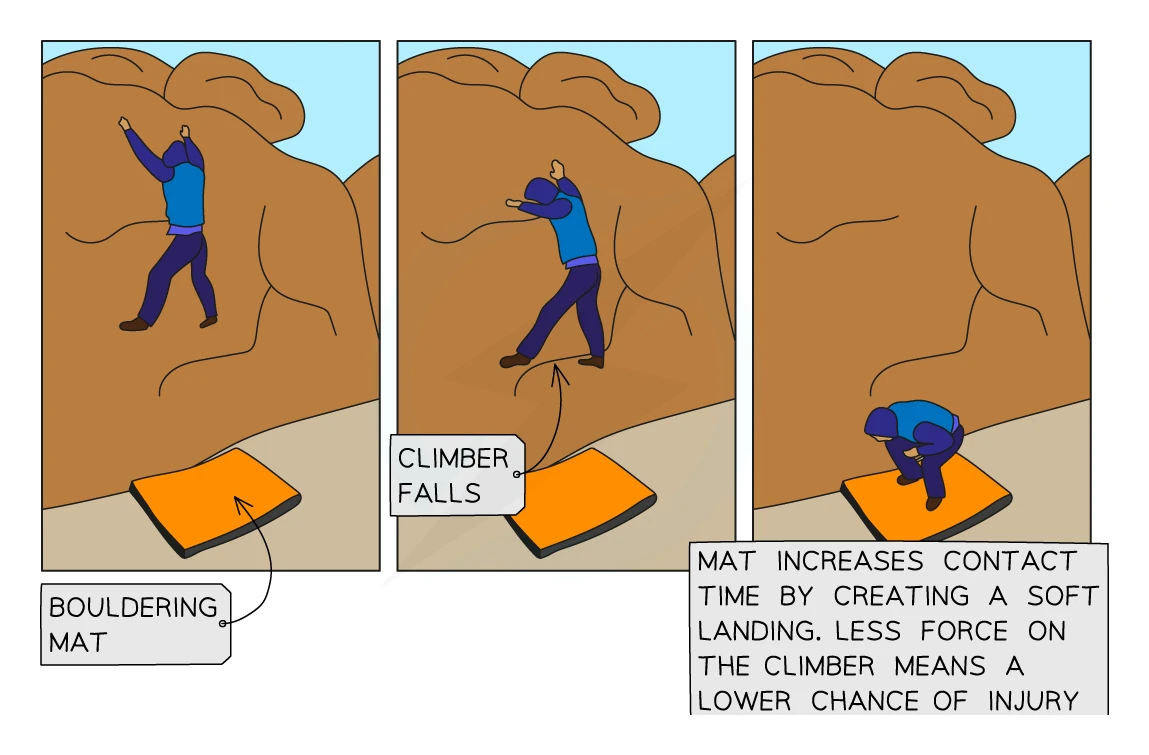
- Gymnasium and bouldering crash mats: thick, low-density foam pads under climbing walls or below gym apparatus stretch the contact time of a fall from milliseconds to tenths of a second, dropping the peak force on the body to a survivable level
- Playground rubber surfacing: replaces tarmac under climbing frames so a child's fall has a longer stop, reducing the force absorbed by bones and joints
Choosing the right thickness of safety surface
- The contact time needed depends on the change in that has to be absorbed:
- Large mass and high speed → large change in momentum → thicker / longer-stopping surface needed (a lorry crashing into a barrier needs more deformable material than a bicycle hitting a kerb)
- Small mass and low speed → smaller change in momentum → thinner surfacing is enough (a child stepping off a low platform onto a soft surface; a thin yoga mat under simple floor exercises)
- Safety features lower the risk of serious injury without erasing it altogether; they swap a brutally large force over a short time for a smaller, but still real, force over a longer one