4PH1
Moments
Forces & Motion · 1 question type
What a moment is
- A moment is the turning effect of a force about a fixed point called the
- A force does not always make an object change its straight-line motion; if the object is free to rotate about a hinge or axle, the force instead makes it spin
- Common everyday moments include:
- the handle of a door rotating about its hinges
- a spanner loosening a bolt
- a child on one end of a see-saw lifting another child at the far end
- a screwdriver prising open a tin lid
- a tap being twisted on or off
- a wheelbarrow being tipped up to be wheeled
- the blades of a pair of scissors closing about the rivet
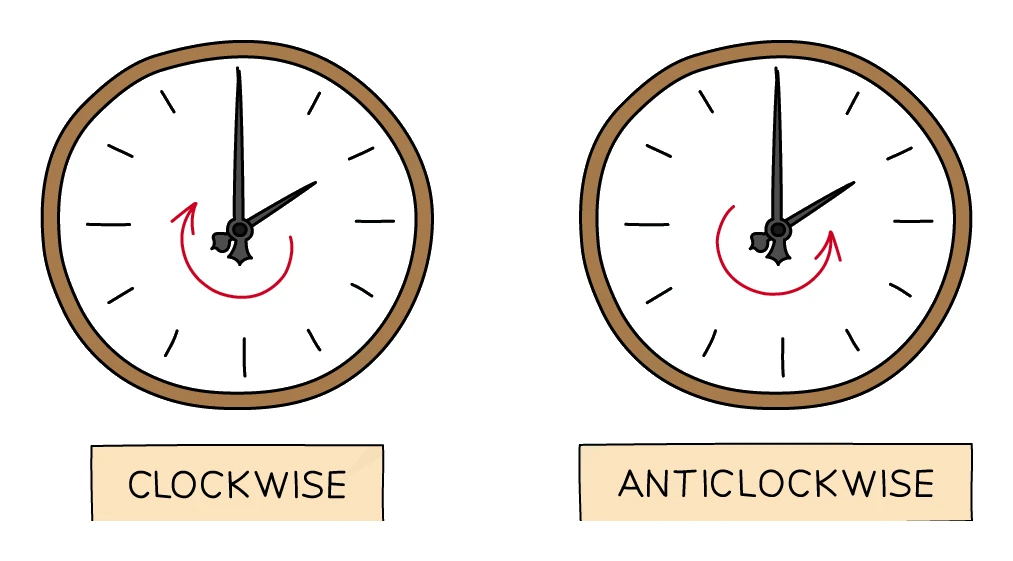
- The rotation may be clockwise or anticlockwise, depending on which side of the pivot the force is applied and which way it points
The equation
M = F × d
- where:
- M = moment of the force (newton metres, N m)
- F = force applied (N)
- d = from the pivot to the line of action of the force (m)
- The unit follows from the equation: newton × metre → newton metre (N m). If the lever arm is given in centimetres, the moment can equally be quoted in N cm; convert to metres unless the question asks otherwise
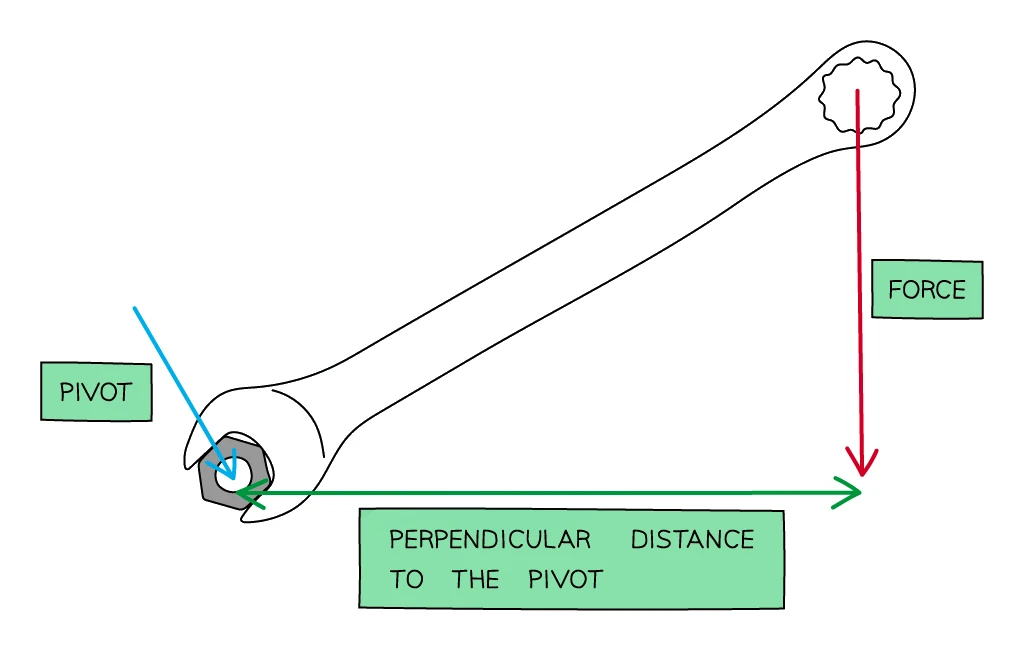
Why the distance must be perpendicular
- The lever arm d is the shortest distance from the pivot to the line along which the force acts, measured at right angles to that line
- A force pointing straight at the pivot has zero perpendicular distance, so it produces no no matter how large it is; it simply tries to push the pivot itself
- For a beam lying flat, only the vertical forces (those pointing straight up or straight down) turn it about a pivot on the beam; a force directed along the length of the beam contributes no moment at all
Long lever arms make life easier
- For a fixed pivot, a longer lever arm reduces the force you must apply to get the same moment
- Real-life consequences:
- A door is far easier to push open at the handle (far from the hinge) than near the hinge itself; the same moment comes from a much smaller hand force when d is large
- A wheel nut wrench with a long extension bar makes seized nuts shift that a stubby spanner cannot
- A short crowbar prises open a crate with a much smaller hand force than fingers alone
Worked example
Calculating a moment
A spanner applies a force of 40 N at a perpendicular distance of 0.30 m from the centre of the nut (the pivot).
Solution:
- Write the formula: moment = force × perpendicular distance
- Substitute: moment = 40 × 0.30
- = 12 N m