4PH1
Moments
Forces & Motion · 1 question type
The balancing condition
- The states that, when an object is balanced about a pivot:
total clockwise moment about the pivot = total anticlockwise moment about the pivot
- "Balanced" here means the object is in , so it is either not rotating, or rotating at a steady rate
- If the totals are not equal, the side with the larger total wins, and the object turns that way until something stops it (or until the geometry rebalances)
Using the principle on a beam
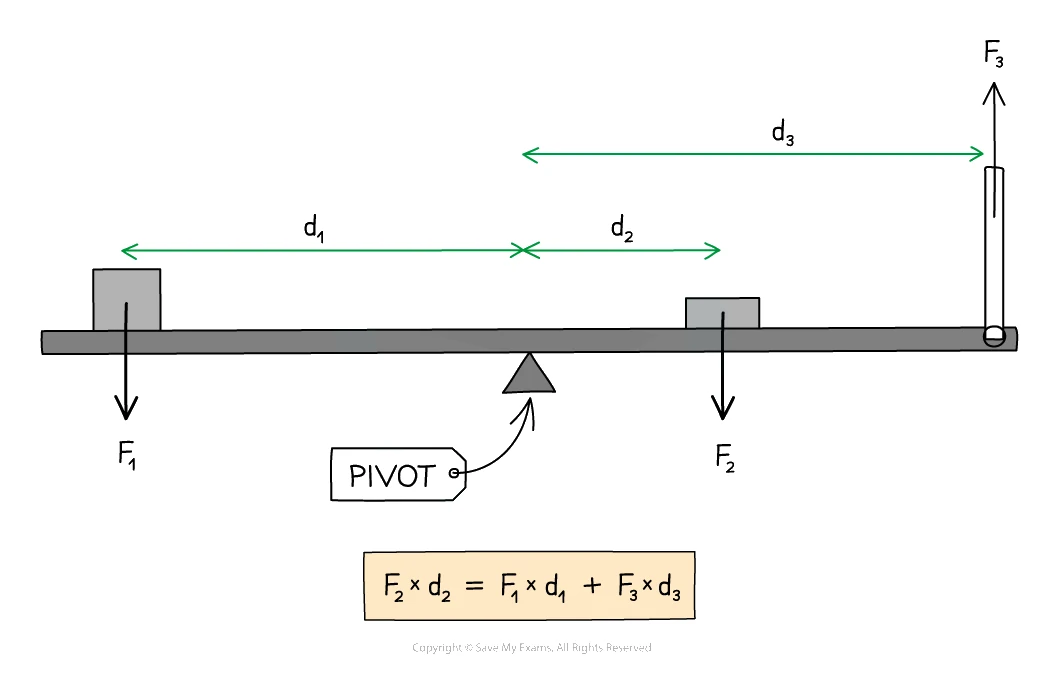
- For a horizontal beam pivoted at one point with several vertical forces acting on it:
- work out the moment of each force separately using M = F × d
- add up every moment that turns the beam clockwise
- add up every moment that turns the beam anticlockwise
- set the two totals equal to find the unknown quantity
Exam tip
The principle of moments
"State the principle of moments" is a 1-marker, so you need to know that for a balanced object the total clockwise moment about the pivot equals the total anticlockwise moment. Saying "moments are equal" without naming clockwise and anticlockwise loses the mark.
Worked example
Using the principle of moments to find an unknown force
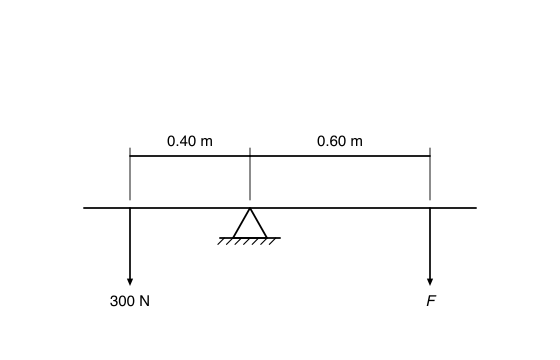
A uniform light beam is pivoted at its centre. A downward load of 300 N acts at 0.40 m from the pivot. A second downward force F acts at 0.60 m on the opposite side of the pivot.
Solution:
- Clockwise moment = 300 × 0.40 = 120 N m
- For balance (principle of moments): anticlockwise moment = 120 N m
- So: F × 0.60 = 120
- F = 120 ÷ 0.60 = 200 N
Supporting a beam with two upward forces
- A light beam is one whose own mass is small enough to be ignored, so its weight contributes nothing to the moment calculation
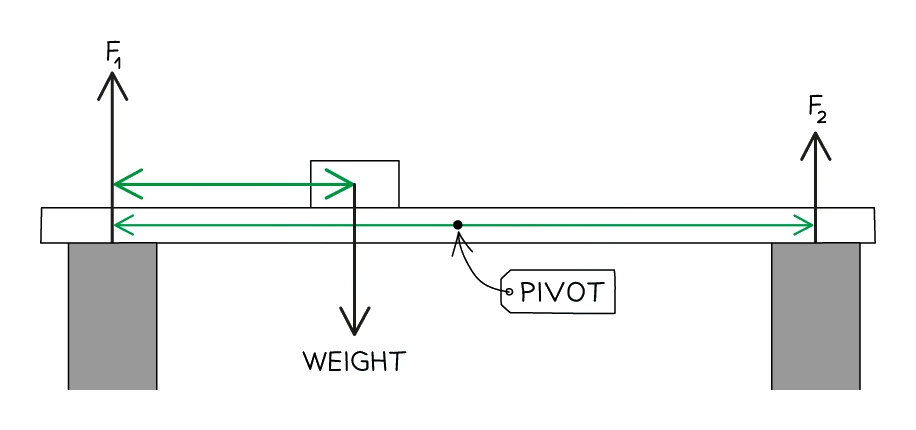
- When a light beam is held up by two supports with an object resting somewhere along it:
- the two upward support forces F₁ and F₂ must together equal the downward weight of the object (translational equilibrium)
- taking moments about either support also gives a second equation relating F₁ and F₂ to the load position (rotational equilibrium)
- As the load is slid from one support towards the other:
- the support closer to the load takes a larger share of the upward force
- the support further from the load takes a smaller share
- in the limit where the load sits directly above one support, that support takes the entire weight and the other takes none