4PH1
Moments
Forces & Motion · 1 question type
What centre of gravity means
- The of an object is the single point through which its entire weight can be treated as acting
- When drawing a free-body diagram, the weight arrow is always drawn from this point pointing straight down
- The centre of gravity is a useful fiction; the object's weight is really shared across every particle in it, but treating it as a single force at one point gives the same moment about any pivot
Centre of gravity of symmetrical objects
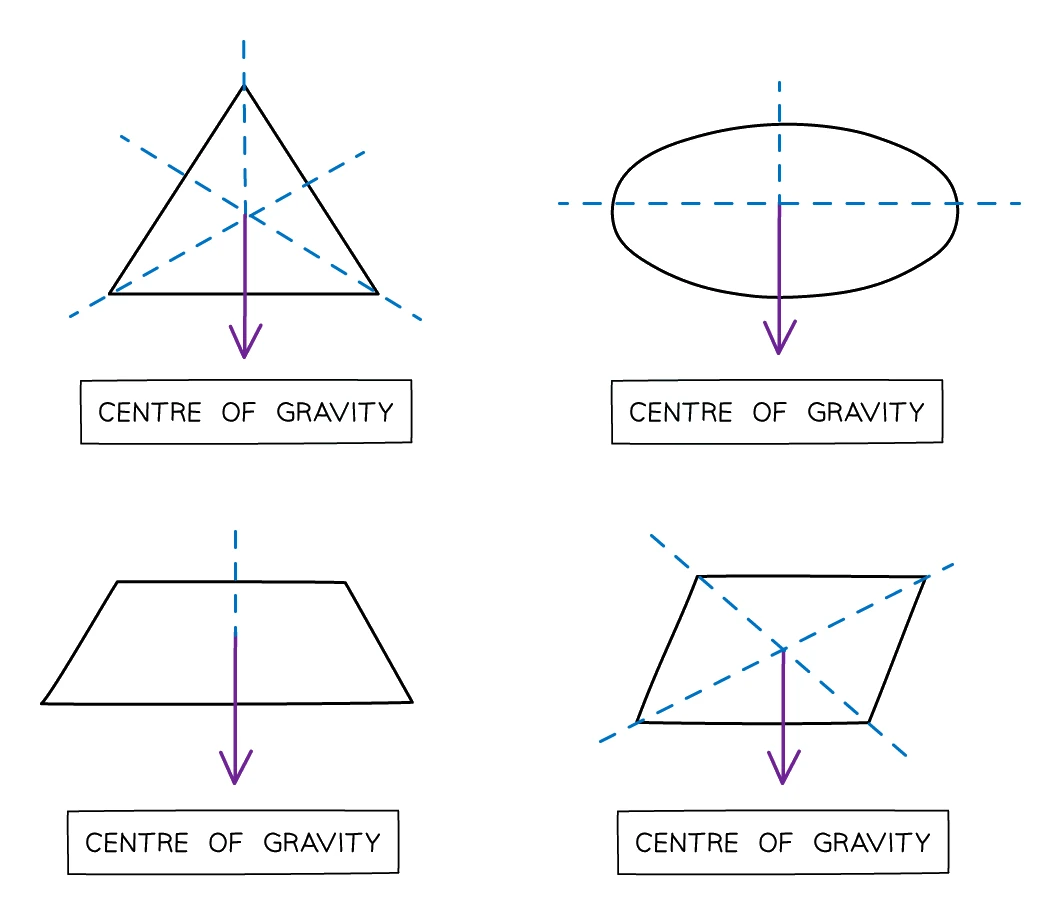
- For an object with uniform density and a clear axis of symmetry, the centre of gravity sits on every axis of symmetry; for a fully symmetric object it sits at the geometric centre:
- a uniform sphere → at the very centre of the sphere
- a uniform cube → at the centre of the cube
- a uniform thin rectangular sheet → at the point where the two diagonals cross
- a uniform thin disc → at the centre of the disc
Exam tip
Locating where the weight arrow goes
What comes up: a diagram of a hanging or resting object — "draw an arrow to show the weight of the object" (2 marks).
Write (two marks): (1) one vertical, downward arrow; (2) the arrow's tail starts at the centre of gravity of the object.
Watch out: placing the arrow anywhere other than the centre of gravity — even if it points in the right direction — loses the second mark. The starting point of the arrow is the credited point.
Finding the centre of gravity of an irregular shape
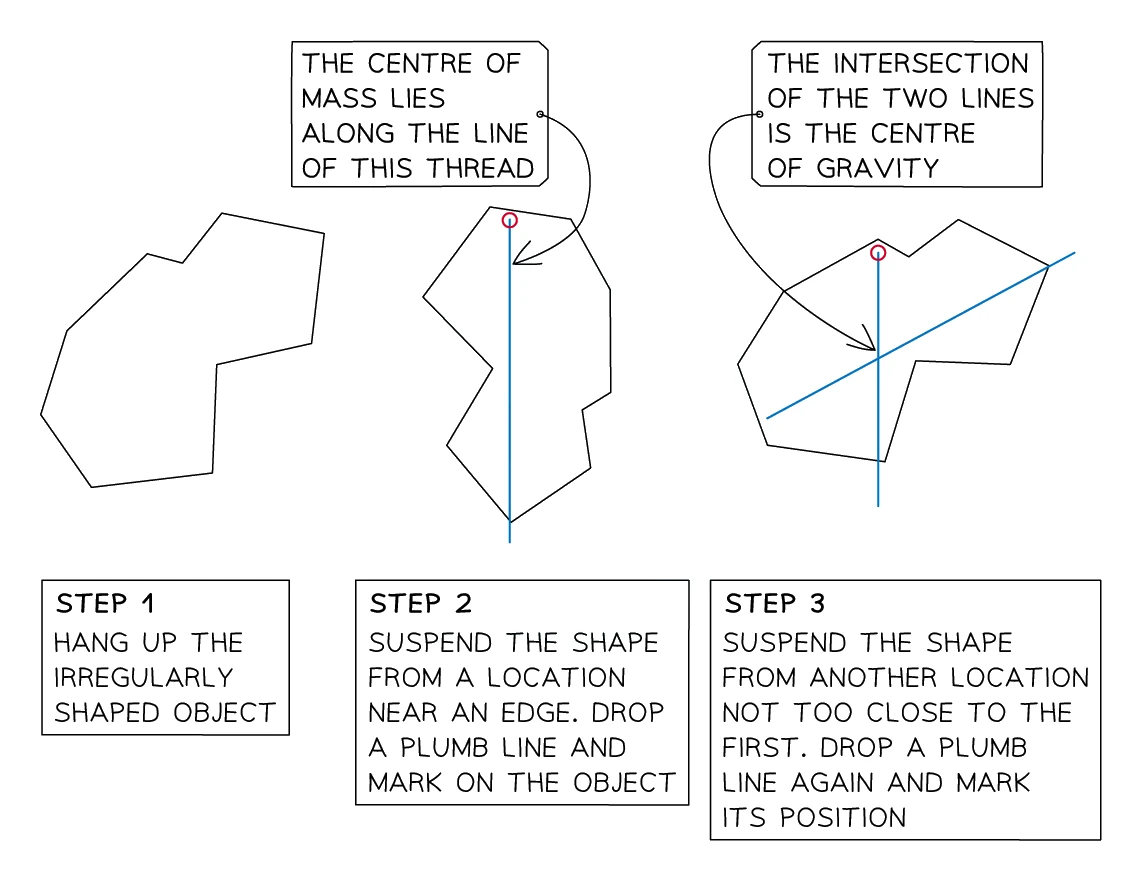
- For an awkward, irregular flat shape the centre of gravity is found experimentally using a plumb line:
- Punch or drill a small hole near one edge of the shape and hang it from a horizontal pin or nail so it can swing freely
- Wait until the shape stops swinging; the centre of gravity must now lie somewhere directly below the pin (otherwise there would still be an unbalanced moment about the pin)
- Hang a plumb line (a string with a small weight tied to its lower end) from the same pin so it falls straight down across the shape
- With a pencil, trace the line of the string onto the shape
- Take the shape off the pin, choose a second hole well away from the first, and repeat steps 1–4 from this new pivot
- The two pencil lines cross at a single point, and that intersection is the centre of gravity
- Repeating with a third hole and a third line gives a sanity check; if the third line does not pass through the same intersection, one of the readings was off
Centre of gravity can lie outside the object
- The centre of gravity does not have to be inside the solid material of the object:
- a doughnut (torus) has its centre of gravity in the empty space at the middle of the ring
- an L-shaped bracket has its centre of gravity inside the concave corner, outside the solid metal
- a C-shaped magnet has its centre of gravity in the air gap between the two pole faces
- This is why such objects can balance in surprising ways; the relevant pivot only has to lie under the centre of gravity, even if that point is in empty air
Centre of gravity, posture and stability
- The position of an object's centre of gravity shifts when its shape changes:
- a person standing upright has a centre of gravity in the lower abdomen, about one metre off the ground
- the same person leaning forward to touch their toes has a centre of gravity that has moved forward and lower, far enough that if they overbalance, their feet leave the ground
- A wide base and a low centre of gravity make an object harder to tip over:
- a sports car with a low centre of gravity corners more sharply without rolling than a tall delivery van
- racing bicycles drop the rider's centre of gravity by tilting the body forward, improving stability into a turn