Current, Potential Difference & Resistance
Electricity
What an electric current is
- Electric current is the rate of flow of electric charge around a circuit
- Current is measured in amperes, symbol A (often shortened to "amps")
- One ampere is the current that flows when one coulomb of charge passes a point in one second, so 1 A = 1 C/s
- For current to flow, there must be a complete (unbroken) conducting loop with a source of voltage in it, such as a cell or battery
Charge carriers in different materials
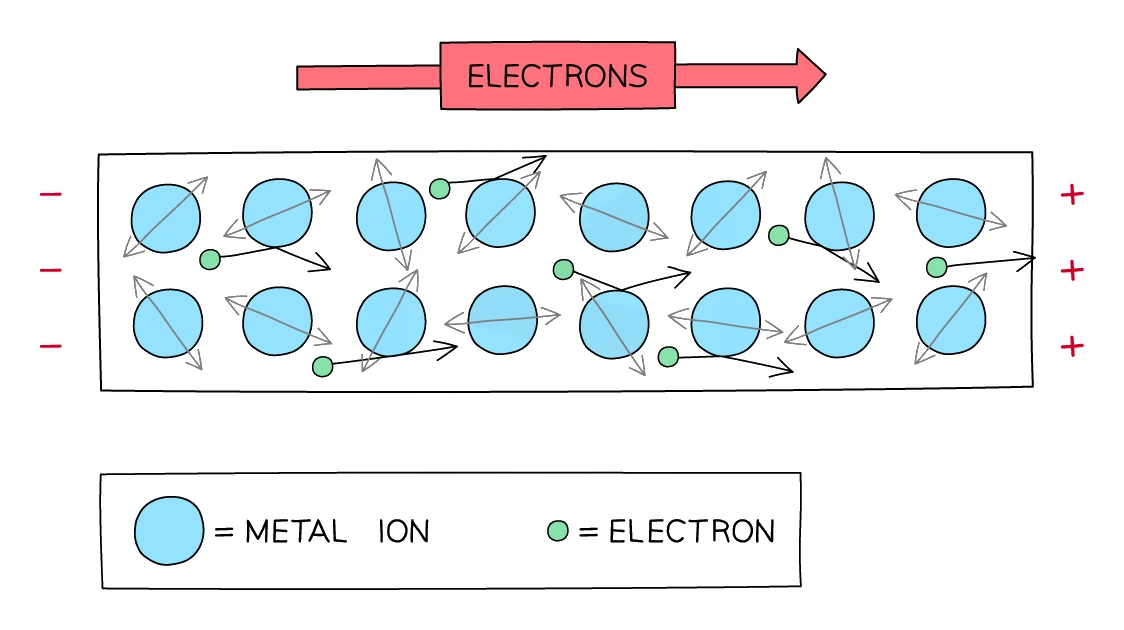
- In a metallic conductor, the moving charges are negatively charged electrons; the heavy positive metal ions are fixed in a lattice and only the outermost electrons drift through it
- In a liquid electrolyte or ionised gas, the moving charges include both positive and negative ions, which drift in opposite directions
Conventional current vs electron flow
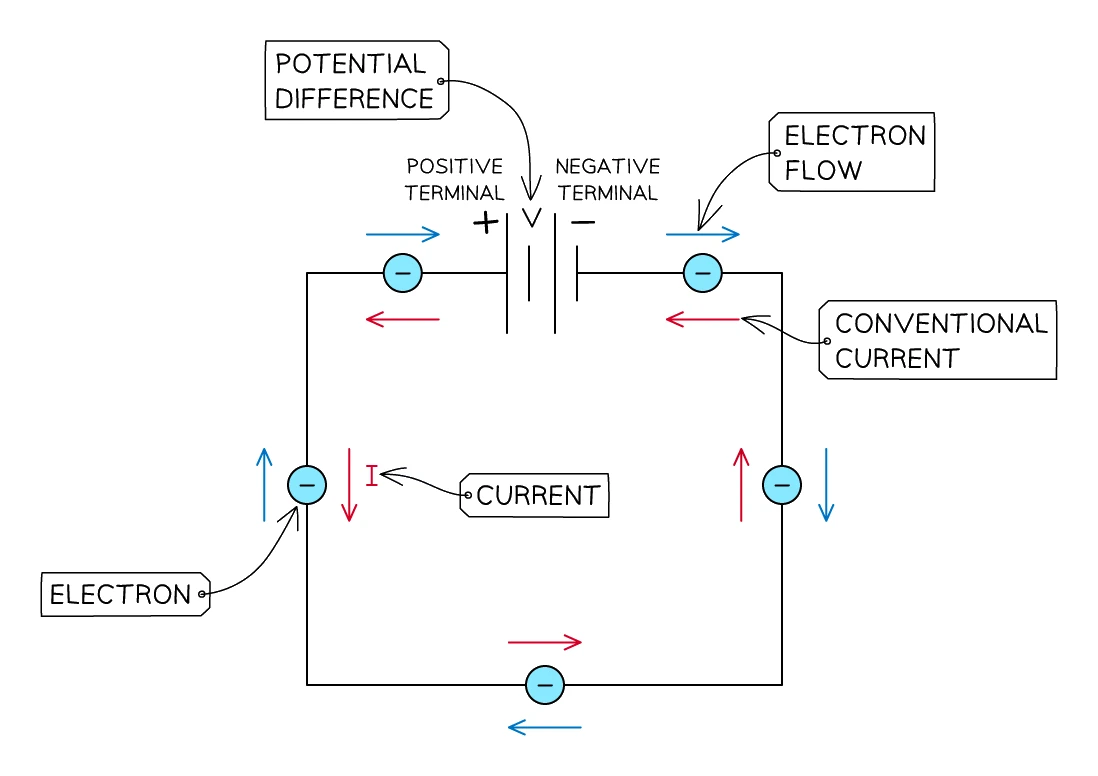
- Long before electrons were discovered, scientists agreed that current flows from the positive terminal of a cell, around the external circuit, and back to the negative terminal. This historical choice is called the direction, and it is the direction shown by every arrow on every circuit diagram in exam questions
- In a metal wire, the electrons actually drift the other way, from the negative terminal, through the wire, back to the positive terminal
- Both descriptions refer to exactly the same physical situation; they just measure the flow in opposite senses. In exam answers, always use the conventional direction unless asked for electron flow explicitly
Measuring current
- An ammeter is the instrument that measures current
- An ammeter must be wired in series with the component whose current is being measured, because the same current that flows through the component must also flow through the ammeter
- An ideal ammeter has zero , so inserting it does not affect the circuit it is measuring
The charge equation
Q = I × t
- where:
- Q = charge that has passed (coulombs, C)
- I = current (amps, A)
- t = time the current has been flowing (s)
- Rearrangements:
- I = Q / t (current is charge per second)
- t = Q / I
- Convert any milliamp values into amps before substituting: 1 mA = 1 × 10⁻³ A. A current of 250 mA, for example, is 0.250 A
Common exam question
Calculating charge, current or time with Q = It
Question: Calculate the charge transferred, the current, or the time taken, using charge = current × time, sometimes with the answer wanted in a stated unit (2–3 marks).
Set in 6 of the 24 papers. The marks are for the substitution or rearrangement (one scheme gives each its own mark when you solve for the current), the evaluation, and then whatever the question adds: a unit (coulombs or C, marked on its own) or a conversion. Times are often given in hours or milliseconds, or the answer is wanted in minutes; each conversion is a separate mark, awarded independently of the arithmetic, so 1 hour becomes 3600 s before you multiply and seconds are turned into minutes only at the end. A power-of-ten slip costs one mark, and an answer written with a prefix such as nC is accepted.
Worked example
Calculating charge from current and time
A torch bulb carries a current of 0.40 A for 30 s. Calculate the charge that passes through the bulb.
Solution:
- Write the equation: Q = I × t
- Substitute: Q = 0.40 × 30
- Q = 12 C