Current, Potential Difference & Resistance
Electricity
What voltage is
- Voltage (also called ) between two points in a circuit is the energy transferred per unit charge that passes between those two points
- Voltage is measured in volts, symbol V
- One volt is the voltage between two points when one joule of energy is transferred for every coulomb of charge that moves between them, so 1 V = 1 J/C
- "Potential difference" emphasises that voltage is always a difference between two ends; like temperature difference or height difference, it only makes sense as a comparison between two points
Common exam question
Defining voltage and current
Question: State the meaning of voltage, or of electric current (1 mark).
Asked in 2 of the 24 papers, once for each. For voltage the mark is for energy transferred per unit charge: "work done" may replace energy transferred and "per coulomb" may replace per unit charge, but V = E/Q on its own earns it only if you define every term. For current, write the rate of flow of charge, or the charge passing per second: "rate of flow of electrons" is ignored and scores nothing.
A third paper tests the volt in multiple-choice form: it is a joule per coulomb, not a joule per second (the watt) or a coulomb per second (the ampere).
Where charges gain and lose energy
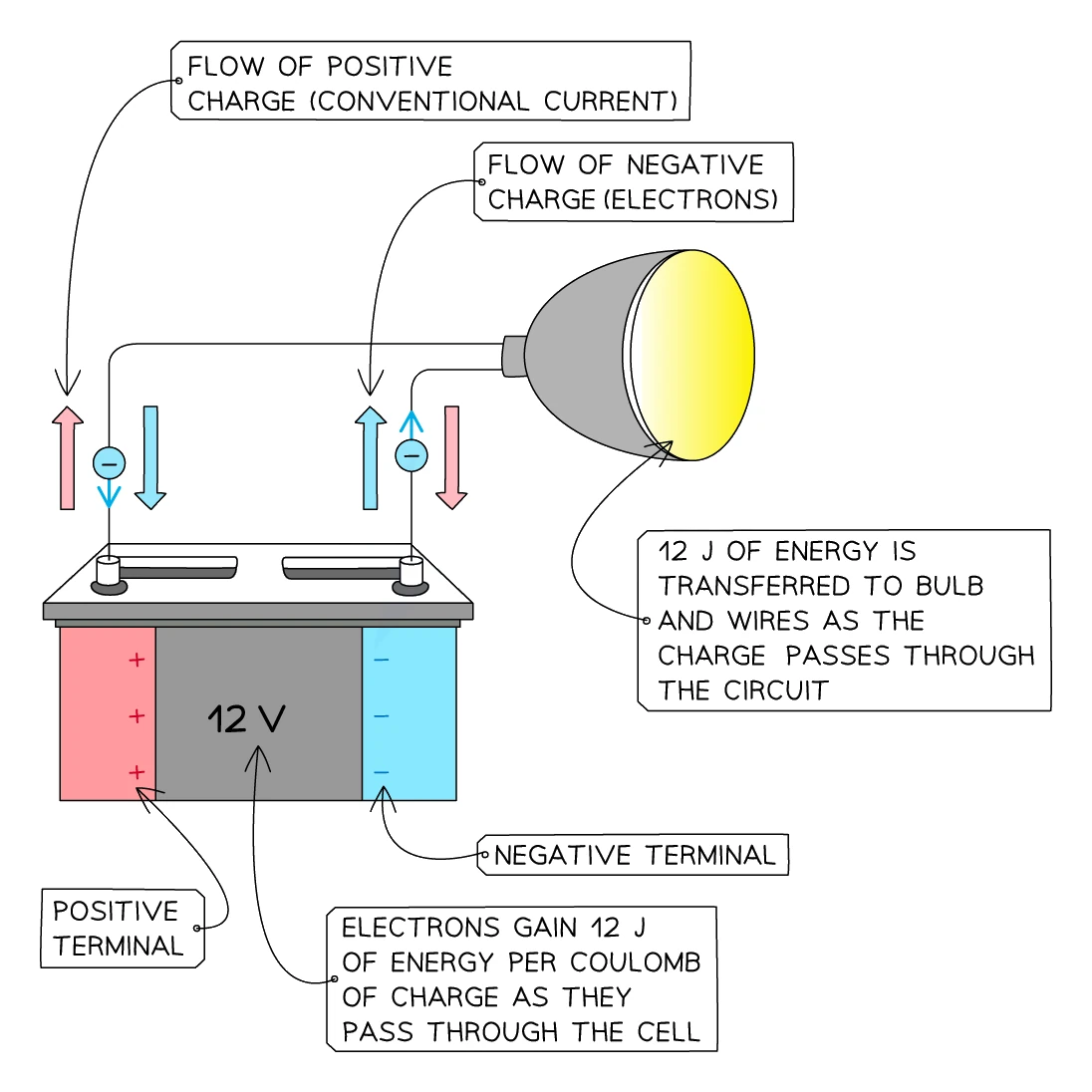
- A charge gains energy when it is pushed through the cell by the chemical reaction inside; this is the cell doing work on the charge
- A charge loses energy when it passes through a component such as a bulb, a heater or a motor; this is the charge doing work on the surroundings, transferring its energy to light, internal energy of the surroundings, or kinetic energy
- Around a full loop, the total energy gained at the cell exactly equals the total energy lost in the rest of the circuit. This is conservation of energy applied to electricity
- Numerical intuition: a 9 V battery gives each coulomb that crosses it a 9 J energy boost; if that same coulomb then traverses a single 9 V bulb on the way back round, it hands the full 9 J to the bulb's filament
Measuring voltage
- A voltmeter is the instrument that measures voltage
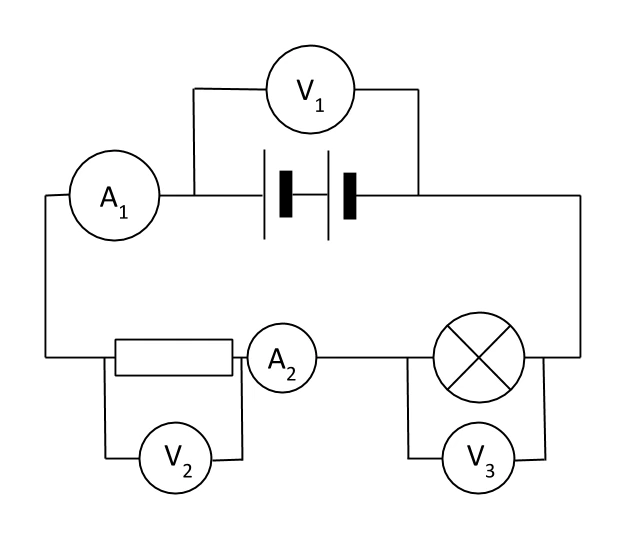
- A voltmeter must be wired in parallel with the component whose voltage is being measured, so its two leads sit on either side of the component, reading the voltage across it
- An ideal voltmeter has infinite , so no current is diverted through it and the rest of the circuit is undisturbed
- Practical tip: build the rest of the circuit first, get it working, then clip the voltmeter across the chosen component. This avoids confusing yourself with the voltmeter mid-build
Common exam question
Adding an ammeter or voltmeter to a circuit diagram
Question: Draw a circuit diagram for an investigation, or add a meter to a given circuit, so that the current in a component and the voltage across it can be measured (1–4 marks).
Asked in 11 of the 24 papers, as anything from a one-mark addition to a four-mark circuit diagram. The ammeter goes in series with the component (for the current in the cell, on the main branch of the circuit) and the voltmeter in parallel with that component alone. Each placement is a mark, and the symbols are marked too: a voltmeter drawn across both the component and the variable resistor is rejected, and one scheme withholds the complete-circuit mark for extra components.
The energy-charge-voltage equation
E = Q × V
- where:
- E = energy transferred (J)
- Q = charge that has moved (C)
- V = voltage between the two points (V)
- Rearrangements:
- V = E / Q (voltage is energy per coulomb, straight from the definition)
- Q = E / V
Common exam question
Calculating energy, charge or voltage with E = QV
Question: Calculate the energy transferred, the charge or the voltage using energy transferred = charge × voltage (3 marks).
Set in 4 of the 24 papers. Finding charge or voltage earns a mark each for substitution, rearrangement and evaluation; a power-of-ten slip costs one. The data usually come in standard form or with a prefix, so turn millijoules into joules before you evaluate: one scheme ignores unit conversions until the evaluation mark, so a missed conversion costs that mark. Writing the formula in symbols is fine, but C stands for coulombs: a "C" written for charge is rejected in two of these schemes and ignored in a third, so use Q.
When a question asks how long a lamp takes to transfer a given energy at a given voltage, the expected route is energy = current × voltage × time, but the scheme also accepts finding the charge from E = QV and then the time from Q = It.