4PH1
Momentum
Forces & Motion · 1 question type
The principle
- The states that, when no outside force acts on a group of interacting objects, the total of the group before the interaction equals the total momentum after the interaction
- "Interaction" in this context can mean:
- a between two objects that come together
- an where one object breaks into two or more pieces
- Because momentum is a vector, the signs of velocities must be tracked carefully when totals are taken, because opposite-direction velocities can partially or fully cancel
Applying conservation to a collision
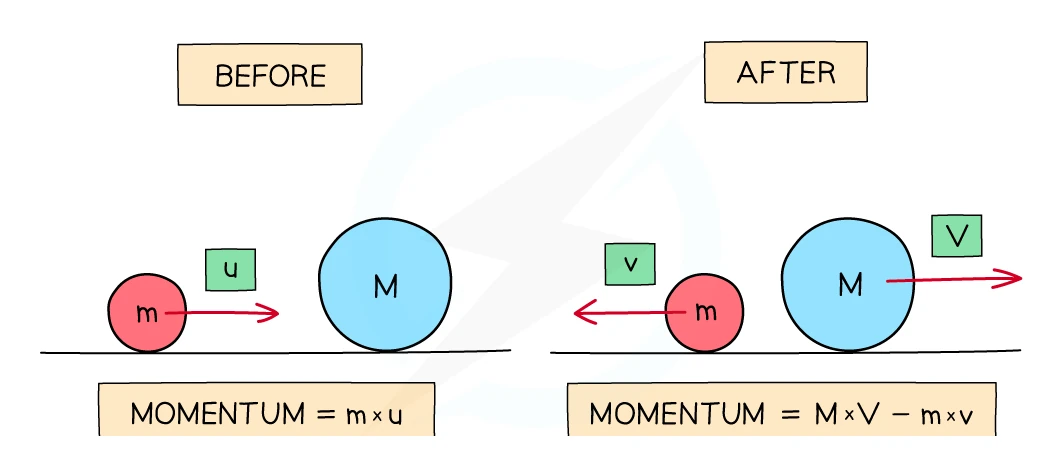
- Pick a positive direction for the whole problem at the start
- Write the total momentum before the collision:
p_before = m₁u₁ + m₂u₂
- Write the total momentum after the collision:
p_after = m₁v₁ + m₂v₂
- Set the two equal (the heart of conservation) and solve for the unknown velocity:
m₁u₁ + m₂u₂ = m₁v₁ + m₂v₂
- If two objects start moving towards each other at equal and opposite momenta, the system's total momentum is zero, and the same zero must come out after the collision (e.g. the two objects might end up at rest, or they might fly off back-to-back at matched momenta)
Worked example
Conservation of momentum: finding velocity after a collision
A 4.0 kg trolley moving at 5.0 m/s collides with and sticks to a 6.0 kg trolley that is at rest. Find the velocity of the combined trolleys immediately after the collision.
Solution:
- Total momentum before: p = 4.0 × 5.0 + 6.0 × 0 = 20 kg m/s
- By conservation of momentum, total momentum after = 20 kg m/s
- Total mass after: 4.0 + 6.0 = 10 kg
- Combined velocity: v = p ÷ m = 20 ÷ 10 = 2.0 m/s (in the original direction of travel)