Momentum
Forces & Motion · 1 question type
Force as the rate of change of momentum
- Combining F = ma and the definition p = mv gives a more general form of Newton's second law:
F = Δp / t = (mv − mu) / t
- where:
- F = resultant force (N)
- mv − mu = change in momentum, Δp (kg m/s), i.e. final momentum minus initial momentum
- t = time over which the change happens (s)
- In words: the resultant force on an object equals its
Contact time and impact force
- For a given change in momentum, the force and the contact time are inversely proportional to one another:
- Halve the contact time and the impact force doubles
- Triple the contact time and the impact force falls to a third
- Real safety design therefore aims to extend the during a collision to make the impact force as small as possible (see section 5)
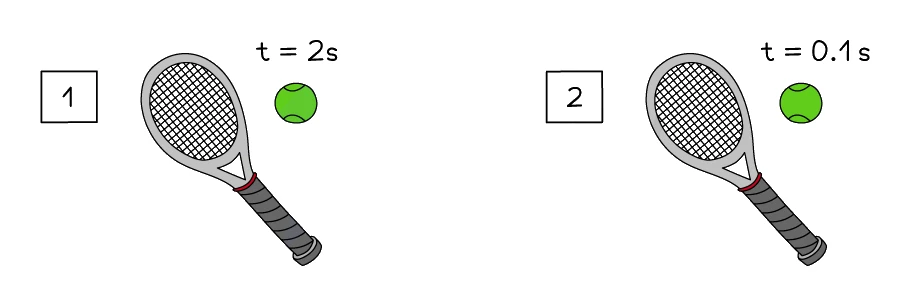
Example A — during the same return shot, a 0.40 kg football undergoes the same change in momentum of 8.0 kg m/s in two different scenarios: scenario 1 has a foot-on-ball contact time of 0.050 s, scenario 2 has a contact time of 0.50 s. Compare the average force on the ball.
- Scenario 1: F = Δp / t = 8.0 / 0.050 = 160 N
- Scenario 2: F = Δp / t = 8.0 / 0.50 = 16 N
- The same change in momentum, delivered over ten times longer, gives a force that is ten times smaller
Example B — a 1200 kg car drives at 18 m/s into a wall and rebounds at 4.0 m/s in the opposite direction. The collision lasts 0.20 s. Calculate the average force on the car and state its direction.
- Take the car's forward (towards-wall) direction as positive: u = +18 m/s, v = −4.0 m/s
- Δp = m(v − u) = 1200 × (−4.0 − 18) = 1200 × (−22) = −26 400 kg m/s
- F = Δp / t = −26 400 / 0.20 = −132 000 N
- The minus sign tells you the force on the car points in the opposite direction to its original motion, that is, backwards from the wall, as you would expect
Average force from change in momentum (F = Δp / t)
A 0.50 kg ball travelling at 8 m/s hits a wall and rebounds at 6 m/s. It is in contact with the wall for 0.02 s. Calculate the average force on the ball.
Solution:
- Take the ball's initial direction as positive, so u = +8 m/s and v = −6 m/s (it rebounds the other way).
- Change in momentum: Δp = m(v − u) = 0.50 × (−6 − 8) = 0.50 × (−14) = −7 kg m/s
- Average force: F = Δp ÷ t = −7 ÷ 0.02 = −350 N
- The minus sign shows the force acts opposite to the ball's initial motion; its magnitude is 350 N.
State which direction is positive before substituting. If you forget the rebound velocity is negative, Δp comes out as 0.50 × (6 − 8) = −1 kg m/s and the force is wrong — that slip caps the answer at one mark.