4PH1
Momentum
Forces & Motion · 1 question type
Statement of the law
- of motion states:
Whenever two objects interact, the forces they exert on each other are equal in magnitude and opposite in direction.
- The first two laws are statements about forces on one object at a time; the third law is the one that compares a pair of forces, each on a different object
How to spot a true third-law pair
- A pair of forces is a Newton's-third-law pair if and only if all three of the following are true:
- The two forces act on two different objects (never on the same object)
- The two forces are equal in magnitude and opposite in direction
- The two forces are the same type (e.g. both gravitational, both normal contact, both electrostatic). If you can't name the force type, calling them both "push" or both "pull" is enough
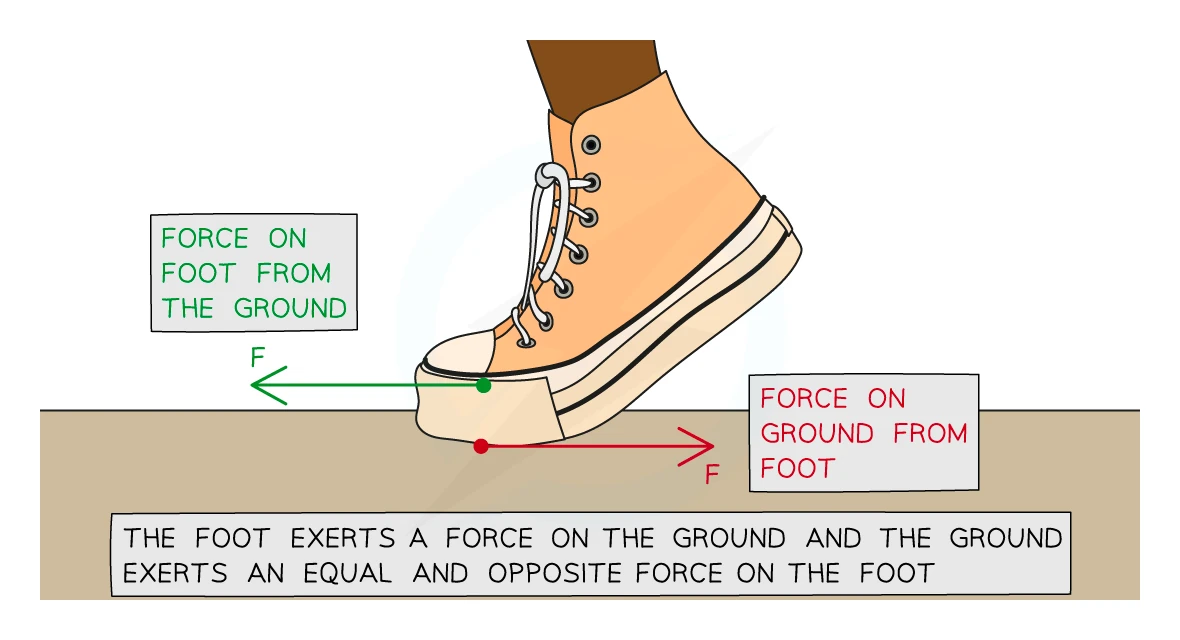
Walking as a third-law example
- When you walk, your foot pushes backwards on the ground (a contact force from foot on ground)
- The ground, by Newton's third law, pushes forwards on your foot with an equal-sized force (a contact force from ground on foot)
- The forwards push on you is what actually accelerates you across the room. The energy to move, though, comes from your own muscles, not from the ground
The book-on-table trap
- A common mistake is to call the weight of a book and the upward reaction of the table a third-law pair. They are not:
- both arrows act on the same object (the book), failing rule 1
- they are different types of force (gravity vs contact), failing rule 3
- The book-on-table picture is really a worked illustration of Newton's first law: two balanced forces on one object, so its motion does not change
- The genuine third-law partner of the book's weight is the pull the book exerts back on the Earth, equal in size and opposite in direction, but acting on the Earth rather than on the book
Third law in a collision
- When two objects collide, the force one exerts on the other is matched by an equal and opposite force back:
F_{A on B} = − F_{B on A}
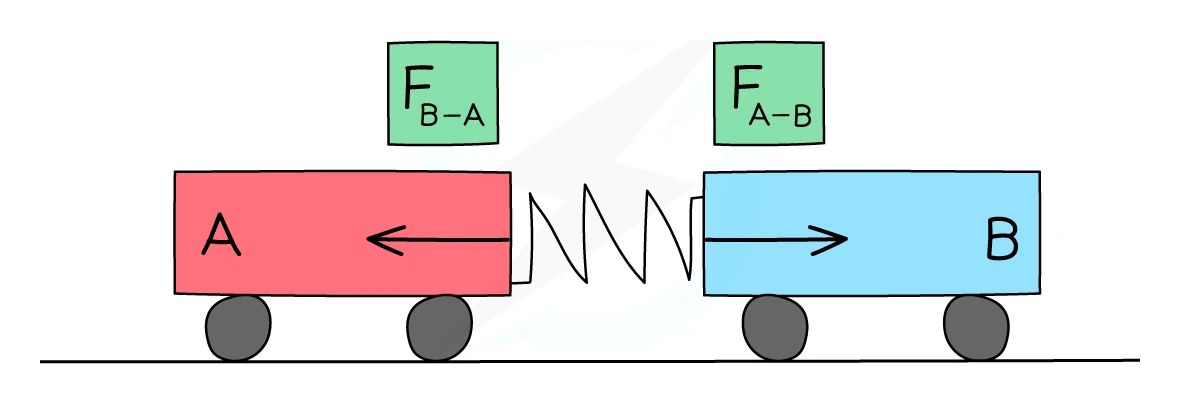
- Equal forces do not mean equal accelerations, because Newton's second law (a = F / m) shows that for a fixed force, a smaller mass picks up a larger acceleration. A small car colliding with a heavy lorry feels the same-size force but is flung backwards far more than the lorry creeps forwards