Fission & Fusion
Radioactivity & Particles
How a chain reaction starts
- Each induced fission of uranium-235 needs one neutron going in but releases 2 or 3 neutrons coming out
- If any of those released neutrons strikes another uranium-235 nucleus, it can trigger another fission, releasing more neutrons, which trigger more fissions, and so on
- This self-sustaining sequence is a chain reaction:
a chain reaction is a process in which the neutrons released by one fission go on to cause further fissions, releasing more neutrons that cause still more fissions
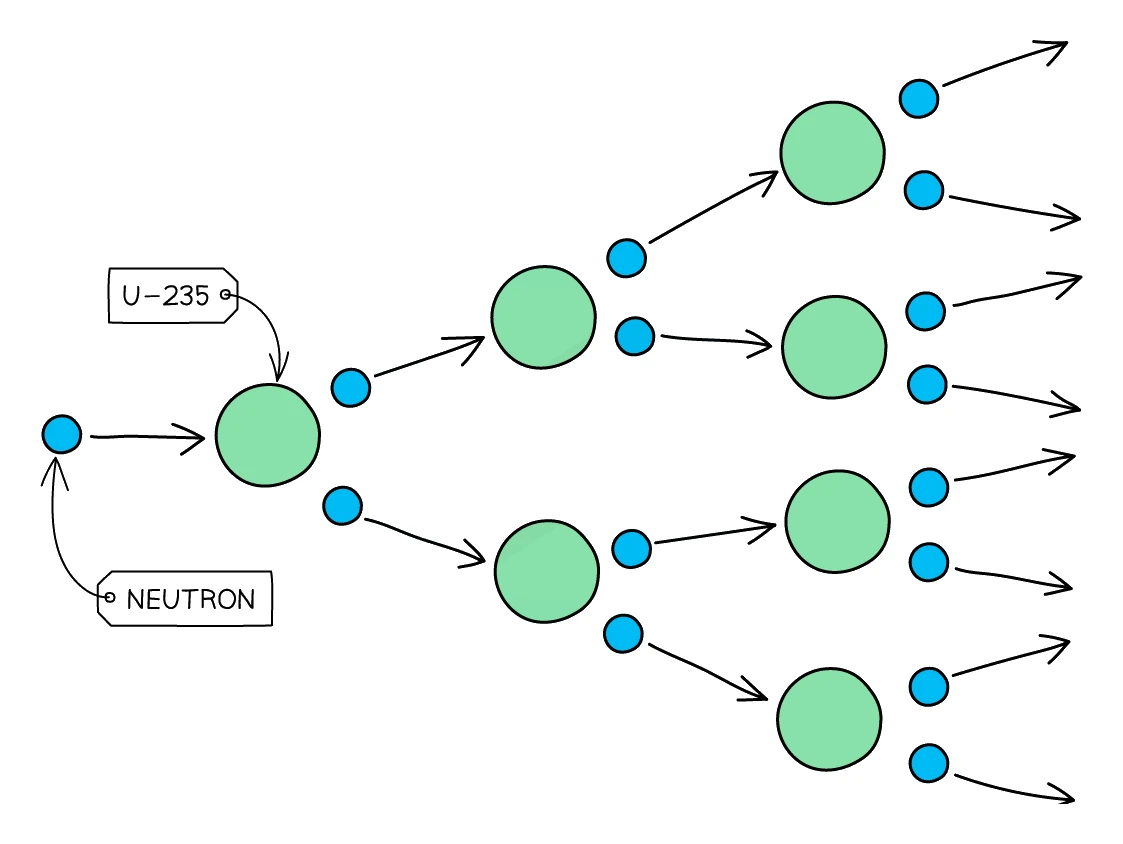
- The number of fissions per second grows exponentially unless something stops it
Common exam question
Describing a chain reaction
Question: Describe what is meant by a chain reaction, or describe how a chain reaction occurs in a fission reactor (2–3 marks).
Asked in 3 of the 24 papers. The marks follow the neutrons: a fission releases neutrons; those neutrons are absorbed by other uranium nuclei; and those nuclei undergo fission in turn, releasing more neutrons. The 3-mark versions either start one step earlier, with a uranium nucleus absorbing a neutron and splitting, or credit the three steps above separately. Each step is its own mark, so spell out all of them.
Say the neutrons are absorbed by (or captured by) uranium nuclei: on the step where the first nucleus takes in a neutron, "collide with", "hit" and "aimed at" are ignored.
Generations of a chain reaction
- Each "generation" of the chain is one round of fissions:
| Generation | Fissions in this generation (3 neutrons per fission, all triggering further fissions) |
|---|---|
| 0 | 1 |
| 1 | 3 |
| 2 | 9 |
| 3 | 27 |
| 4 | 81 |
| 5 | 243 |
| 10 | 59 049 |
- In practice not every neutron causes a fission; some escape from the fuel, some are absorbed by impurities. The effective number of new fissions per old fission is called the multiplication factor k:
- k > 1: supercritical, fission rate grows; bomb-like behaviour
- k = 1: critical, fission rate is steady; this is what a working reactor maintains
- k < 1: subcritical, fission rate dies away
Critical mass
- For a chain reaction to keep going at all, there has to be enough fissile material in one place so that a typical neutron meets another uranium-235 nucleus before escaping
- The smallest mass of fissile material that can sustain a chain reaction is the critical mass. For pure uranium-235 it is around 50 kg; for plutonium-239 it is about 10 kg
- Below the critical mass, neutrons escape from the surface faster than new fissions can replace them, so the chain dies. Above the critical mass, the chain takes off
- In a power station the mass of fuel exceeds the critical mass but the chain reaction is held at k = 1 by absorbing the excess neutrons (see control rods, below)
- In a nuclear weapon a supercritical mass is assembled suddenly, k jumps well above 1, and the entire fuel undergoes fission in a fraction of a second. The uncontrolled release of energy is a nuclear explosion