Fission & Fusion
Radioactivity & Particles · 3 question types
Definition
Nuclear fission is the splitting of a large unstable nucleus into two smaller nuclei
- The large nucleus that breaks apart is called the parent nucleus
- The two smaller nuclei produced are the
- The reaction also produces 2 or 3 free neutrons and a burst of gamma radiation
- The daughter nuclei are themselves unstable and usually radioactive, decaying further over time
Fissile materials
- Only certain isotopes will undergo fission. These are called . The two used in practice are:
- Uranium-235 (²³⁵₉₂U), the fuel in almost every commercial fission reactor
- Plutonium-239 (²³⁹₉₄Pu), used in some reactors and in most nuclear weapons; produced inside reactors from non-fissile uranium-238
Spontaneous vs induced fission
- A small number of nuclei split all on their own, without anything hitting them. This is spontaneous fission. It is rare and far too slow to be useful for generating electricity
- The fission used in reactors is , where a free neutron is fired at the nucleus and triggers the split:
- A slow-moving (thermal) neutron is absorbed by a uranium-235 nucleus
- The nucleus becomes uranium-236, which is highly unstable
- Within a tiny fraction of a second, uranium-236 splits into two daughter nuclei and emits 2 or 3 fresh neutrons plus gamma rays
Why uranium-235 needs help to fission
- Uranium-235 has a half-life of about 700 million years, so on its own it decays incredibly slowly. The amount of energy released by spontaneous fission is far too small to power a reactor
- Adding the extra neutron pushes uranium-235 over the edge into uranium-236, which has no stable existence and falls apart almost immediately. Inducing fission speeds up the energy release by many orders of magnitude
Describing induced fission (3–4 marks)
What comes up: "Describe what happens when a uranium nucleus undergoes induced fission" or "Describe how a chain reaction takes place."
Write (four marks): (1) A slow-moving neutron is absorbed by a uranium nucleus. (2) The nucleus splits into two smaller daughter nuclei. (3) The split also releases further neutrons (and energy). (4) Those neutrons can be absorbed by other uranium nuclei, so the fission process repeats.
Watch out: The mark scheme rejects "daughter nuclei splitting again" as the reason fission continues — it is the released neutrons, not the daughters, that trigger the next fission. Also reject writing "atoms" where you mean nuclei.
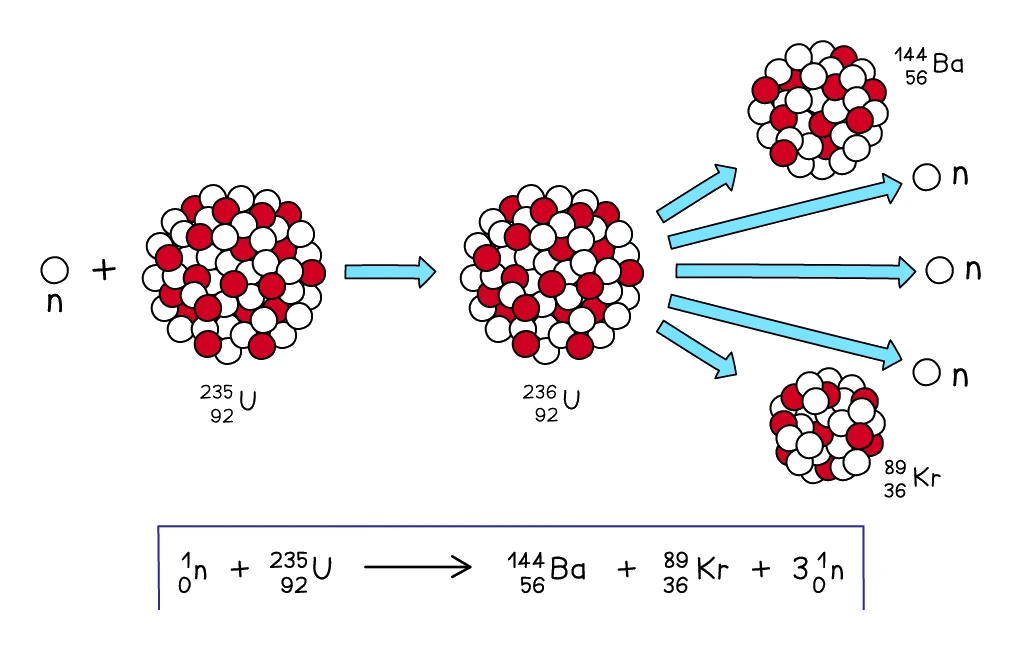
A typical fission equation
- One of many possible fission outcomes for uranium-235 is:
²³⁵₉₂U + ¹₀n → ¹⁴⁴₅₆Ba + ⁸⁹₃₆Kr + 3 ¹₀n + energy
- Check the totals:
- Mass numbers: 235 + 1 = 236 on the left; 144 + 89 + (3 × 1) = 236 on the right ✓
- Atomic numbers: 92 + 0 = 92 on the left; 56 + 36 + (3 × 0) = 92 on the right ✓
- The daughter nuclei vary from one fission event to the next. Barium-144 and krypton-89 are one possibility; strontium-90 and xenon-143 another. The reactor does not produce a single pair of products every time
Where the energy goes
- The products of fission fly apart at very high speed. The energy that was locked up inside the parent nucleus reappears as the kinetic energy of the fast-moving daughter nuclei and neutrons, plus the energy carried away by gamma rays
- When the fast-moving daughter nuclei collide with surrounding atoms in the fuel, their kinetic energy is transferred as heat. That heat is what is harvested to make electricity in a power station