Fission & Fusion
Radioactivity & Particles
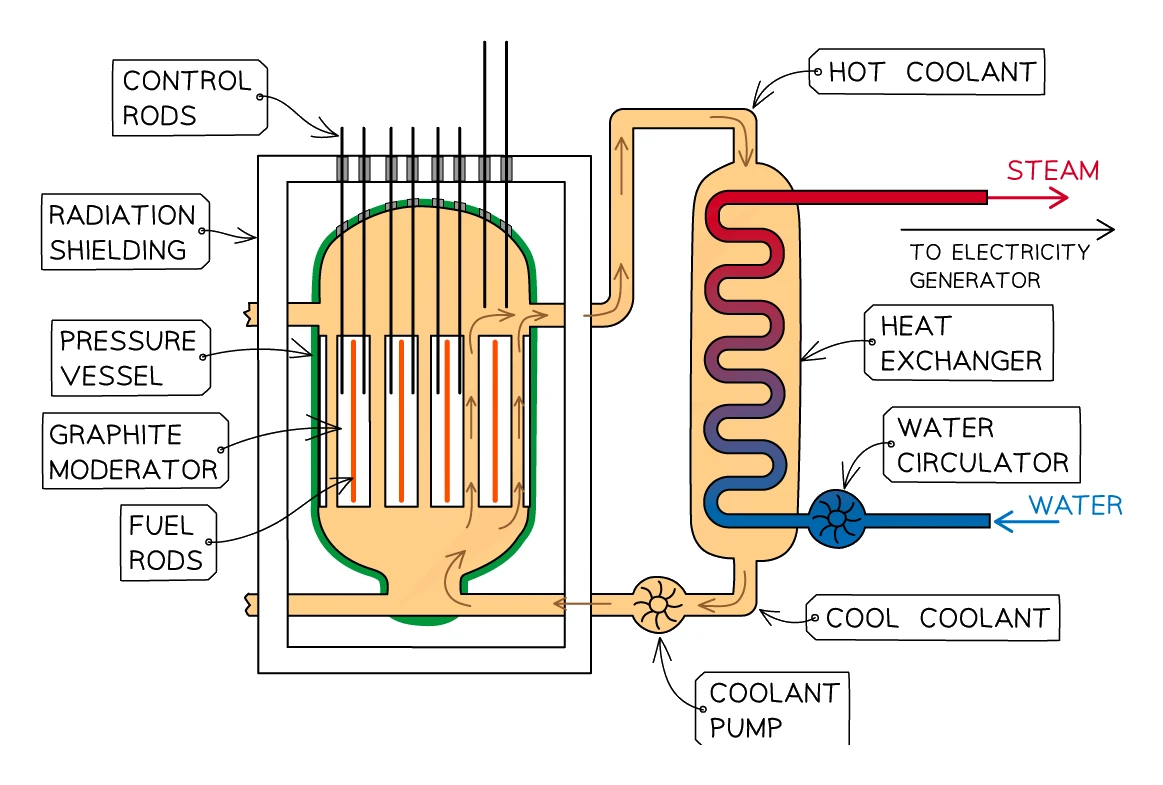
A nuclear reactor's job is to keep the chain reaction running steadily (k = 1) so that the heat output is constant and controllable. To do that it needs four key components:
Fuel rods
- Long thin rods of uranium dioxide containing enriched uranium (uranium ore is mostly uranium-238; for reactor fuel it is enriched to a few percent uranium-235)
- The fuel rods sit in a regular array inside the reactor core
- The geometry matters: the rods are spaced so that neutrons leaving one rod have a good chance of triggering fission in a neighbouring rod, but not so close that the reaction runs out of control
Moderator
- The neutrons released from fission are fast, far too fast to be absorbed efficiently by uranium-235
- A moderator is a material that fills the space between the fuel rods. As fast neutrons travel through it, they bounce off the moderator atoms and lose kinetic energy in each collision
- After many collisions, the neutron is travelling slowly enough that it is in thermal equilibrium with the moderator. These slow neutrons are called thermal neutrons and are very efficiently absorbed by uranium-235
- Common moderators: water (the most widely used), heavy water (D₂O), and graphite
- A good moderator must:
- Have light atoms (light atoms absorb more energy per collision, the same as a billiard ball bouncing off another billiard ball rather than off a bowling ball)
- Not absorb neutrons itself, otherwise it would shut the chain reaction down
Control rods
- The reactor needs to swallow up the excess neutrons left over after each fission has triggered exactly one more fission. That is the job of control rods
- Control rods use a material that soaks up neutrons very efficiently but does not itself fall apart in the process. The standard choices are boron and cadmium
- The rods are lowered into, or raised out of, the reactor core to adjust the absorption rate:
- Lower the rods deeper → more neutrons absorbed → fewer fissions → reactor cools down
- Raise the rods further → fewer neutrons absorbed → more fissions → reactor heats up
- An automatic feedback system continuously adjusts the rod position to keep k at exactly 1
- In an emergency shutdown, the rods are dropped all the way into the core. Almost every neutron is absorbed and the chain reaction stops within seconds
Common exam question
The moderator and the control rods
Question: Give the material and the job of the moderator and the control rods (as a tick table or sentences to complete), or describe the role of the control rods (2–4 marks).
Asked in 3 of the 24 papers. The moderator (graphite, or water) slows the neutrons down, and slow neutrons are much more likely to cause fission. The control rods (boron) absorb the excess neutrons, which stops those neutrons causing fission and so slows the rate of fission; they are lowered into or raised out of the core to adjust that rate. Keep "slow" with the moderator and "absorb" with the control rods, and do not swap them.
When the question asks for the role of the control rods, the material scores nothing: the two marks are any two of absorbing neutrons, stopping those neutrons causing fission and slowing the rate of fission, so "made of boron" on its own earns none.
Shielding
- Fission products, neutrons and gamma rays are all dangerous
- The reactor core is surrounded by thick shielding, typically a steel pressure vessel inside a reinforced concrete containment building several metres thick
- The shielding has two jobs:
- Absorb the radiation so that workers and the surrounding area are safe
- Contain any radioactive material in the event of an accident
Common exam question
The role of the shielding
Question: Describe the role of the shielding around a nuclear reactor, or name a material suitable for the reactor walls (1–2 marks).
Asked in 2 of the 24 papers. One mark is for saying that the shielding prevents radiation escaping from the core (saying that it absorbs the radiation, or that it protects the people working outside the core, is accepted instead); the second is for saying how: it absorbs the neutrons, fission products and gamma rays. For the material, concrete, lead or thick steel each score.
Be exact about what the shielding does to the radiation: vague wording such as "stops it" or "it can't pass through" is ignored, while "absorbs" is credited. Points about the strength or structure of the reactor are ignored too.
Heat extraction and electricity generation
- The heat from the fissioning fuel is removed by a coolant (usually water, sometimes pressurised carbon dioxide gas or liquid sodium) flowing through the core
- The hot coolant heats water in a separate loop, producing high-pressure steam
- The steam drives a turbine connected to a generator, which produces electricity by electromagnetic induction (topic 18)