Fission & Fusion
Radioactivity & Particles · 3 question types
The electrostatic barrier
- Hydrogen nuclei are protons, each carrying a positive charge of +1
- Two positive charges repel each other. The closer they come, the stronger the repulsion (Coulomb's law: F ∝ 1/r²)
- For fusion, the two protons have to come close enough that the strong nuclear force can take over and bind them. The strong force has a very short range, about 10⁻¹⁵ m
- To get that close, the protons have to overcome an enormous electrostatic repulsion. They need a huge amount of kinetic energy to bull through the barrier and reach the strong-force range
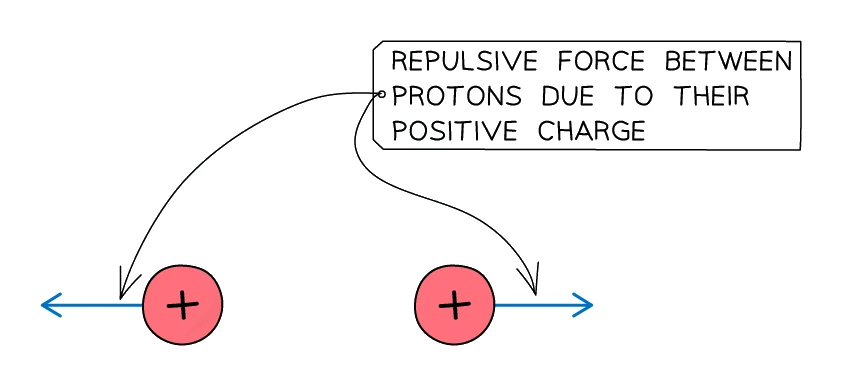
Why fusion needs extreme conditions
- High kinetic energy means high speed, and high speed means high temperature, because temperature is a measure of the average kinetic energy of the particles
- The conditions for fusion are:
- Extremely high temperature (many millions of degrees), so that the nuclei are moving fast enough to overcome electrostatic repulsion
- Extremely high pressure (or density), to pack the nuclei close together so that they collide often enough for fusion to happen at a useful rate
- In the core of the Sun:
- Temperature ≈ 15 million °C
- Pressure ≈ 250 billion atmospheres
- At anything like Earth-surface conditions, two hydrogen nuclei almost never approach close enough to fuse. The gas would have to be heated to tens of millions of degrees to produce a meaningful fusion rate. That is why fusion is so difficult to reproduce on Earth
Conditions needed for nuclear fusion (4 marks)
What comes up: "Explain the two conditions needed for nuclear fusion to occur" (often framed as: two positively charged nuclei must overcome the repulsive electrostatic force between them).
Write (four marks): (1) Very high temperature is needed. (2) At high temperature, nuclei have high kinetic energy (high speed). (3) Very high pressure is needed. (4) High pressure means nuclei are closer together (or: collide more frequently), making fusion possible.
Watch out: Simply stating "high temperature overcomes repulsion" does not score full marks. The mark scheme requires you to link temperature to the kinetic energy of the nuclei, and pressure to how closely packed or how often they collide. State both conditions and their reasons separately.
How stars achieve those conditions
- A star is a vast ball of hydrogen gas held together by its own gravity
- Gravity pulls every atom of the star towards the centre, squeezing the gas into a dense, hot core
- At the temperatures and pressures inside the core, hydrogen fuses into helium, releasing energy
- The energy released flows outwards and creates an outward pressure (radiation pressure plus hot-gas pressure) that resists the inward pull of gravity
- A stable star is in equilibrium: the inward gravitational force equals the outward pressure force at every depth. As long as the core has hydrogen left to fuse, the star stays the same size
Inside a star: building heavier elements
- Once the hydrogen in the core runs out, the core contracts and heats up further until helium nuclei start to fuse into heavier elements such as carbon, oxygen, and so on
- In very large, hot stars, fusion can continue all the way up to iron. Iron is the most tightly bound nucleus, so fusing iron does not release energy; it absorbs it. When the core of a very large star reaches iron, fusion stops and the star collapses, often triggering a supernova (covered in topic 23)