4PH1
Fission & Fusion
Radioactivity & Particles · 3 question types
Definition
Nuclear fusion is the joining together of two small nuclei to form a larger nucleus
- The combined nucleus is more stable (more tightly bound) than the two separate nuclei, so the reaction releases energy
- Fusion is the opposite of fission. Fission breaks a heavy nucleus apart; fusion glues light nuclei together. Both release energy because nuclei in the middle of the periodic table (around iron) are the most tightly bound
Exam tip
Define fission and fusion
Defining or distinguishing fission and fusion comes up, so you need to know: fission is splitting a large nucleus into two smaller ones, and fusion is joining two small nuclei into a larger one. Write nuclei, not "atoms" (which is rejected).
A typical fusion equation: deuterium + tritium
- The easiest fusion reaction to achieve on Earth is between two heavy isotopes of hydrogen, deuterium (²₁H) and tritium (³₁H):
²₁H + ³₁H → ⁴₂He + ¹₀n + energy
- Check the totals:
- Mass numbers: 2 + 3 = 4 + 1 ✓
- Atomic numbers: 1 + 1 = 2 + 0 ✓
- The products are a helium-4 nucleus plus a free neutron, and a huge release of energy (roughly 17 MeV per fusion, four times the energy per nucleon released by uranium-235 fission)
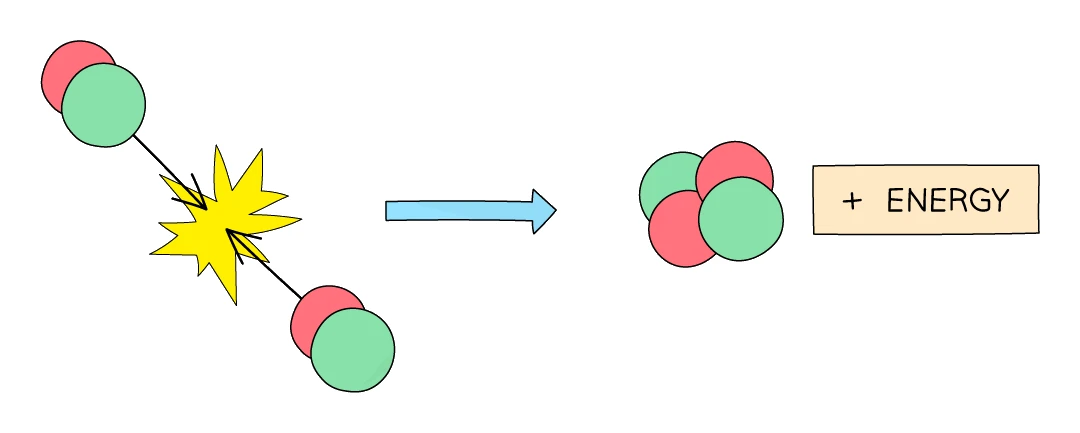
How fusion releases energy
- The mass of the products is slightly less than the mass of the starting nuclei
- The "lost" mass has been converted into energy according to Einstein's relation E = mc². Even a tiny mass difference becomes a huge amount of energy because c² is so large
- This same mass-into-energy conversion happens in fission, but the fraction of mass converted per fusion event is larger, which is why fusion produces more energy per kilogram of fuel
Why fusion is special
- Fusion is the energy source of the Sun and all stars
- The sunlight you receive each day is produced by hydrogen-fusion reactions in the Sun's core, and takes about 8 minutes to travel from the Sun to Earth
- On Earth, fusion has been demonstrated in hydrogen bombs (uncontrolled) and in experimental fusion reactors (controlled), but a commercially viable fusion power station does not yet exist