MathematicsExam code: 0580
Trigonometric Graphs and Equations
Pythagoras and Trigonometry
What a sketch must show
- A sketch is asked for in its own right, usually for 2 marks, and it needs the shape and the key points rather than plotted accuracy
- Mark where the curve meets the axes, and show the maximum of 1 and minimum of −1 for sine and cosine
- Run the curve across the whole interval the question states, no further and no less
- Draw it freehand and smoothly, never with a ruler
- For a tangent sketch, put the asymptotes in as dotted vertical lines, since the branches make no sense without them
- Where the sketch is part (a) and an equation is part (b), the sketch is meant to be used, so draw the horizontal line on it and mark the crossings
Worked example
Sketching a curve to place the answers
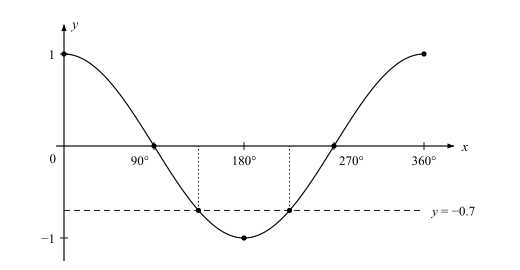
Sketch y = cos x for 0° ⩽ x ⩽ 360° and use it to explain why cos x = −0.7 has two solutions in that interval.
Solution:
- Mark the axes first: x from 0° to 360°, and y from −1 to 1, since the curve never leaves that range
- Plot the five points the curve is fixed by: (0, 1), (90, 0), (180, −1), (270, 0) and (360, 1)
- Join them with one smooth curve, drawn freehand rather than ruled
- Draw the horizontal line y = −0.7 across the sketch
- The line sits below the axis, and the curve is below the axis between 90° and 270°
- The line therefore crosses the curve twice, once on the way down and once on the way back up
- So there are two solutions, one between 90° and 180° and one between 180° and 270°
- The sketch is what shows where the second answer lives; the calculator only ever gives the first