MathematicsExam code: 0580
Right Angled Triangles
Pythagoras and Trigonometry
Pythagoras' Theorem
The relationship
- Pythagoras' theorem links the three sides of a right-angled triangle, and it works in no other triangle
- The longest side is the hypotenuse, and it is always the one opposite the right angle
- The theorem states a² + b² = c², in which c stands for the hypotenuse while a and b stand for the other two sides
- Whichever of those two you call a and whichever you call b makes no difference to the result
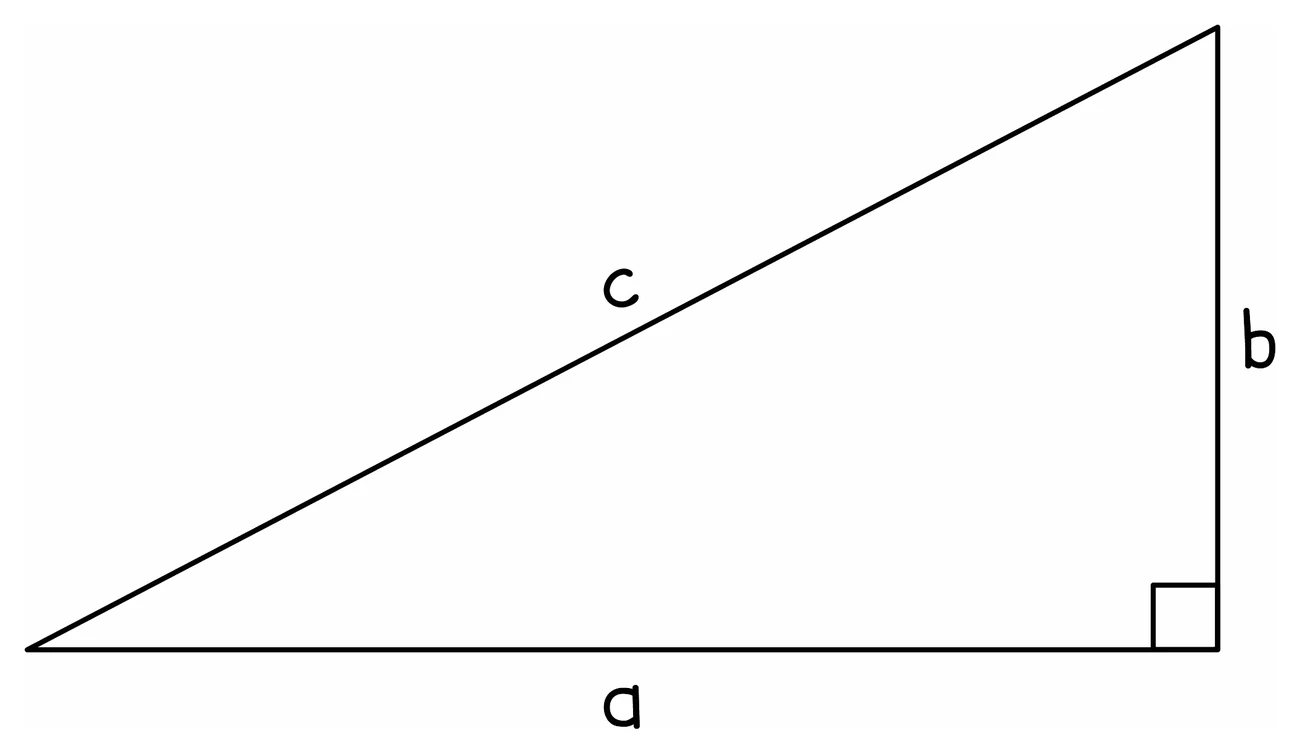
- Papers do not use the words "Pythagoras" or "hypotenuse" in the question: they simply give a right-angled triangle with two sides marked
Using it both ways
- To find the hypotenuse, square both shorter sides, add, then take the square root
- To find a shorter side, square the hypotenuse and the known shorter side, subtract, then take the square root
- Adding when you should subtract is the standard error, and the check is simple: the hypotenuse must come out as the longest side
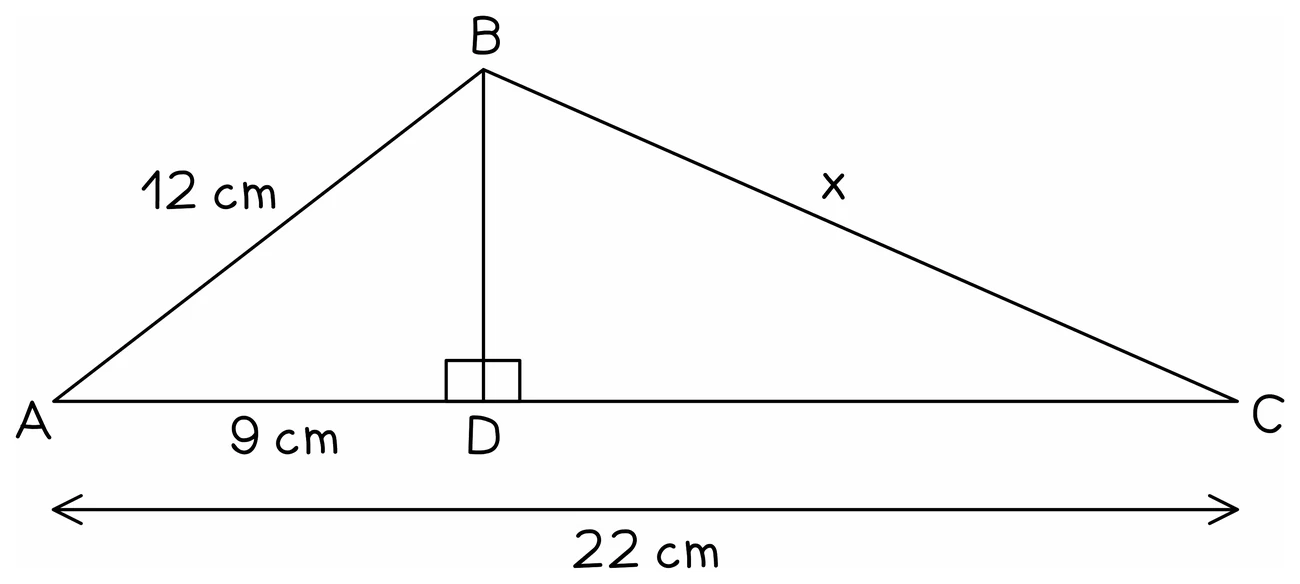
- Where an answer does not work out exactly, leave it as a surd if the question asks for an exact value, and otherwise round as instructed
- Cut a bigger figure into right-angled pieces and the theorem applies again, so dropping a perpendicular inside an isosceles triangle or a trapezium opens it up
Worked example
Both directions in one triangle
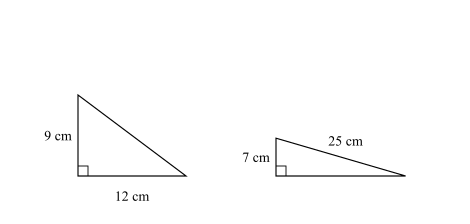
A right-angled triangle has shorter sides 9 cm and 12 cm. Find the hypotenuse. A second right-angled triangle has hypotenuse 25 cm and one shorter side 7 cm. Find the other shorter side.
Solution:
- For the first, the unknown is the hypotenuse, so add
- c² = 9² + 12² = 81 + 144 = 225
- c = √225 = 15 cm
- For the second, the unknown is a shorter side, so subtract
- a² = 25² − 7² = 625 − 49 = 576
- a = √576 = 24 cm
- Check both: 15 is longer than 9 and 12, and 24 is shorter than 25