Right Angled Triangles
Pythagoras and Trigonometry
The values to know
- For a handful of angles the ratios can be written exactly, as a fraction or a surd rather than a rounded decimal
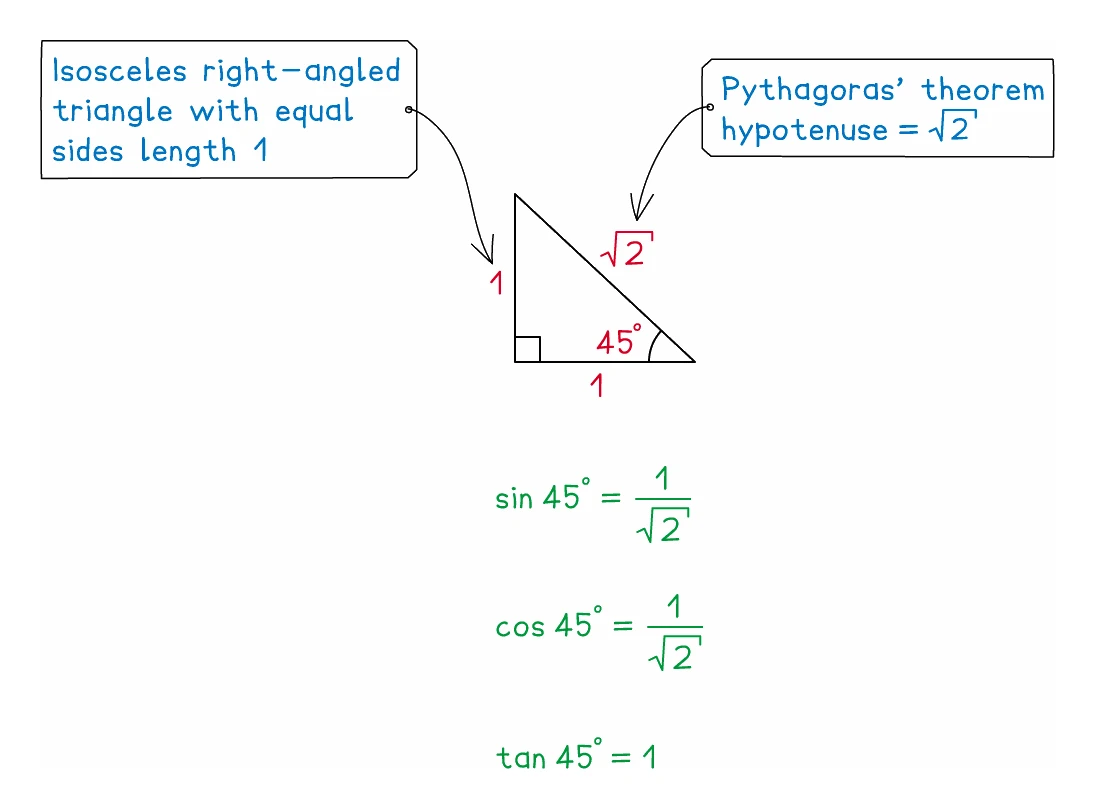
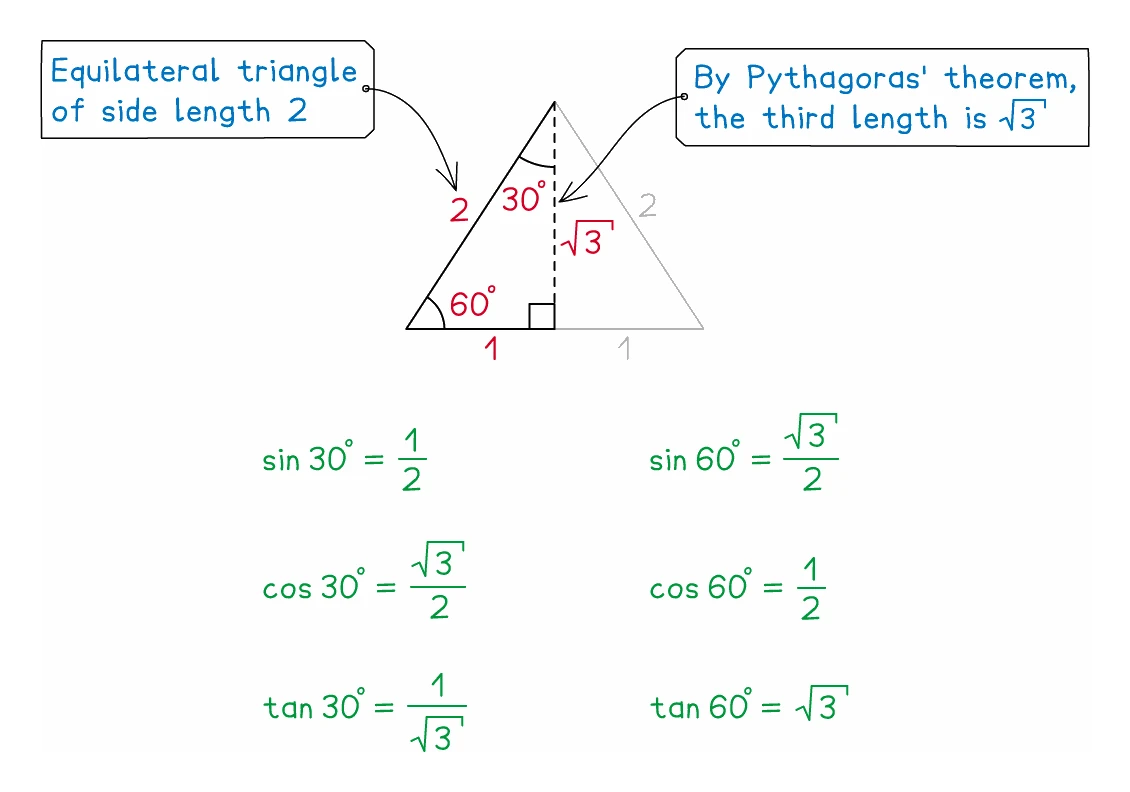
| θ | 0° | 30° | 45° | 60° | 90° |
|---|---|---|---|---|---|
| sin θ | 0 | ½ | √2 ÷ 2 | √3 ÷ 2 | 1 |
| cos θ | 1 | √3 ÷ 2 | √2 ÷ 2 | ½ | 0 |
| tan θ | 0 | √3 ÷ 3 | 1 | √3 | — |
- The syllabus requires sine and cosine at 0°, 30°, 45°, 60° and 90°, and tangent at 0°, 30°, 45° and 60° only
- Tangent has no value at 90°, which is why the syllabus stops short of it there
- The sine row read forwards matches the cosine row read backwards, which halves what there is to remember
- √2 ÷ 2 is the same as 1 ÷ √2, and √3 ÷ 3 is the same as 1 ÷ √3, so either form is correct
- These come up whenever a question asks for an exact value, which rules out a rounded decimal
Worked example
Using the exact values
Without a calculator, find the exact value of sin 60° × cos 30°, and of tan 45° + sin 30°.
Solution:
- These come from the two triangles worth memorising, so no calculator is needed
- sin 60° = √3/2 and cos 30° = √3/2
- Multiplying: (√3/2) × (√3/2) = (√3 × √3) / (2 × 2)
- √3 × √3 = 3, so the answer is 3/4
- tan 45° = 1 and sin 30° = 1/2
- Adding: 1 + 1/2 = 3/2, or 1.5
- 3/4 = 0.75 and 3/2 = 1.5 exactly, so either form is exact here; a surd such as √3/2 has no exact decimal, so it has to stay as a surd
Exam tip
Write down the exact value you use
On the non-calculator paper, write the exact value you need on its own line, such as tan 30° = 1/√3, before you substitute it. The schemes give a mark for that correct value by itself, even when the rearranging that follows goes wrong. Write the one you use: some schemes refuse to credit a value that appears only in a table of them all, written out from memory.
Worked example
An exact length from an exact trig value
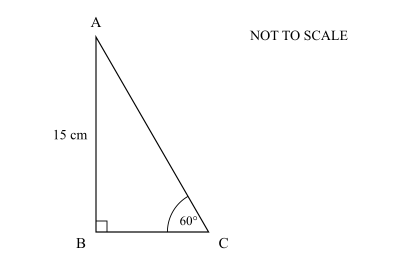
Triangle ABC has a right angle at B. Angle ACB = 60° and AB = 15 cm. Without a calculator, find the exact lengths of BC and AC, each in the form a√b.
Solution:
- From the 60° angle at C, AB is the opposite side, BC is the adjacent side and AC is the hypotenuse
- For BC, O and A means tangent, and tan 60° = √3
- √3 = 15 ÷ BC, so BC = 15 ÷ √3
- Multiply the top and the bottom by √3: BC = 15√3 ÷ 3 = 5√3 cm
- For AC, O and H means sine, and sin 60° = √3/2
- √3/2 = 15 ÷ AC, so AC = 15 ÷ (√3/2) = 30 ÷ √3
- Multiply the top and the bottom by √3: AC = 30√3 ÷ 3 = 10√3 cm
- Check with Pythagoras: (5√3)² + 15² = 75 + 225 = 300, and (10√3)² = 100 × 3 = 300