Right Angled Triangles
Pythagoras and Trigonometry
Elevation and depression
- An angle of elevation is measured up from the horizontal to the line of sight, and an angle of depression is measured down from it
- Both are measured from the horizontal, never from the vertical, which is the usual misreading
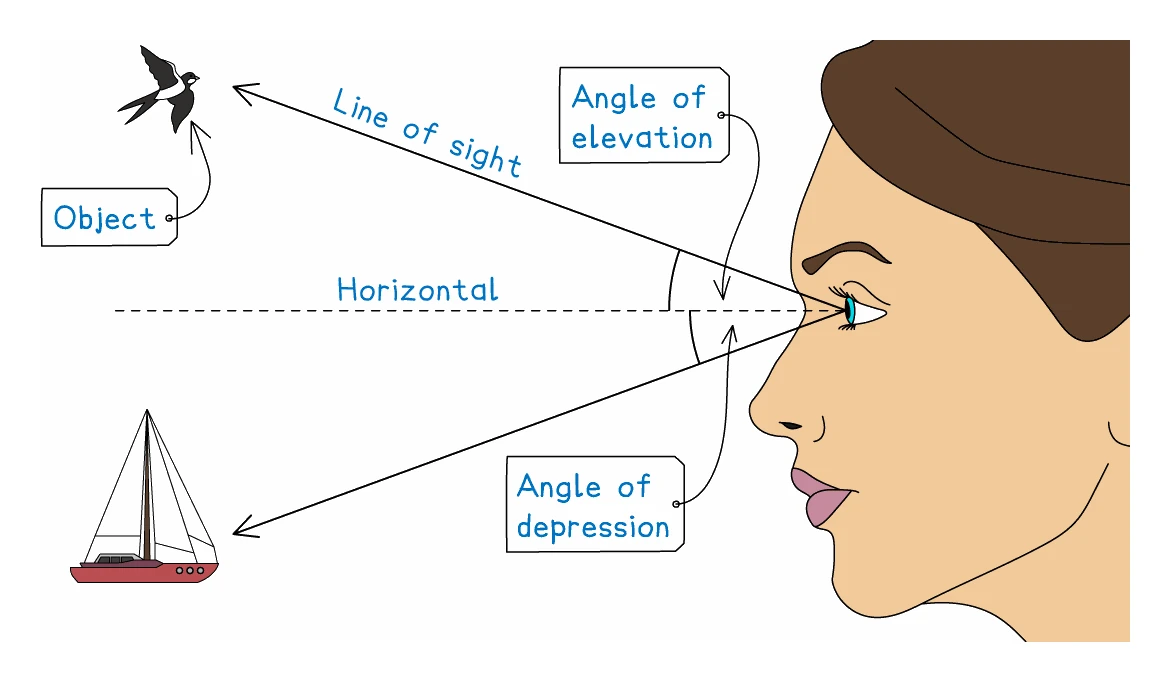
- Sketch the situation with the horizontal drawn in and the right angle marked, then apply SOHCAHTOA
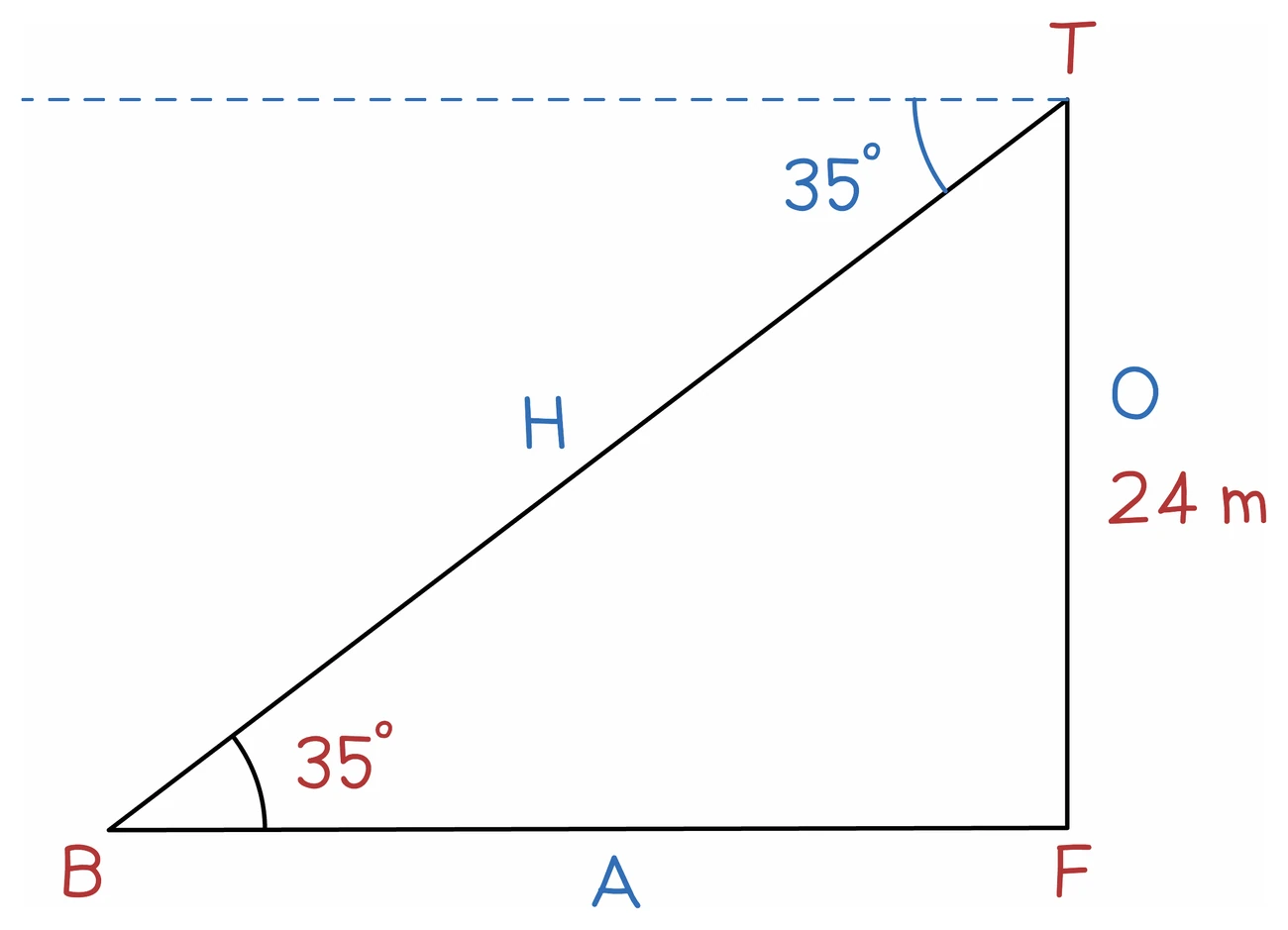
- Tangent appears most often, because these questions usually pair a height with a horizontal distance
Worked example
An angle of elevation
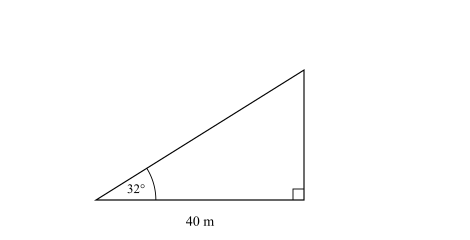
From a point 40 m from the base of a tower, the angle of elevation of the top is 32°. Find the height of the tower, correct to 1 decimal place.
Solution:
- The horizontal distance is adjacent to the 32° angle and the height is opposite it
- O and A means tangent
- tan 32° = height ÷ 40
- height = 40 × tan 32°
- height = 24.9947…
- The tower is 25.0 m tall to 1 decimal place
Worked example
An angle of depression between two masts
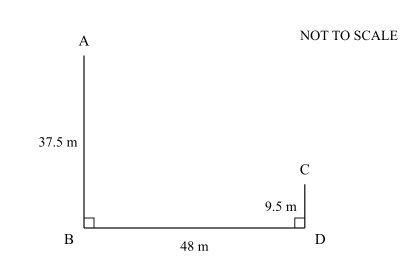
Two vertical masts stand on horizontal ground. Mast AB has its foot at B and is 37.5 m tall, and mast CD has its foot at D and is 9.5 m tall. B and D are 48 m apart. Find the angle of depression of C, the top of the shorter mast, from A, correct to 1 decimal place.
Solution:
- Draw a horizontal line from C across to AB, meeting it at E, so angle AEC = 90°
- EC is the gap between the masts, 48 m, and E is 9.5 m above the ground
- So AE is the difference in heights: 37.5 − 9.5 = 28 m
- The angle of depression of C from A equals angle ACE, the angle of elevation of A from C, because the horizontals through A and C are parallel
- From angle ACE, AE is opposite and EC is adjacent, so use tangent
- tan(ACE) = 28 ÷ 48
- Angle ACE = tan⁻¹(28 ÷ 48) = 30.256…
- The angle of depression is 30.3° to 1 decimal place
- Using the full height, tan⁻¹(37.5 ÷ 48) = 38.0°, gives the angle of depression of D, the foot of the shorter mast, instead
Shortest distance to a line
- The shortest distance from a point to a line is the perpendicular distance, measured at a right angle to the line
- The syllabus names this directly, and these papers ask for a "shortest distance" in 6 of the 21
- Drawing that perpendicular creates a right-angled triangle, which Pythagoras or SOHCAHTOA then solves
- The syllabus adds that knowledge of bearings may be required in two-dimensional problems like these, so a north line can appear on the same diagram
Exam tip
Draw the perpendicular before you calculate
Draw the perpendicular from the point to the line, and mark its right angle, before any calculation. The schemes give a method mark just for recognising that the shortest distance is this perpendicular, so it can score even if the working after it goes wrong. Where that recognition is shown only on the diagram, some schemes count it only if the right angle is marked.
Worked example
Shortest distance from a point to a line
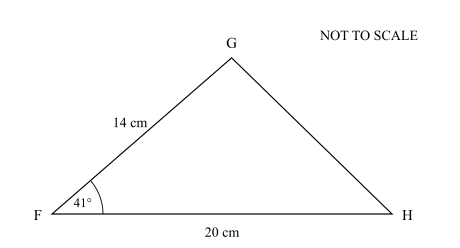
In triangle FGH, FG = 14 cm, FH = 20 cm and angle GFH = 41°. Find the shortest distance from G to the line FH, correct to 3 significant figures.
Solution:
- The shortest distance is the perpendicular from G to FH: call its foot N, so angle GNF = 90°
- In the right-angled triangle GNF, FG is the hypotenuse and GN is opposite the 41° angle
- O and H means sine: sin 41° = GN ÷ 14
- GN = 14 × sin 41° = 9.1848…
- The shortest distance is 9.18 cm to 3 significant figures
- FH = 20 cm is not needed for this route, but it gives a check through the area: ½ × 14 × 20 × sin 41° = 91.848… cm², and that area is also ½ × 20 × GN, so GN = 2 × 91.848… ÷ 20 = 9.18 cm
- When the area is what you know, rearranging area = ½ × base × distance in the same way finds the distance directly