Sine Rule, Cosine Rule and Area of Triangles
Pythagoras and Trigonometry
Labelling and Choosing a Rule
The labelling convention
- These three rules work in any triangle, not just right-angled ones, which is what makes them different from Pythagoras and SOHCAHTOA
- All three are printed in the List of formulas, so none has to be memorised, but each must be labelled correctly before it can be used
- Capital letters mark the angles and the matching small letter marks the side opposite that angle
- Side a lies opposite angle A, side b opposite angle B, and side c opposite angle C
- Relabel the triangle in the question to match, rather than trying to fit the formula to whatever letters the diagram already uses
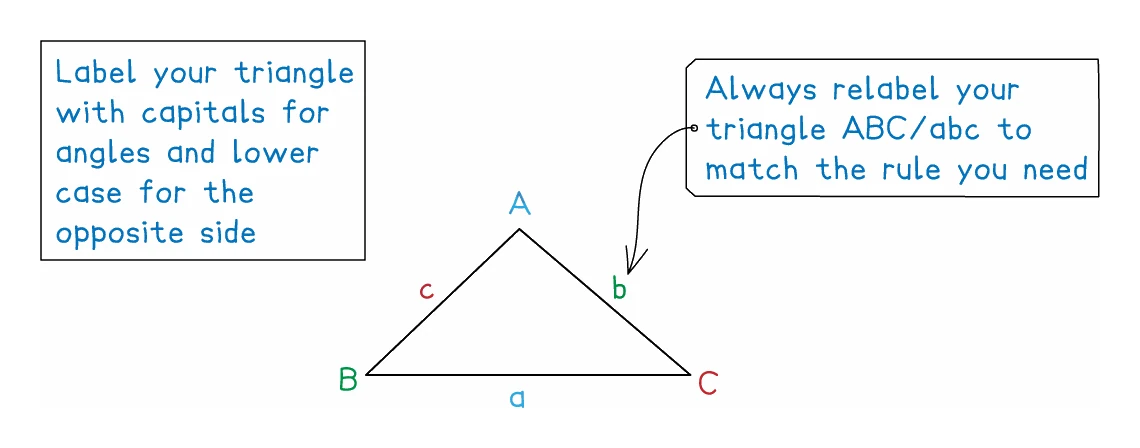
- Getting a side paired with the wrong angle is the commonest cause of a wrong answer here
Which rule
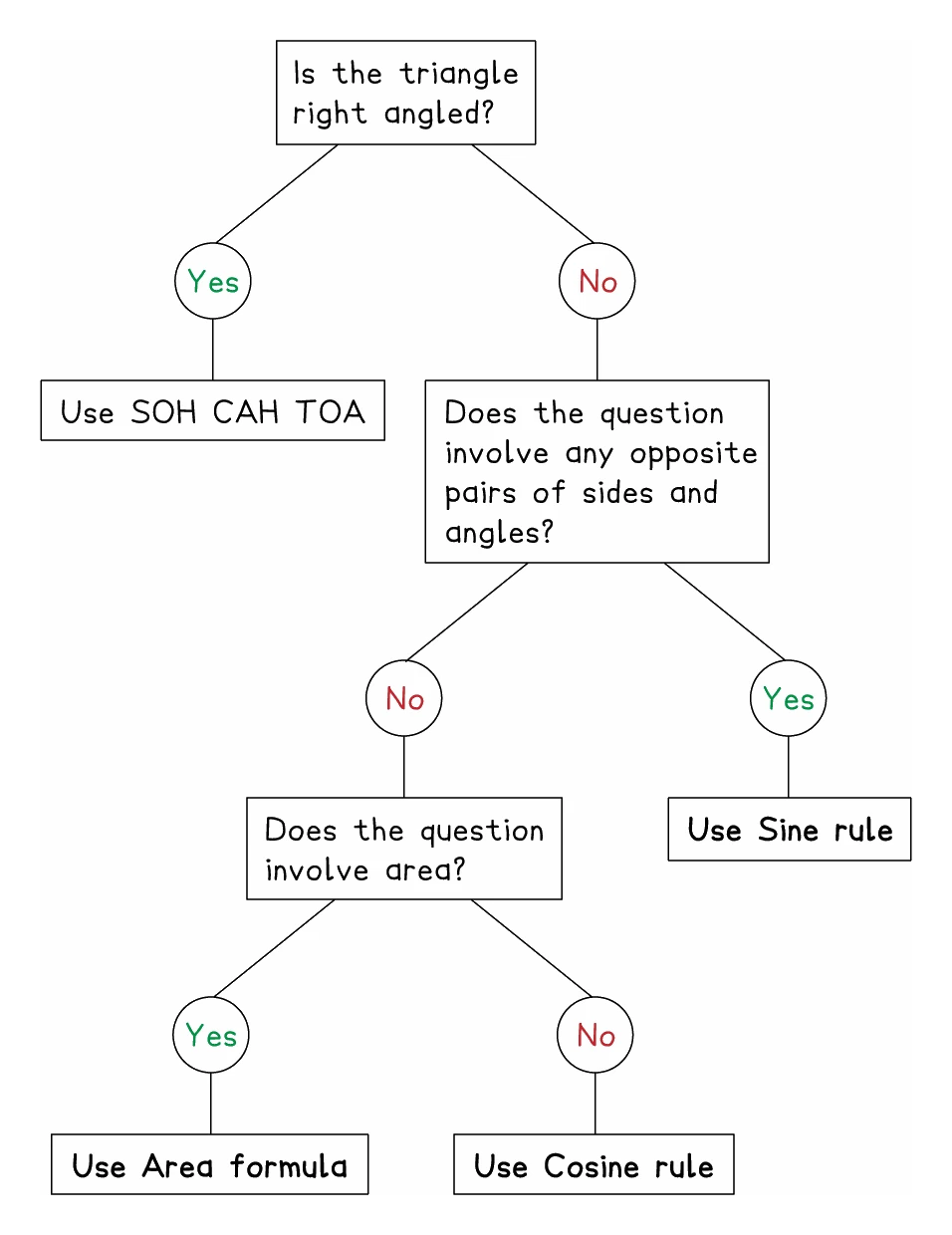
- Choose the rule from what you already know and what you are being asked for
| Rule | Use it when |
|---|---|
| Sine rule | a side and the angle facing it are both known, and you want the partner of another such pair |
| Cosine rule | two sides and their included angle are known, and the third side is wanted |
| Cosine rule | all three sides are known, and any angle is wanted |
| Area formula | two sides and their included angle are known, and the area is wanted |
-
The included angle means the one wedged between the two sides, at the corner where they meet
-
Quick test: spot a side sitting opposite a known angle and the sine rule applies; without such a pair, it is the cosine rule
-
A question worth many marks usually needs two rules in succession, often the cosine rule then the sine rule
-
Angles in a triangle add to 180°, which frequently supplies the missing angle without any rule at all
-
Papers never name the rules in the question, so recognising which applies is part of what is being tested
Worked example
Deciding which rule fits
For each triangle, say which rule you would use. (a) Angle A = 40°, side a = 9 cm, angle B = 65°. (b) Sides b = 7 cm and c = 10 cm with angle A = 55° between them. (c) All three sides known, angle B wanted.
Solution:
- The deciding question is always the same: is a side known together with the angle opposite it?
- (a) Side a and angle A are a matching pair, and angle B is known, so the sine rule finds side b
- (b) The angle given lies between the two known sides, so no side has its opposite angle known
- That is the cosine rule, finding side a from b, c and angle A
- (c) Three sides and no angles, so again no matching pair: the cosine rule rearranged for cos B
- If (b) had asked for the area rather than a side, two sides and the angle between them is exactly ½ab sin C
- The papers never print the words "sine rule" or "cosine rule", so this choice is always yours to make