Sine Rule, Cosine Rule and Area of Triangles
Pythagoras and Trigonometry
Two sides and their included angle
- The printed formula is Area = ½ab sin C
- Angle C must sit between the two sides a and b, and any pair of sides with their included angle will do
- Where that angle is not given, find it first with the sine or cosine rule
- If C happens to be 90°, sin 90° = 1 and the formula collapses to the familiar half base times height
- Convert all the lengths to the same unit before substituting, and give the area in the unit the question asks for
Worked example
Area from two sides and the included angle
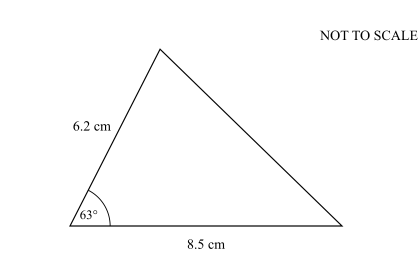
A triangle has sides of 8.5 cm and 6.2 cm with an angle of 63° between them. Find its area, correct to 3 significant figures.
Solution:
- The angle lies between the two given sides, so the area formula applies directly
- Area = ½ × 8.5 × 6.2 × sin 63°
- Area = 26.35 × sin 63°
- Area = 23.4780…
- The area is 23.5 cm² to 3 significant figures
- On the non-calculator paper the angle has an exact sine instead: with 30° in place of 63°, sin 30° = ½ and the area is ½ × 8.5 × 6.2 × ½ = 13.175 cm²
Exam tip
Carry your earlier answers into the next part
Long questions on these rules often chain their parts: a length or angle you calculate in one part is needed in a later one, for another rule or for an area. The method marks that use it are given for your own answer, even a wrong one, so substitute it and keep going rather than leave the part blank.
Worked example
The area of a quadrilateral in two triangles
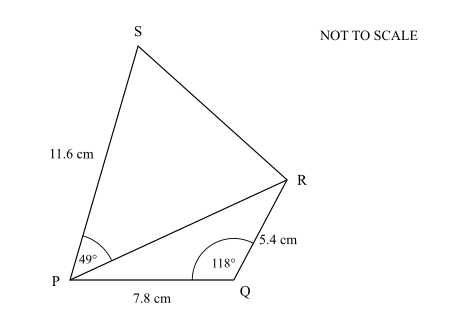
In quadrilateral PQRS the diagonal PR is drawn. PQ = 7.8 cm, QR = 5.4 cm, PS = 11.6 cm, angle PQR = 118° and angle RPS = 49°. Find the length of PR and the area of PQRS, each correct to 3 significant figures.
Solution:
- The diagonal splits PQRS into two triangles, PQR and PRS
- In triangle PQR the angle Q lies between PQ and QR, so the cosine rule gives PR
- PR² = 7.8² + 5.4² − 2 × 7.8 × 5.4 × cos 118°
- PR² = 60.84 + 29.16 − 84.24 × cos 118° = 90 + 39.5482… = 129.5482…
- The angle is obtuse, so cos 118° is negative and subtracting 84.24 × cos 118° adds 39.5482…
- PR = √129.5482… = 11.3819…, so PR = 11.4 cm to 3 significant figures
- Triangle PQR: area = ½ × 7.8 × 5.4 × sin 118° = 18.5948… cm²
- Triangle PRS: angle RPS lies between PR and PS, so area = ½ × 11.3819… × 11.6 × sin 49° = 49.8222… cm²
- Area of PQRS = 18.5948… + 49.8222… = 68.4171…, so the area is 68.4 cm² to 3 significant figures
- Use the unrounded PR in the second triangle: with 11.4 the total comes to 68.496…, which rounds to 68.5 instead