MathematicsExam code: 0580
Sine Rule, Cosine Rule and Area of Triangles
Pythagoras and Trigonometry
Finding a side
- The printed form is a² = b² + c² − 2bc cos A
- Angle A must be the one between sides b and c, and side a must be the one facing it
- Substitute, work out the right-hand side, then square root
- Keep the subtraction intact: the whole 2bc cos A is subtracted, and where A is obtuse its cosine is negative, so the term is added in effect
Worked example
A side by the cosine rule
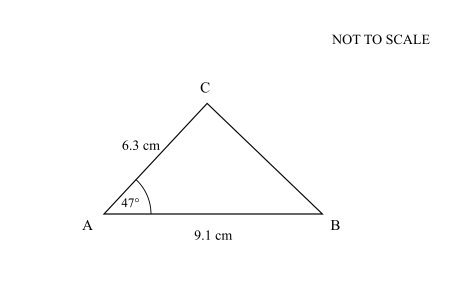
In triangle ABC, b = 6.3 cm, c = 9.1 cm and their included angle is A = 47°. Find side a, correct to 3 significant figures.
Solution:
- Two sides with their included angle, and the third side wanted, so the cosine rule applies
- a² = 6.3² + 9.1² − 2 × 6.3 × 9.1 × cos 47°
- a² = 39.69 + 82.81 − 114.66 × cos 47°
- a² = 122.5 − 78.1979… = 44.3020…
- a = √44.3020… = 6.6559…
- So a = 6.66 cm to 3 significant figures
Finding an angle
- With all three sides known, rearrange to cos A = (b² + c² − a²) ÷ 2bc
- That rearrangement is not printed, so either derive it or substitute into the printed form and solve
- Apply the inverse cosine at the end
- A negative value for cos A simply means the angle is obtuse, and the calculator returns it directly with no ambiguity
Worked example
An obtuse angle from three sides
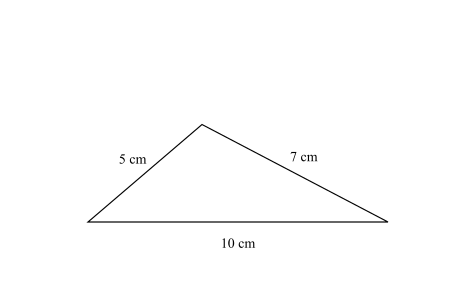
A triangle has sides 6 cm, 8 cm and 12 cm. Find the angle opposite the 12 cm side, correct to 1 decimal place.
Solution:
- All three sides are known, so use the cosine rule for an angle, with a = 12 as the side facing the unknown angle
- cos A = (6² + 8² − 12²) ÷ (2 × 6 × 8)
- cos A = (36 + 64 − 144) ÷ 96 = −44 ÷ 96 = −0.4583…
- The cosine is negative, so the angle is obtuse
- A = cos⁻¹(−0.4583…) = 117.2796…
- So A = 117.3° to 1 decimal place