MathematicsExam code: 0580
Sine Rule, Cosine Rule and Area of Triangles
Pythagoras and Trigonometry
Finding a side
- The printed form is a ÷ sin A = b ÷ sin B = c ÷ sin C
- Only two of the three parts are needed, so pick the pair that contains your unknown and the pair you know completely
- Substitute, then multiply across to make the unknown side the subject
Worked example
A side by the sine rule
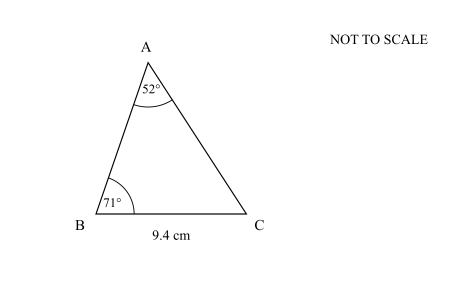
In triangle ABC, angle A = 52°, angle B = 71° and side a = 9.4 cm. Find side b, correct to 3 significant figures.
Solution:
- Side a and angle A are an opposite pair, and side b faces angle B, so use the sine rule
- b ÷ sin 71° = 9.4 ÷ sin 52°
- Multiply both sides by sin 71°: b = 9.4 × sin 71° ÷ sin 52°
- b = 11.27887…
- So b = 11.3 cm to 3 significant figures
- Check: b faces the larger angle, so it should be the longer side, and it is
Finding an angle
- Inverting all three fractions moves the angles into the numerators, giving sin A ÷ a = sin B ÷ b = sin C ÷ c
- That flipped version is not printed, but it follows from the printed one, so either form can be written down
- Substitute, make the sine of the unknown angle the subject, then apply the inverse sine
- Give angles correct to one decimal place, as the syllabus requires
The ambiguous case
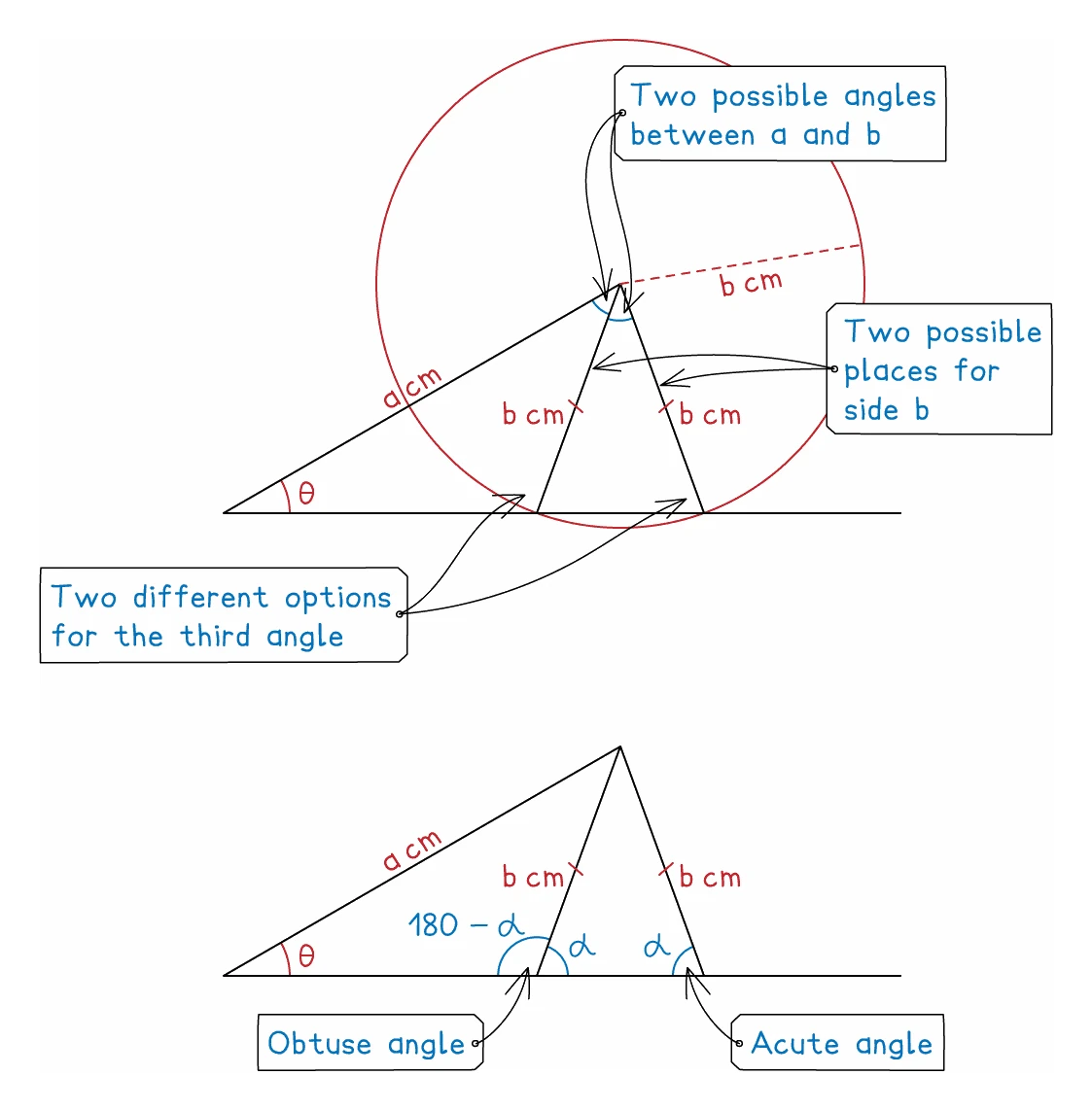
- Inverse sine on a calculator only ever returns the acute answer, but an obtuse angle can have the same sine
- Whenever the sine rule is used to find an angle, there is a second candidate: 180° minus the acute answer
- The syllabus names this the ambiguous case and includes it explicitly, along with obtuse angles generally
- The obtuse candidate is possible only if it and the angle you already know add up to less than 180°; when both are possible, the diagram or the wording decides
- This never happens with the cosine rule, which returns the obtuse angle directly
Worked example
An angle, with the ambiguous case
In triangle ABC, side a = 7.6 cm, side b = 5.2 cm and angle B = 34°. Find angle A.
Solution:
- Side b and angle B are an opposite pair, and angle A faces side a, so the sine rule applies, inverted to put the angles in the numerators
- sin A ÷ 7.6 = sin 34° ÷ 5.2
- Multiply both sides by 7.6: sin A = 7.6 × sin 34° ÷ 5.2
- sin A = 0.8172…
- The calculator gives A = sin⁻¹(0.8172…) = 54.8136…, so A = 54.8° to 1 decimal place
- The obtuse alternative is 180 − 54.8136… = 125.2°, and both are consistent with the given information: the third angle C would be 91.2° or 20.8°
- Either can be correct here, so a real question settles it, with its diagram or by saying that the angle is obtuse