Congruence and Similarity
Lengths, Areas and Volumes
Powers of the same scale factor
- Call the enlargement's scale factor k, measured on the lengths. Areas and volumes then scale by powers of that same k
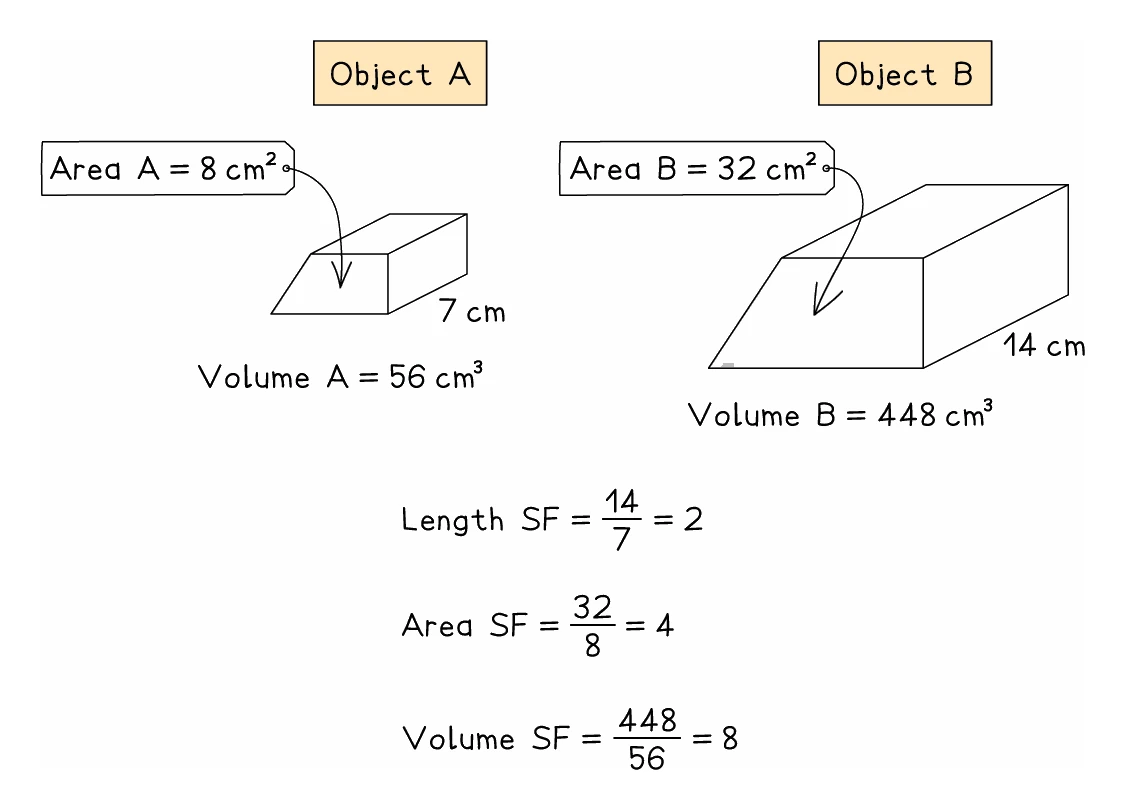
| Quantity | Scales by | Recovering k |
|---|---|---|
| Length | k | — |
| Area | k² | take the square root |
| Volume | k³ | take the cube root |
- The powers follow from the units, since an area is two lengths multiplied together and a volume is three
- Multiplying an area by k instead of k², and using the ratio of two areas as if it were the length scale factor, are the standard errors in this topic
- Identify first whether each quantity given is a length, an area or a volume, because the whole method turns on that
Worked example
Volume from a length scale factor
Two cones are mathematically similar. The smaller has height 4 cm and volume 32 cm³. The larger has height 10 cm. Find the volume of the larger cone.
Solution:
- Heights are lengths, so they give the length scale factor
- k = 10 ÷ 4 = 2.5
- Volume scales by k³, so the volume scale factor is 2.5³ = 15.625
- Volume of the larger cone = 32 × 15.625
- Volume = 500 cm³
- Check as fractions: k = 5/2, so k³ = 125/8, and 32 × 125/8 = 4000/8 = 500
Exam tip
Go through the length scale factor
Given two areas or two volumes, turn their ratio into the length scale factor first: k = √(area ratio) or k = ∛(volume ratio). That line earns the first method mark on its own, whichever way up you write the fraction. Then raise it to the power you need: areas in the ratio 4 : 25 mean lengths in the ratio 2 : 5, so the volumes are in the ratio 8 : 125.
Worked example
Length from an area scale factor
Two similar shapes have areas of 45 cm² and 125 cm². A side of the smaller shape is 6 cm. Find the corresponding side of the larger.
Solution:
- The quantities given are areas, so they give the area scale factor
- Area scale factor = 125 ÷ 45 = 25/9
- The length scale factor is the square root of this
- k = √(25/9) = 5/3
- The missing side is on the larger shape, so multiply
- 6 × 5/3 = 10 cm
- Check: the areas would then be in the ratio (10/6)² = (5/3)² = 25/9, and 125 ÷ 45 = 25/9