MathematicsExam code: 0580
Congruence and Similarity
Lengths, Areas and Volumes
Same shape, different size
- Two shapes are similar when one is an enlargement of the other, turned or flipped over if need be, which means their angles match and every pair of corresponding sides shares the same ratio
- Papers usually say "mathematically similar", occasionally just "similar", and either phrasing is the signal to look for a scale factor
- Congruence is the special case of similarity where the scale factor is 1, so congruent shapes are similar but similar shapes are usually not congruent
Proving it
- For triangles, equal angles are enough: if the three angles match, the sides are automatically in proportion
- State each pair of equal angles and give the geometrical reason, exactly as in an angles question
- The reasons are usually vertically opposite angles, alternate or corresponding angles on parallel lines, or angles shared by both triangles
- For shapes that are not triangles, equal angles are not enough on their own: every pair of corresponding sides must also give the same scale factor (a square and a long rectangle have equal angles but are not similar)
- Similar triangles frequently overlap on the diagram or sit point to point in an hourglass, and redrawing them separately, facing the same way, prevents mismatching the sides
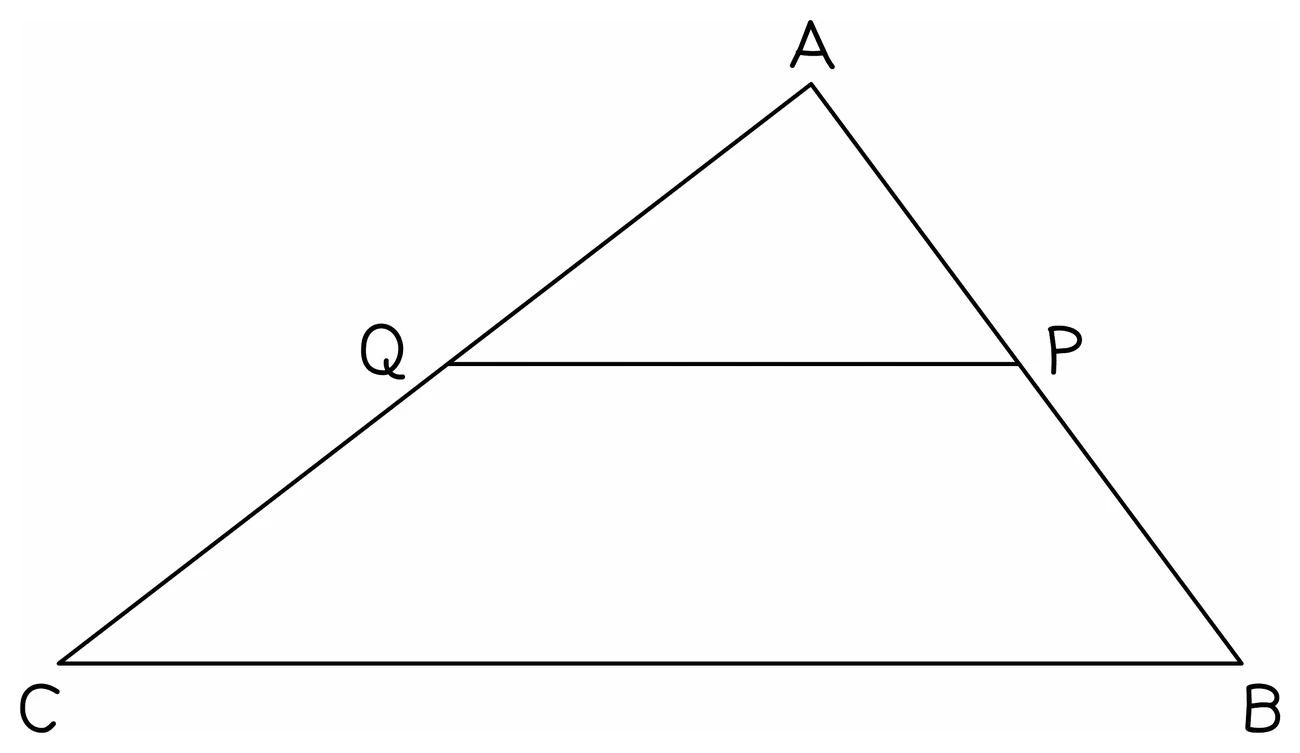
Worked example
Showing that two triangles are similar
In triangle ABC, the line DE is parallel to BC, with D on AB and E on AC. Show that triangle ADE is similar to triangle ABC.
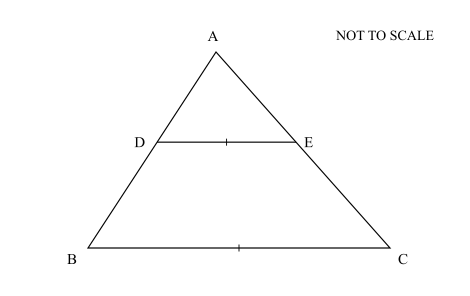
Solution:
- Similarity needs every pair of corresponding angles to be equal, so take them one pair at a time and name the reason each time
- Angle A is shared by both triangles, so angle DAE = angle BAC (the angle is common)
- DE is parallel to BC, and AB crosses both, so angle ADE = angle ABC (corresponding angles are equal)
- For the same reason with AC as the crossing line, angle AED = angle ACB
- All three pairs of corresponding angles are equal
- Therefore triangle ADE is similar to triangle ABC
- Naming the reason beside each pair is what earns the marks; listing the equal angles without reasons does not
- Write the letters in matching order, so that A pairs with A, D with B and E with C