MathematicsExam code: 0580
Congruence and Similarity
Lengths, Areas and Volumes
Finding a missing length
- Pick a pair of sides whose lengths are both known, one from each shape, and divide one by the other to get the scale factor
- Multiply to move towards the larger shape and divide to move towards the smaller one
- Choosing the direction that goes small to large keeps the scale factor above 1, which many find easier to check
- Pair the sides correctly before dividing: corresponding sides sit between the same pair of equal angles
- Sanity check the answer, since a length on the larger shape must come out larger
Exam tip
Pair whole sides in the ratio line
Write the matching sides as an equal pair of fractions before you solve: that line earns the method mark even if the arithmetic after it slips. Every length in it must be a whole side of its own triangle. When the diagram splits a line into two pieces, add the pieces, or take one away from the whole, to get that side before it goes into the fraction.
Worked example
A missing length on a similar shape
Two triangles are mathematically similar. A side of 4 cm on the smaller corresponds to 7 cm on the larger. Another side of the smaller is 6 cm. Find the corresponding side, x cm, on the larger.
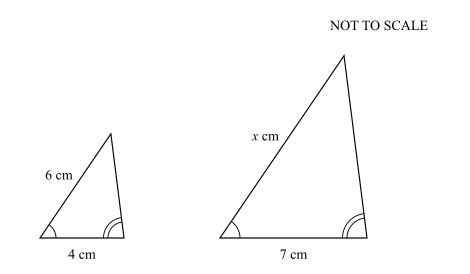
Solution:
- Take the scale factor from the pair of sides that are both known
- Scale factor = 7 ÷ 4 = 1.75
- The missing side is on the larger shape, so multiply
- x = 6 × 1.75 = 10.5, so the side is 10.5 cm
- Check: 10.5 ÷ 6 = 1.75, matching the scale factor from the first pair