MathematicsExam code: 0580
3D Pythagoras and Trigonometry
Pythagoras and Trigonometry
Reduce it to two dimensions
- Nothing new is needed here: the tools are still Pythagoras' theorem and SOHCAHTOA
- The whole difficulty is finding the right-angled triangle inside the solid, so the first move is always to locate one
- Once found, redraw that triangle flat on the page rather than leaving it drawn at an angle inside the solid
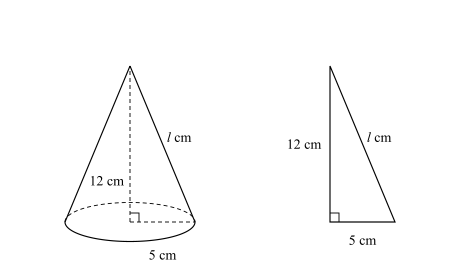
- A 3D drawing distorts angles, so a triangle that looks right-angled in the picture may not be, and one that looks skewed often is
- Many problems need two triangles in succession, where the answer from the first becomes a side of the second
- Keep the full unrounded value between the two stages and round only at the very end
The space diagonal
- The longest straight line inside a cuboid runs between opposite corners, and it is what a "longest rod that fits in the box" question asks for
- Reach it in two steps: Pythagoras across the base to get the base diagonal, then Pythagoras again using that diagonal and the height
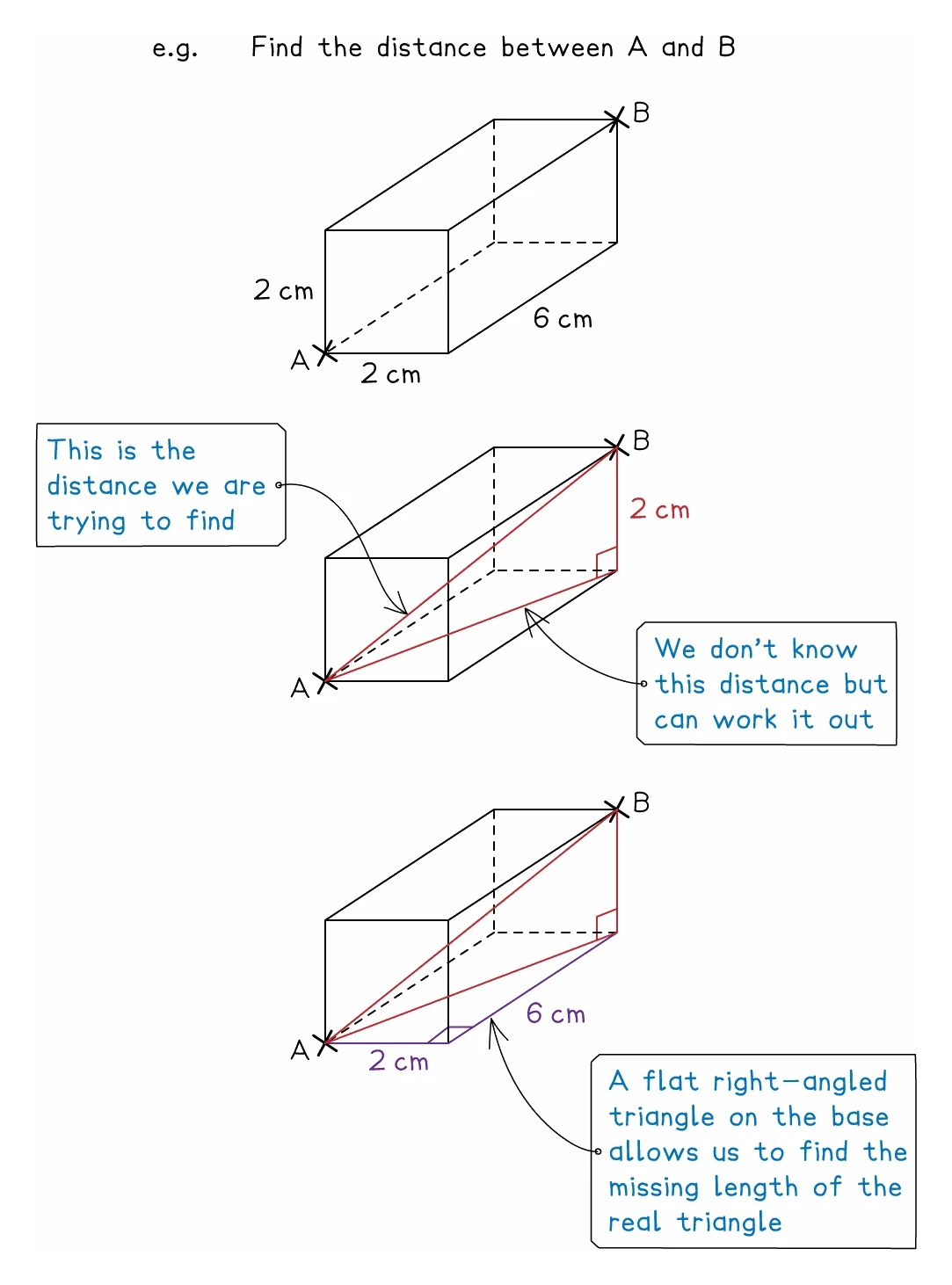
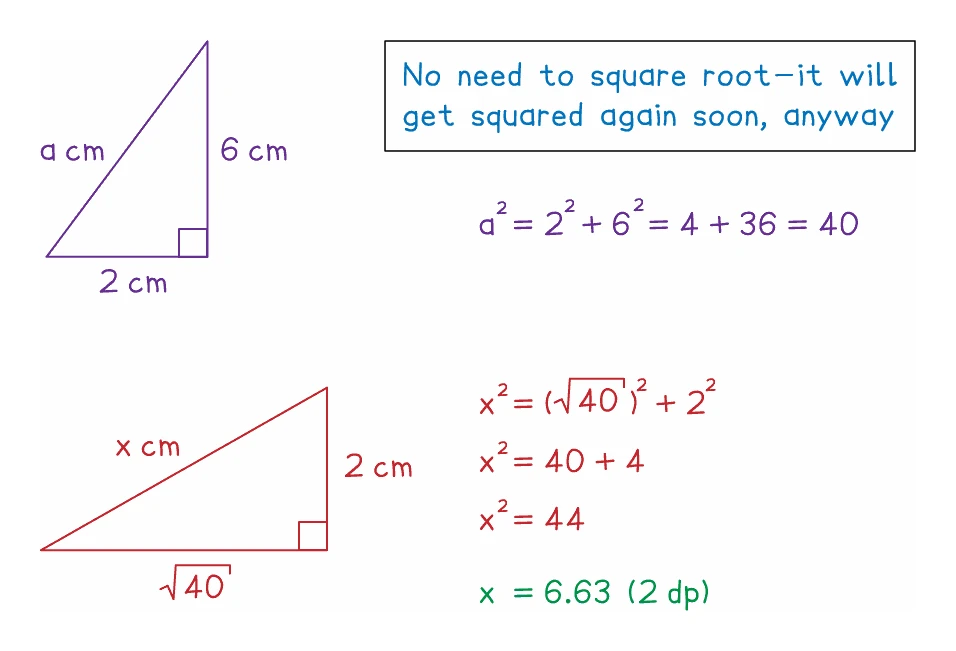
- There is a one-step version, d² = x² + y² + z², but it is not on the list of formulas, so learn it or use the two-step route
- Either route earns the method marks: the schemes credit the three squares added in one line, and the first face diagonal on its own earns a method mark
Worked example
The longest rod in a box
A box is a cuboid measuring 5 cm by 12 cm by 9 cm. Find the length of the longest straight rod that fits inside it, correct to 3 significant figures.
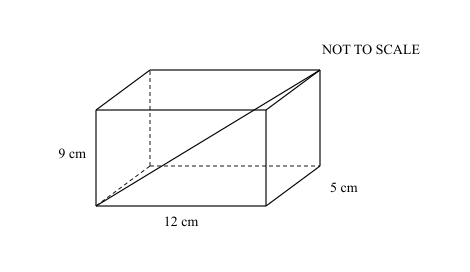
Solution:
- The longest line joins two opposite corners, so first find the diagonal across the 5 cm by 12 cm base
- Base diagonal² = 5² + 12² = 25 + 144 = 169, so the base diagonal is √169 = 13 cm
- Now use that diagonal and the 9 cm height as the two shorter sides of a second right-angled triangle
- Rod² = 13² + 9² = 169 + 81 = 250
- Rod = √250 = 15.8113…
- The longest rod is 15.8 cm to 3 significant figures
- On the non-calculator paper, leave the length as √250 cm; to show that a rod of a given length does not fit, compare squares: a 16 cm rod does not fit, because 16² = 256 is more than 250