3D Pythagoras and Trigonometry
Pythagoras and Trigonometry
Finding it
- The syllabus names this skill directly, and it is the part of the topic students find hardest to see
- A plane is a flat surface, such as the base of a solid, and the angle is measured between the line and the plane itself, not between the line and an edge
- Build the right-angled triangle in three steps
- Drop a perpendicular from the top of the line straight down onto the plane
- Join where it lands to the point where the line meets the plane
- Those two, with the original line, form a right-angled triangle whose right angle is on the plane
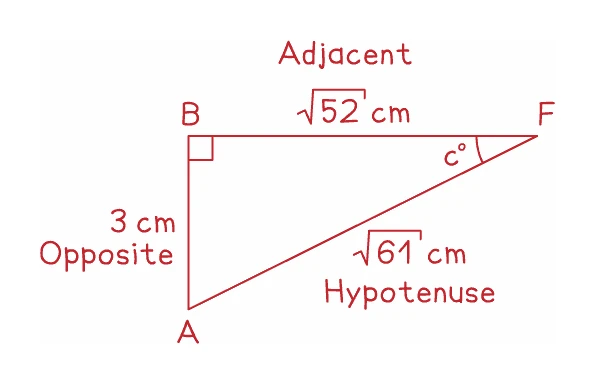
- The angle you want sits where the line meets the plane
- A useful image: hold the line like a fishing rod and let the line drop vertically to the surface, then look at the triangle that forms
- Where the foot of the perpendicular is the centre of a base, the horizontal side is half a diagonal, not half an edge
Worked example
Angle between a diagonal and the base
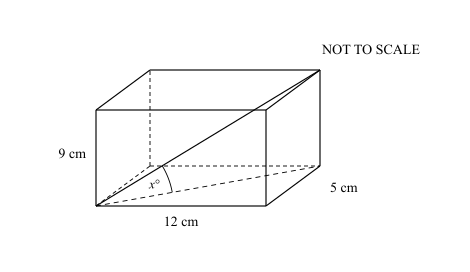
A cuboid measures 5 cm by 12 cm by 9 cm. Find the angle between the space diagonal and the base, correct to 1 decimal place.
Solution:
- The space diagonal rises from one corner of the base to the opposite top corner
- Dropping vertically from the top corner lands on the far corner of the base, so the horizontal side is the base diagonal, 13 cm
- The vertical side is the height, 9 cm, and the right angle is at that far corner of the base
- The angle is opposite the height and adjacent to the base diagonal, so use tangent
- tan x° = 9 ÷ 13
- x = tan⁻¹(9 ÷ 13) = 34.6951…
- The angle is 34.7° to 1 decimal place
- Without a calculator you cannot find the angle itself, so a non-calculator question asks for a ratio instead: here tan x° = 9/13 exactly
Exam tip
Name the angle before you calculate it
Before working out any lengths, name the angle with three letters: the upper end of the line, then the point where the line meets the plane (the vertex, in the middle), then the foot of the perpendicular. Mark it on the diagram too. This angle is set in 7 of the 21 papers, and most of their schemes give a mark for identifying the correct angle on its own, so that mark survives a wrong length later.
Worked example
Angle between a pyramid's slant edge and the base
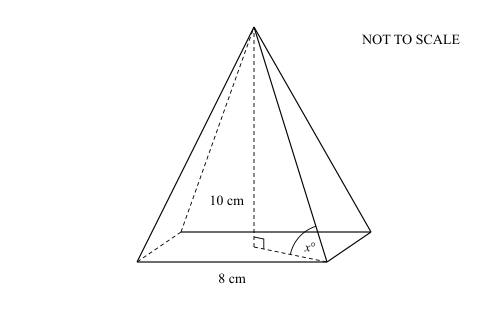
A pyramid has a square base of side 8 cm, and its apex is 10 cm vertically above the centre of the base. Find the angle between a slant edge and the base, correct to 1 decimal place.
Solution:
- The apex drops vertically to the centre of the base, so the horizontal side runs from the centre to a corner, which is half a diagonal
- The full base diagonal is √(8² + 8²) = √128, so half of it is √(4² + 4²) = √32 = 5.6568…
- The vertical side is the height, 10 cm, and the right angle is at the centre of the base
- The angle sits at the corner, opposite the height and adjacent to the half-diagonal, so use tangent
- tan x° = 10 ÷ 5.6568…
- x = tan⁻¹(1.7677…) = 60.5037…
- The angle is 60.5° to 1 decimal place
- Using half an edge, 4 cm, instead of half a diagonal would give tan⁻¹(10 ÷ 4) = 68.2°, which is wrong