Trigonometric Graphs and Equations
Pythagoras and Trigonometry
Why there is more than one answer
- A question gives an interval, almost always 0° ⩽ x ⩽ 360°, and expects every solution inside it
- The calculator's inverse function returns just one angle, so the others come from the symmetry of the graph
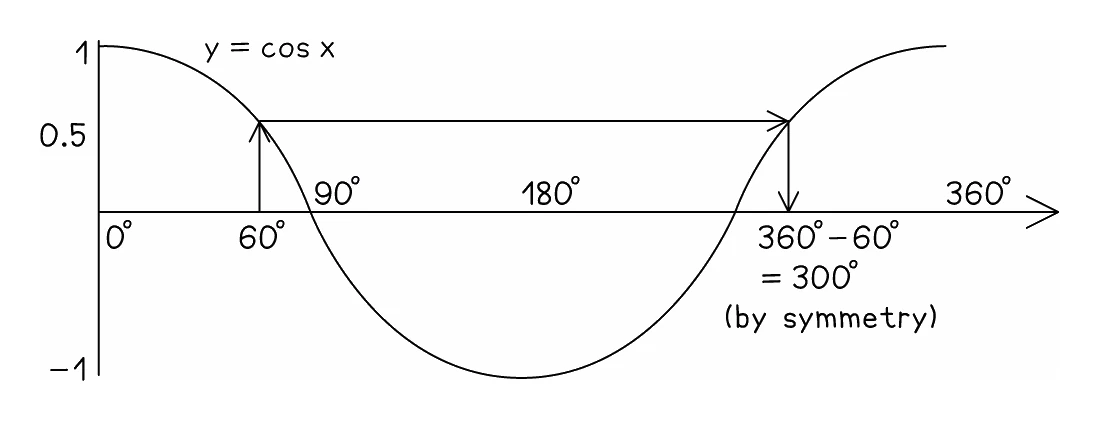
- Two answers is the usual number over a 360° interval for sine or cosine, and the answer line normally shows two spaces
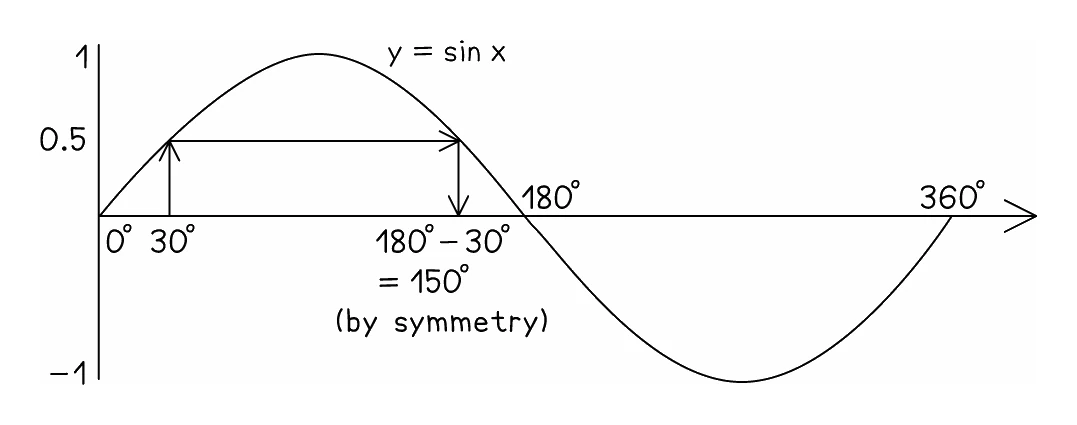
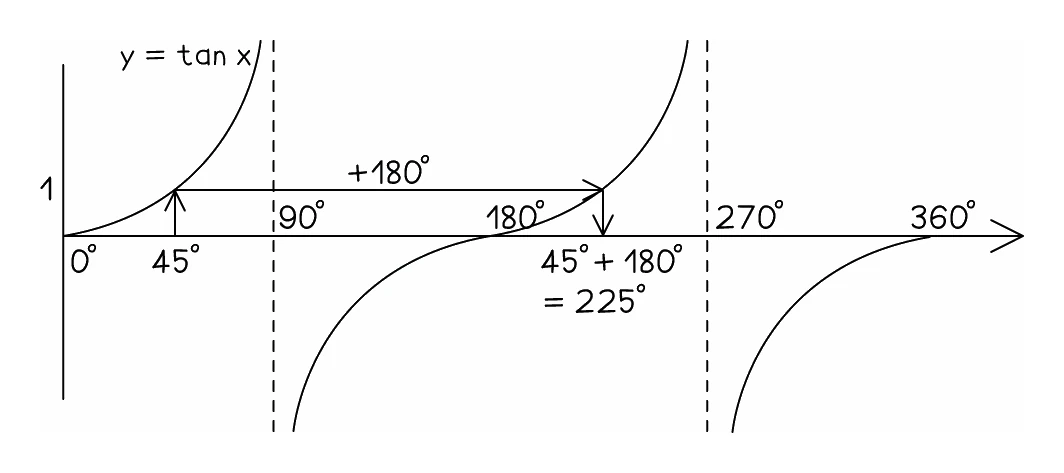
- Tangent behaves differently: its solutions are 180° apart rather than mirrored
The method
- Rearrange first, so the equation reads sin x = …, cos x = … or tan x = …, treating sin x as if it were a single unknown
- Take the inverse function to get the first angle
- Sketch the relevant graph across the interval and draw the horizontal line at that value
- Read off where else the line cuts the curve, using the symmetry rules
- For sine, the second solution is 180° − the first
- For cosine, the second solution is 360° − the first
- For tangent, add 180° to move to the next branch
- Where the first angle comes out negative, apply the symmetry rule to it as it stands, then add 360° to any answer still below 0°; for tangent, keep adding 180° and keep every answer that lands inside the interval
- Check each answer by substituting it back
Worked example
A sine equation with a negative value
Solve 3 sin x + 2 = 0 for 0° ⩽ x ⩽ 360°. Give your answers correct to 1 decimal place.
Solution:
- Rearrange to isolate sin x: 3 sin x = −2, so sin x = −2 ÷ 3
- The calculator gives sin⁻¹(−0.6666…) = −41.8103…, which is outside the interval
- Sine is negative below the axis, so both solutions lie between 180° and 360°
- Using the symmetry about 270°, the solutions are 180° + 41.8103… and 360° − 41.8103…
- So x = 221.8° or x = 318.2° to 1 decimal place
- Check: sin 221.8° and sin 318.2° both give −0.667 to 3 decimal places
Worked example
A cosine equation
Solve 4 cos x = 1 for 0° ⩽ x ⩽ 360°. Give your answers correct to 1 decimal place.
Solution:
- Divide by 4: cos x = 0.25
- The calculator gives cos⁻¹(0.25) = 75.5224…
- For cosine the second solution is 360° minus the first
- 360 − 75.5224… = 284.4775…
- So x = 75.5° or x = 284.5° to 1 decimal place
- Check: the two answers are symmetrical about 180°, as the cosine curve requires
Worked example
A tangent equation without a calculator
Without a calculator, solve tan x + √3 = 0 for 0° ⩽ x ⩽ 360°.
Solution:
- Rearrange to isolate tan x: tan x = −√3
- There is no calculator, so use the exact values: tan 60° = √3
- Changing the sign of the angle changes the sign of tan, so tan(−60°) = −√3 and the first angle is −60°, which is outside the interval
- Add 180° to move to the next branch: −60 + 180 = 120°
- Add another 180°: 120 + 180 = 300°
- One more would give 480°, which is outside the interval, so there are no others
- So x = 120° or x = 300°
- Check: tangent is negative between 90° and 180° and between 270° and 360°, and one answer lies in each
Exam tip
Show the first angle and always give its partner
Write the first angle you find in your working, even when it is negative or is not the angle asked for: on its own it can earn a mark. Then always give its partner. A pair inside the interval that adds to 360° for cosine, to 180° for sine (540° if both are reflex) or differs by 180° for tangent can still earn a mark when the first angle is wrong, so check that your pair fits.
Reading a reflex answer
- A question may give the value and ask specifically for the reflex angle, meaning the one between 180° and 360°
- Work out the first angle (from the calculator, or from the exact values on the non-calculator paper), then apply the symmetry rule to reach the reflex partner
- This is the same method, simply asking for the second solution instead of both