Acids, Bases and Salt Preparations
Inorganic Chemistry
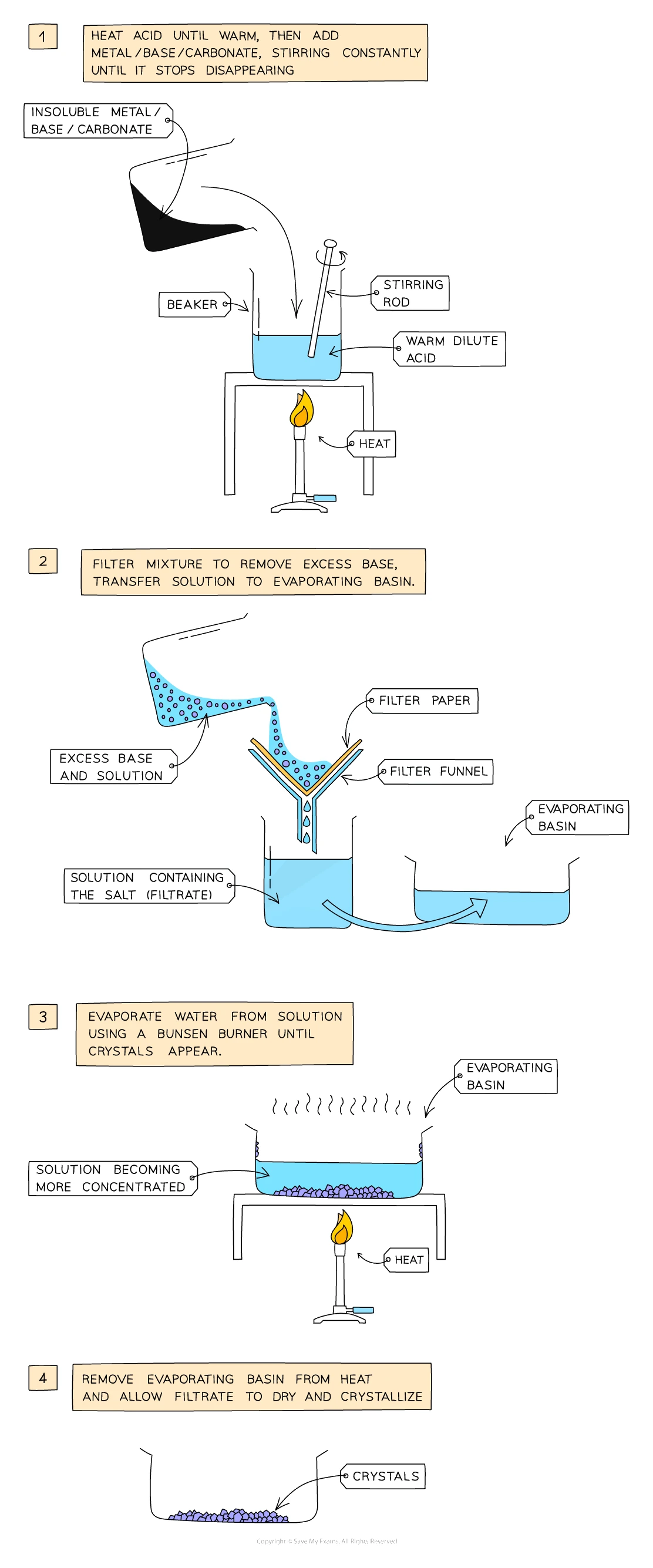
Method A — acid plus an insoluble base
-
Used when the metal involved is insoluble as its base (most transition-metal oxides, carbonates and hydroxides)
-
Works for almost any soluble salt of an unreactive or moderately reactive metal — e.g. CuSO4, ZnCl2, Fe(NO3)3
-
Step-by-step:
- Warm a fixed volume of the dilute acid gently in a beaker (warming speeds up the reaction)
- Add the insoluble base a little at a time, stirring, until no more dissolves — the base is then in excess, which guarantees that no acid is left over
- Filter off the unreacted base, collecting the salt solution as the in a clean container
- Pour the filtrate into an evaporating basin and heat gently to evaporate most of the water
- Stop heating when crystals start to form on a cold glass rod dipped into the solution — the solution is now saturated
- Leave the saturated solution in a warm place to cool and crystallise slowly; any remaining liquid and let the crystals dry on filter paper
-
Worked example: copper(II) sulfate from copper(II) oxide and dilute sulfuric acid
CuO(s) + H2SO4(aq) → CuSO4(aq) + H2O(l)
- Reason to add the base in excess: any unreacted acid would become dangerously concentrated during the evaporation step
- Reason for slow crystallisation: large, well-formed crystals only grow when the solvent leaves slowly
Why you add the solid base in excess — and then filter
What comes up: a 1-mark question asking why excess solid is used in the preparation.
Write: to ensure all the acid has reacted and is fully neutralised (so no acid remains in the final salt solution).
Watch out: do not say "to speed up the reaction" — the mark scheme does not credit rate explanations here; the reason is about completeness of neutralisation.
Getting pure crystals from the salt solution: the crystallisation steps
What comes up: a 4- or 5-mark "describe how to obtain pure, dry crystals" question covering the evaporation and crystallisation stage.
Write (four marks): (1) heat the solution to evaporate some of the water until the solution is saturated (stop when crystals begin to form on a cold glass rod dipped in); (2) leave the solution to cool so that crystals form; (3) filter off the crystals (or decant the remaining liquid); (4) dry the crystals on filter paper or in a warm oven.
Watch out: if you write "evaporate to dryness" the mark scheme caps you at 1 mark — you must stop heating before the crystals are fully dry. Also, do not heat crystals in a hot oven or directly with a Bunsen burner (that loses the drying mark too).
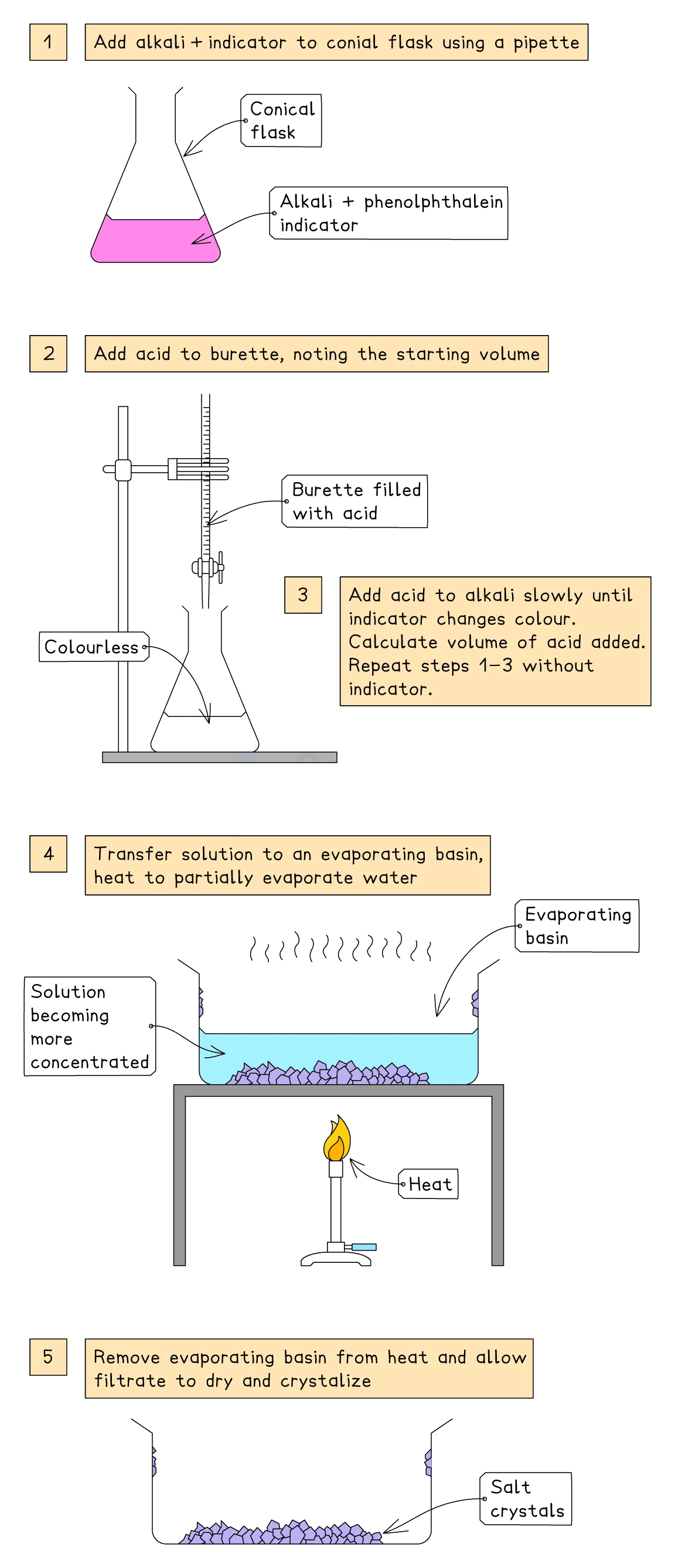
Method B — acid plus an alkali (titration method)
- Used when both reactants are soluble — adding excess of one would just contaminate the salt solution, so a titration is used to find the exact end-point first
- Step-by-step:
- Pipette a fixed volume of the alkali (e.g. 25.0 cm3) into a conical flask with a few drops of indicator
- Titrate with the acid from a burette to find the exact volume needed for neutralisation (see topic 15 section 3 for full titration technique)
- Repeat the reaction without the indicator, using the same volumes that were found in the titration — the resulting solution is now a clean salt solution, free of dye
- Evaporate, cool, decant and dry as in method A
- The indicator-free repeat is essential because the indicator itself would contaminate the salt sample