Acids, Bases and Salt Preparations
Inorganic Chemistry
The principle
- An insoluble salt cannot be crystallised out of a salt-plus-water solution — it would just stay dissolved up to its low solubility
- Instead, the salt is made by precipitation: two soluble salts whose ions can pair up to form the wanted insoluble salt are mixed
AB(aq) + CD(aq) → AD(s) ↓ + CB(aq)
-
One product is the wanted (the insoluble salt); the other product is a soluble salt that stays in the surrounding solution and is washed away
-
The reaction is sometimes called a double displacement or double decomposition reaction
-
Choosing the reactants: pick a soluble salt of each ion that needs to combine — nitrates are always soluble, so a nitrate of the metal is the standard starting material when the salt's other ion is a halide, sulfate or carbonate
-
Step-by-step:
- Measure equal volumes of the two soluble salt solutions of similar concentration into a beaker and stir
- The wanted salt forms immediately as a fine solid suspended in the liquid
- Filter, keeping the residue (the precipitate) on the filter paper
- Wash the residue with distilled water to flush away any soluble salt clinging to the precipitate
- Leave the washed solid to dry on a watch glass in a warm oven
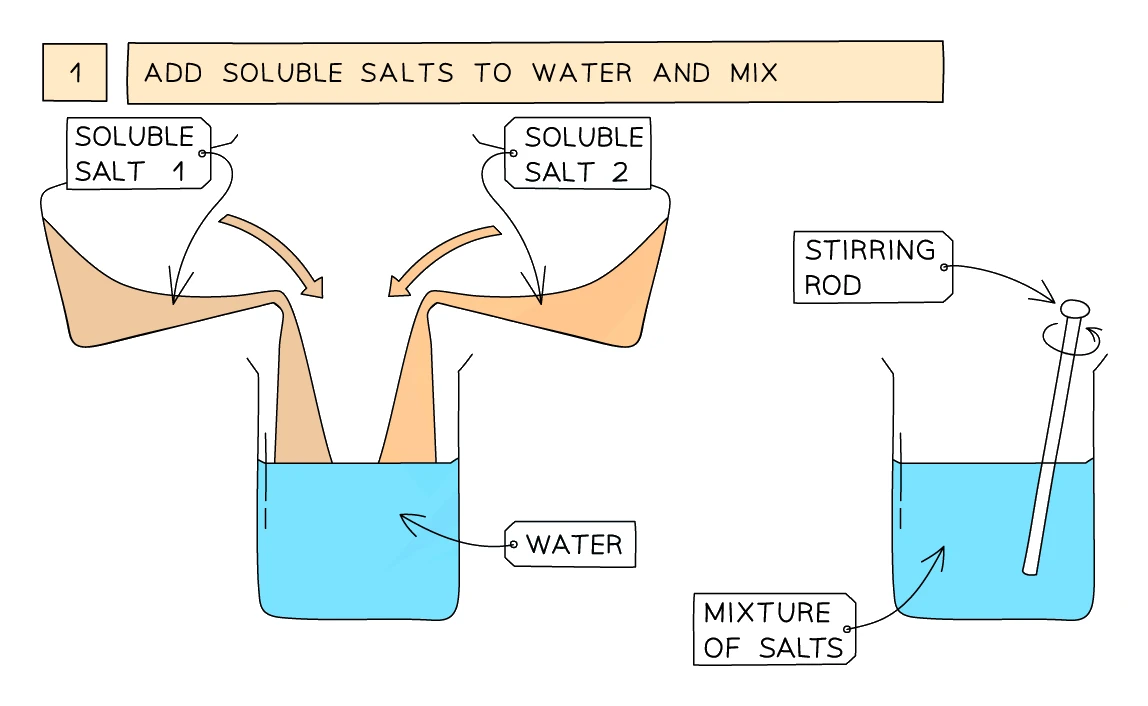
Obtaining a pure, dry sample of an insoluble salt
What comes up: a 3- or 4-mark "describe what to do next" question after two soluble salt solutions have been mixed to form a precipitate.
Write (three marks): (1) filter the mixture to collect the solid precipitate on the filter paper; (2) wash the residue with distilled water to remove any soluble salt clinging to it; (3) dry the solid on filter paper or in a warm oven.
Watch out: drying must be gentle — the mark scheme rejects direct heating with a Bunsen burner for the drying step. Also, if you describe crystallisation steps instead (heating, cooling, re-filtering), you lose most of the marks: the mark scheme awards only 1 mark when an answer treats an insoluble salt as if it were a soluble one.