4BI1
Transport in Plants
Structures and Functions in Living Organisms · 5 question types
Xylem
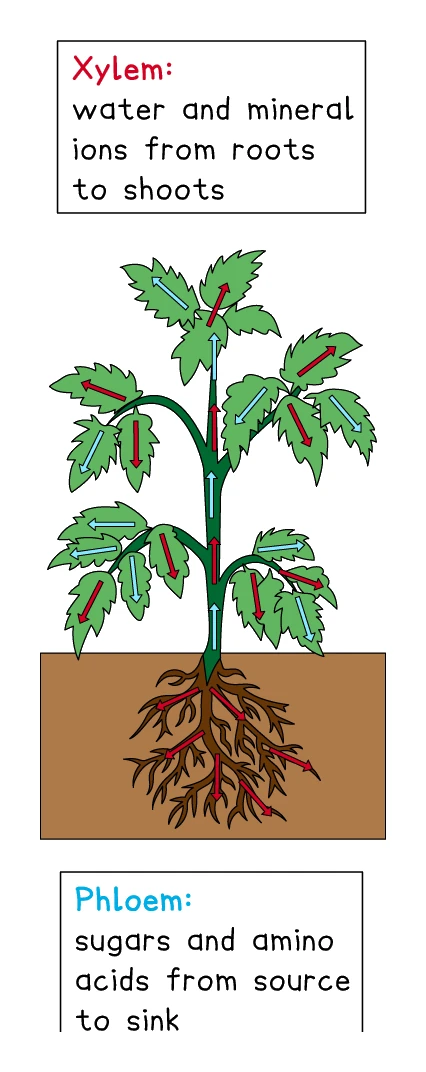
The xylem is the plant's plumbing for water and dissolved minerals. It carries water from the roots upwards to the leaves, where the water is used for photosynthesis and replaces the water lost in transpiration.
Key features of xylem:
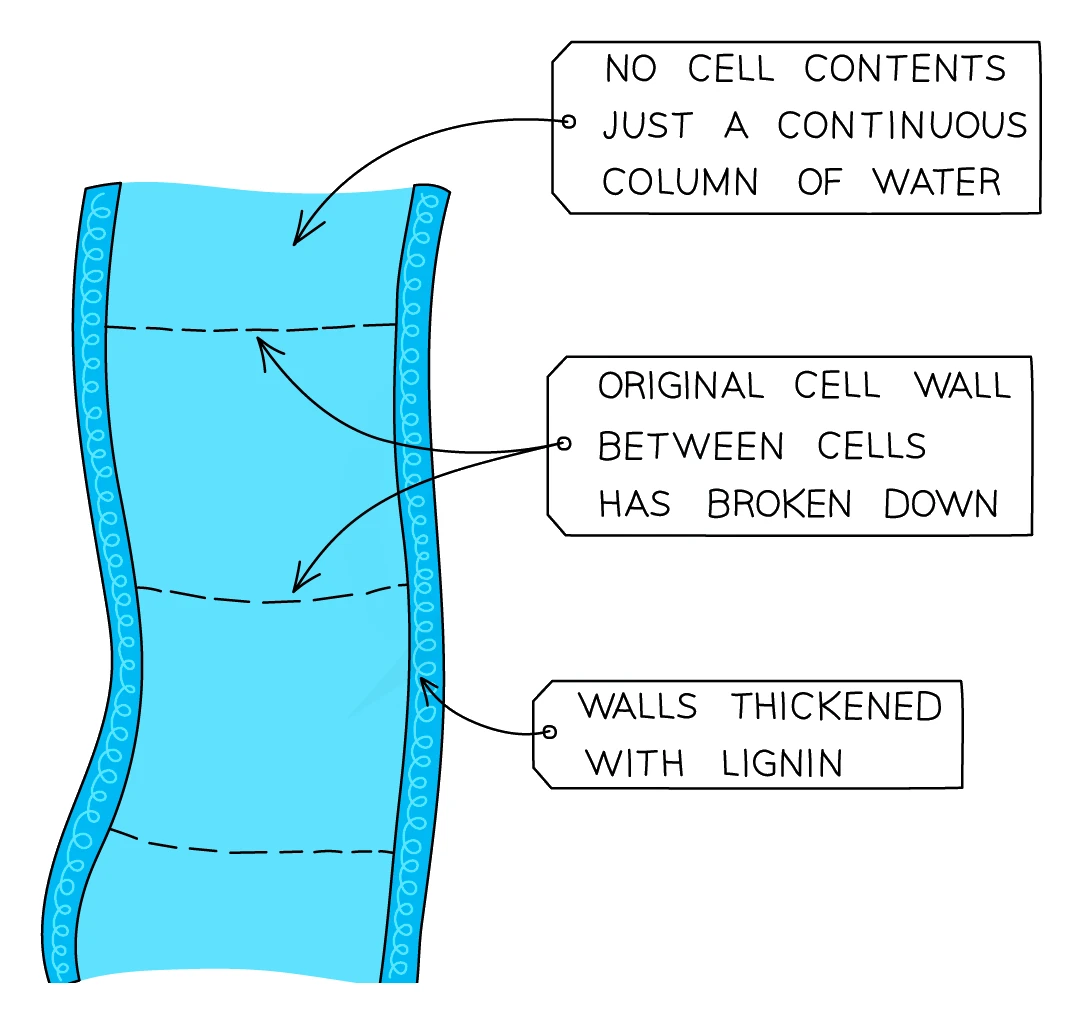
- Made of dead cells stacked end-to-end with the cross-walls removed, forming a long hollow tube (a bit like a stack of empty pipes with the lids taken off).
- The cell walls are reinforced by a tough waterproof material called lignin. Lignin gives xylem its strength and waterproofing, which is why wood (mainly xylem) is so strong.
- Because the cells are dead, the xylem cannot push water; the water moves up by being pulled from above as the leaves transpire (covered in section 4) and by root pressure pushing from below.
- Xylem only carries substances in one direction: upwards from roots to leaves.
What the xylem transports:
- Water from the roots up to every cell that needs it.
- Mineral ions dissolved in the water, such as nitrate (for amino acids and proteins) and magnesium (for chlorophyll).
Phloem
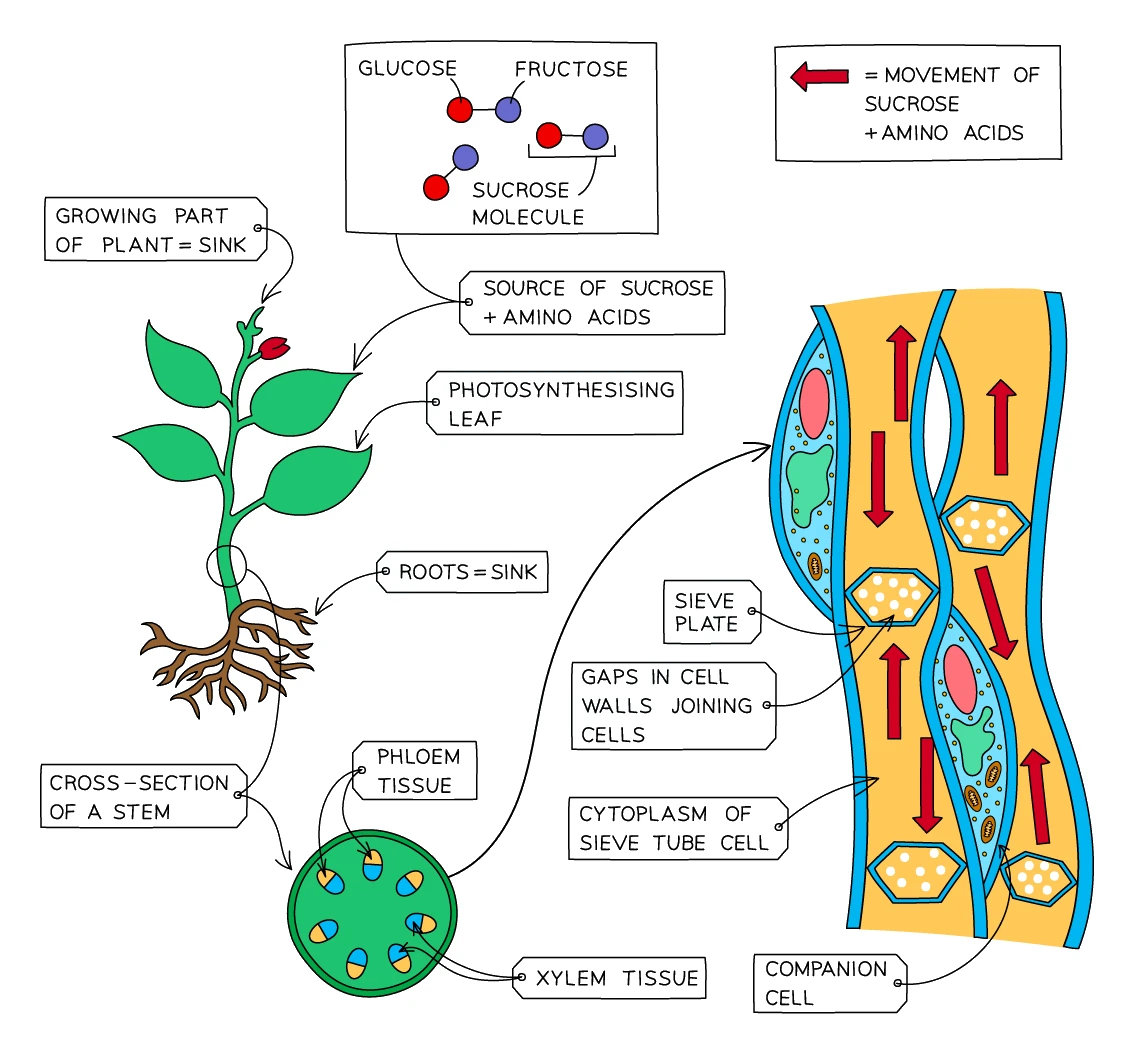
The phloem carries the products of photosynthesis from the leaves (where the plant makes them) to anywhere else in the plant that needs them. This movement is called .
Key features of phloem:
- Made of living cells joined end-to-end, with sieve-like cross-walls between them (called sieve plates) full of small pores that sugars can pass through.
- Cells are connected to neighbouring companion cells that supply the energy for translocation (active transport needs ATP, so the companion cells contain many mitochondria).
- Phloem can carry substances in both directions at the same time, depending on where each substance is needed. Sugars made by photosynthesis in summer might go to the roots for storage; in spring, the same phloem will carry stored sugars from the roots back up to fuel new leaf growth.
What the phloem transports:
- Sucrose (the form in which sugars are transported), made by combining glucose with fructose. Sucrose is more chemically stable than glucose and does not interfere with respiration in the transport cells.
- Amino acids, used everywhere in the plant for protein synthesis.
Side-by-side comparison
| Feature | Xylem | Phloem |
|---|---|---|
| What it carries | Water and dissolved mineral ions | Sucrose and amino acids |
| Direction of flow | Upwards only (roots → leaves) | Both ways (source → sink) |
| Cells alive or dead? | Dead | Living |
| Wall material | Lignin (waterproof, rigid) | Cellulose, with sieve plates between cells |
| Energy required? | No (water is pulled by transpiration) | Yes (active transport, supplied by companion cells) |
| Common name for the process | The transpiration stream | Translocation |