Transport in Plants
Structures and Functions in Living Organisms
The root hair cell
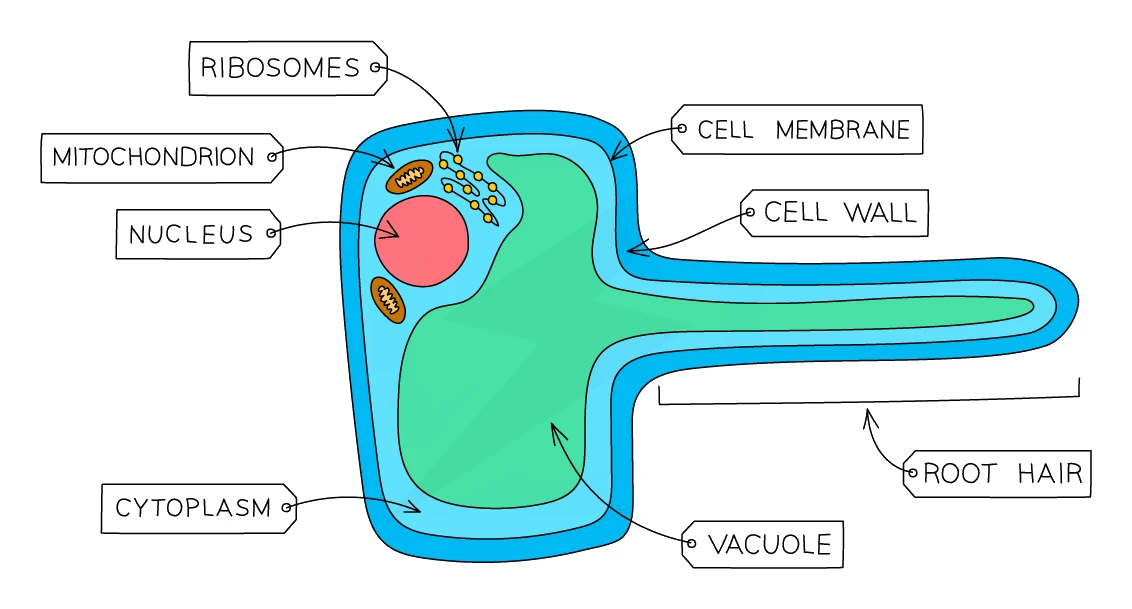
Water and dissolved minerals enter the plant through specialised cells in the roots called root hair cells. Each root hair cell is a single epidermal cell with a long thin extension that sticks out into the soil. Thousands of these hairs cover the surface of every young root, just behind the tip.
Root hair cells are wonderfully adapted for their job:
- Long, thin extension sticking out into the soil, which hugely increases the surface area of the root in contact with soil water. More surface means more water and minerals can be absorbed at once.
- Very thin cell wall so water and ions can move quickly across into the cell.
- No chloroplasts (the root is underground in the dark; chloroplasts would be useless).
- Large permanent vacuole containing a solution of sugars and salts. This makes the inside of the cell more concentrated than the soil water, providing a steep water-potential gradient for osmosis.
- Many mitochondria to supply ATP for the active transport of mineral ions against their concentration gradient.
How water enters the root (osmosis)
Soil water typically has very few dissolved substances. The cytoplasm and vacuole of the root hair cell, in contrast, contain a high concentration of dissolved sugars and salts. Water therefore moves from the soil (high water potential) into the root hair cell (lower water potential) by osmosis through the partially permeable cell membrane.
How mineral ions enter the root (active transport)
Mineral ions such as nitrate and magnesium are present in soil water at very low concentrations but are needed inside the root in much higher concentrations. The plant cannot rely on diffusion, because diffusion would move ions the wrong way (from high to low). Instead, the root hair cells use active transport: protein pumps in the cell membrane use energy from ATP (made by the mitochondria) to pump ions into the cell against their concentration gradient.
This is why root hair cells contain so many mitochondria. Killing a plant root (or starving it of oxygen by waterlogging the soil) shuts down its mitochondria, stops active transport, and the plant quickly suffers a mineral deficiency.
The route of water across the root
Once water has entered the root hair cell, it travels across several layers of cells to reach the xylem at the centre of the root:
root hair cell → root cortex cells → xylem vessels in the centre of the root → up the stem → leaf mesophyll cells
The water moves from one cell to the next by osmosis, always travelling from higher water potential to lower water potential. Once it reaches the xylem, it is pulled up the plant by the (section 4).