Transport in Plants
Structures and Functions in Living Organisms · 5 question types
Transpiration is the evaporation of water vapour from the surface of a plant's leaves, mostly through the in the lower epidermis
Plants lose huge amounts of water this way: a single large oak tree can transpire over 400 litres of water on a hot day. At first this looks wasteful, but transpiration actually does several useful jobs at the same time:
- It pulls water up the xylem from roots to leaves (the ), bringing fresh water to every photosynthesising cell.
- It transports mineral ions dissolved in the water, distributing them around the plant.
- It cools the leaf on a hot day, in the same way that sweat cools your skin: when water evaporates from the leaf surface, it carries thermal energy away with it.
- It keeps the cells in the leaf turgid, which keeps the leaf firm and properly shaped for catching light.
- It supplies water for photosynthesis in the mesophyll cells.
How the transpiration stream works
The mechanism is a pulling chain that stretches from the soil to the sky:
- Water evaporates from the wet surfaces of the spongy mesophyll cells inside the leaf, leaving as water vapour through the stomata.
- As water leaves each mesophyll cell, that cell pulls in fresh water from its neighbour by osmosis (because losing water lowers its water potential).
- Cells closer to the xylem then pull water from the xylem.
- The water column in the xylem is a continuous unbroken thread of water molecules held together by cohesion (hydrogen bonds between water molecules). When the top of the column is pulled, the whole column moves up.
- At the bottom of the plant, fresh water from the soil is pulled into the root hair cells by osmosis to replace what has been lost.
So transpiration at the leaves drives water uptake at the roots. Water flows up the xylem in a continuous stream.
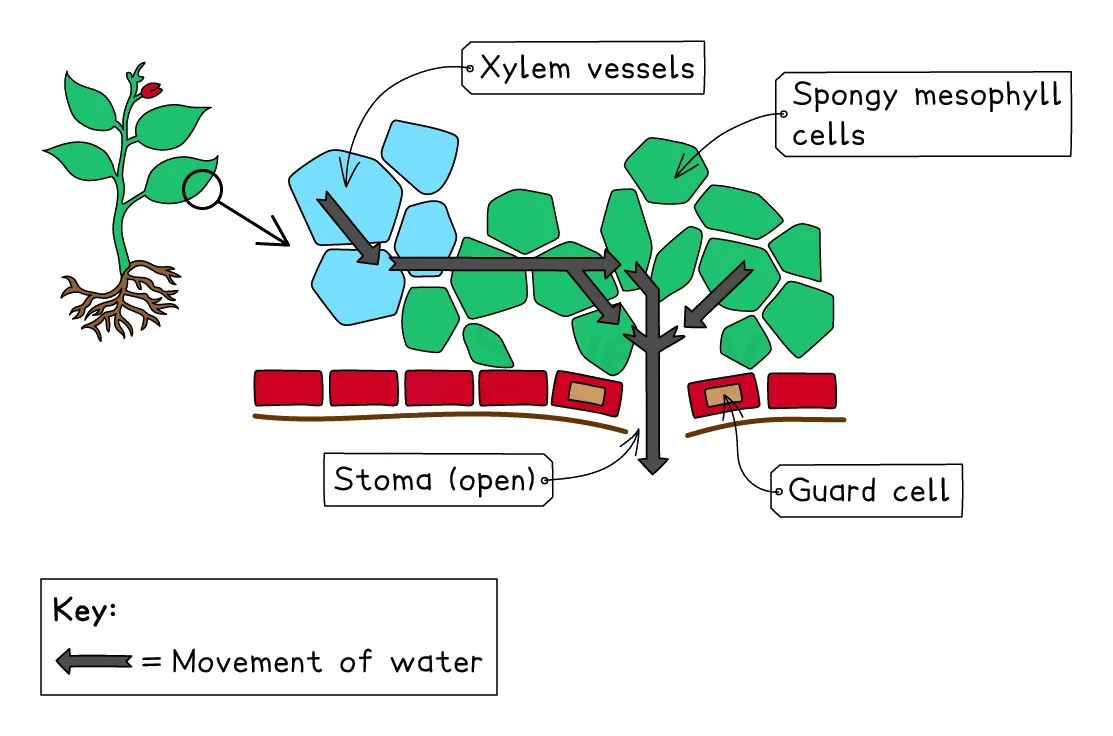
Explain the role of stomata in water transport in the plant
What comes up: a 2-mark question asking you to explain how stomata are involved in moving water through the plant — not just that water leaves through them, but the consequence.
Write (two marks): (1) Water evaporates from the wet surfaces of mesophyll cells and diffuses out as water vapour through the stomata (transpiration). (2) This water loss creates a lower water potential in the leaf, which draws water up from the roots through the xylem (the transpiration stream/water-potential gradient).
Watch out: writing only that "stomata allow water to leave" earns just one mark. The second mark requires you to link the evaporation at the stomata to the pulling of water up from the roots. Both parts of the mechanism must be stated.
Stomata: open by day, closed by night
Stomata are tiny pores in the leaf surface (mostly on the underside), each surrounded by a pair of bean-shaped guard cells that control whether the pore is open or closed.
- In daylight, the guard cells take in water by osmosis and become turgid. Their unusual shape means that as they swell, they bend outwards, opening the stoma. Gases can move in and out freely, allowing photosynthesis to happen.
- At night, the guard cells lose water and become flaccid. They flop back together and close the stoma, reducing water loss when photosynthesis is not happening anyway.
- If the plant is short of water, the guard cells close the stomata even during the day to limit water loss. This stops photosynthesis but saves the plant from wilting.