Transport in Plants
Structures and Functions in Living Organisms · 5 question types
A potometer is a piece of apparatus that measures how fast a plant cutting is taking up water. Since almost all of the water taken up is then lost through transpiration, the rate of water uptake is a very close measure of the rate of transpiration.
Apparatus: the bubble potometer
The bubble potometer is a sealed glass tube system with a leafy shoot at the top, a horizontal scaled capillary tube at the bottom, and a reservoir for refilling. A single air bubble sits in the capillary tube and gets pulled along as the shoot draws up water. The distance the bubble moves in a fixed time is the measure of water uptake.
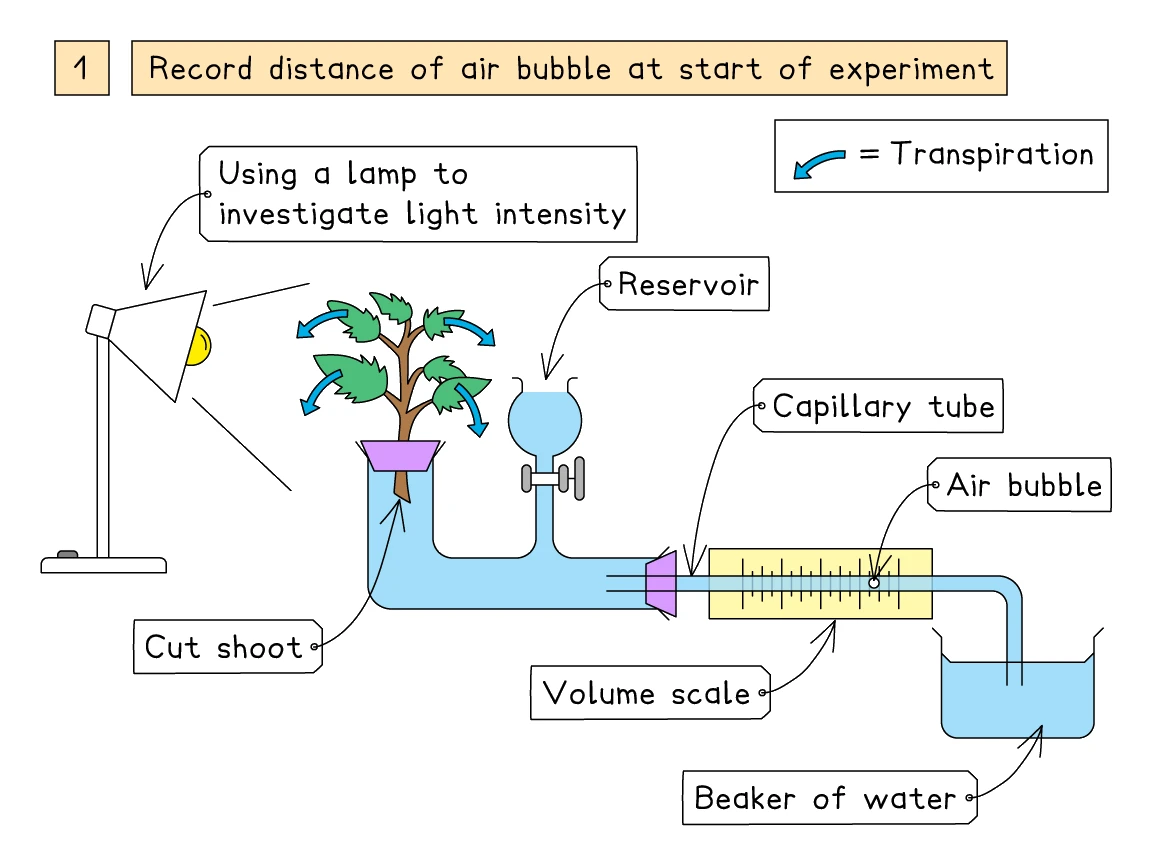
You also need:
- A freshly cut leafy shoot
- A stopwatch
- A lamp (for the light-intensity experiment) or a fan, a plastic bag, or a heater (for the other factors)
- A ruler (often built into the apparatus)
- Petroleum jelly (to seal joints)
Method (testing light intensity as an example)
- Cut a leafy shoot underwater to prevent any air entering the cut end of the xylem. An air bubble inside the xylem would block water uptake.
- Slide the shoot into the rubber bung at the top of the potometer (also underwater) and assemble the apparatus, sealing every joint with petroleum jelly so it is airtight.
- Lift the end of the capillary tube out of the water reservoir briefly to introduce a single air bubble. Lower it back in.
- Place a lamp 10 cm from the leaves and leave the plant to settle for 5 to 10 minutes so the rate becomes steady.
- Record the starting position of the bubble on the scale.
- Start the stopwatch and leave for 30 minutes.
- Record the ending position of the bubble.
- Reset the bubble using the reservoir tap.
- Move the lamp further away (to 20 cm, 40 cm, etc.) and repeat steps 4–8.
Calculating the rate of transpiration
For each lamp distance:
distance moved by bubble (mm) = end position − start position
rate of water uptake (mm/min) = distance moved ÷ time
You will normally find the rate is highest at the closest lamp distance (highest light intensity), and falls as the lamp is moved further away.
Variables to control
- Independent variable (the one you change): the factor under test (light intensity, temperature, wind speed, or humidity).
- Dependent variable (what you measure): rate of water uptake (distance moved by bubble per unit time).
- Control variables: the same shoot, the same number of leaves, the same total leaf area, the temperature of the room, the assembly time, and the time of day.
Investigating the other factors
The same apparatus can be used to test temperature, humidity and wind speed, by changing one variable at a time:
| Factor | How to vary it |
|---|---|
| Wind speed | Direct a fan or hairdryer at the leaves at different distances or speeds |
| Humidity | Spray water inside a clear plastic bag, then wrap it around the leafy shoot |
| Temperature | Move the apparatus between rooms (cold and warm) or place near a heater |
Limitations
- The lamp emits heat as well as light, so changing lamp distance changes both light intensity and temperature. Use an LED bulb (less heat) or place a beaker of water between lamp and plant as a heat shield.
- The room's temperature, humidity and air movement are hard to keep constant from one repeat to the next. Conduct all measurements in the same place at the same time of day.
- The shoot only carries a small leaf area, so any leak or air bubble in the xylem causes a large error. Take care to cut underwater and to seal every joint thoroughly with petroleum jelly.
- The potometer measures water uptake, not transpiration directly. A small fraction of the water taken up goes into building new tissue or is used in photosynthesis rather than evaporating, so the rate is a slight overestimate of true transpiration. The difference is normally too small to worry about.