4BI1
Respiration
Structures and Functions in Living Organisms · 7 question types
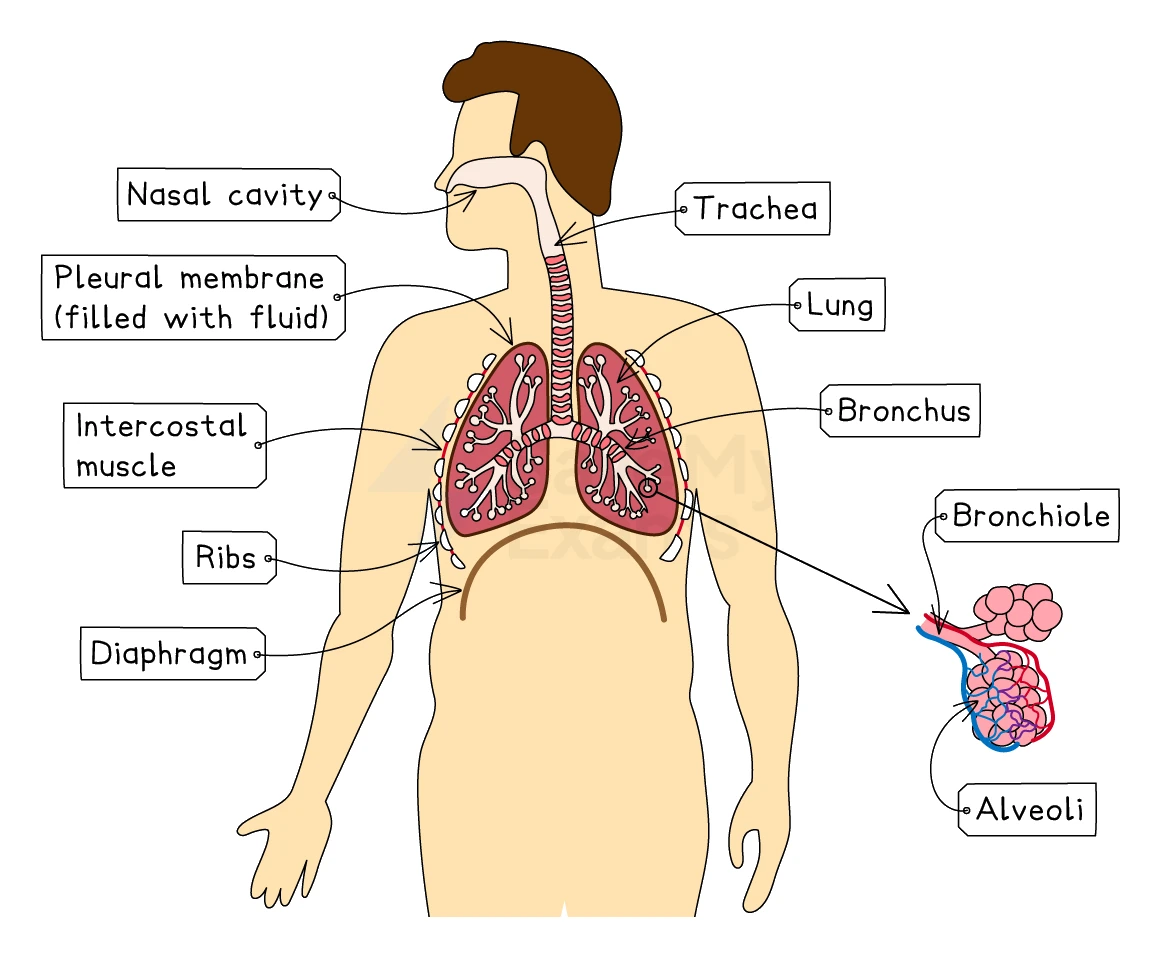
The human gas-exchange organ is the lungs, housed inside the thorax (the chest cavity above the diaphragm). The thorax contains:
| Structure | What it does |
|---|---|
| Ribs | A bony cage that protects the lungs and the heart, and provides anchor points for the muscles that move air in and out |
| Intercostal muscles | Two layers of muscle between each pair of ribs. The external intercostals pull the ribs up and out during inhalation; the internal intercostals pull the ribs down and in during forced exhalation |
| Diaphragm | A thin sheet of muscle below the lungs separating the thorax from the abdomen. It contracts and flattens during inhalation and relaxes back into a dome shape during exhalation |
| Trachea (windpipe) | The single tube carrying air from the throat down towards the lungs. Held open by C-shaped rings of cartilage so it cannot collapse |
| Bronchi (singular: bronchus) | The two large tubes that branch off the trachea, one to each lung |
| Bronchioles | Smaller and smaller tubes that branch out from the bronchi, like the twigs on a tree |
| Alveoli (singular: alveolus) | Tiny balloon-like air sacs at the very end of each bronchiole. This is where gas exchange happens |
| Pleural membranes | Thin double-layered membranes that surround each lung and line the inside of the thorax, with a slippery fluid in between so the lungs can move smoothly against the chest wall |
Order of air flow during inhalation:
mouth/nose → trachea → bronchus → bronchioles → alveoli