Respiration
Structures and Functions in Living Organisms · 7 question types
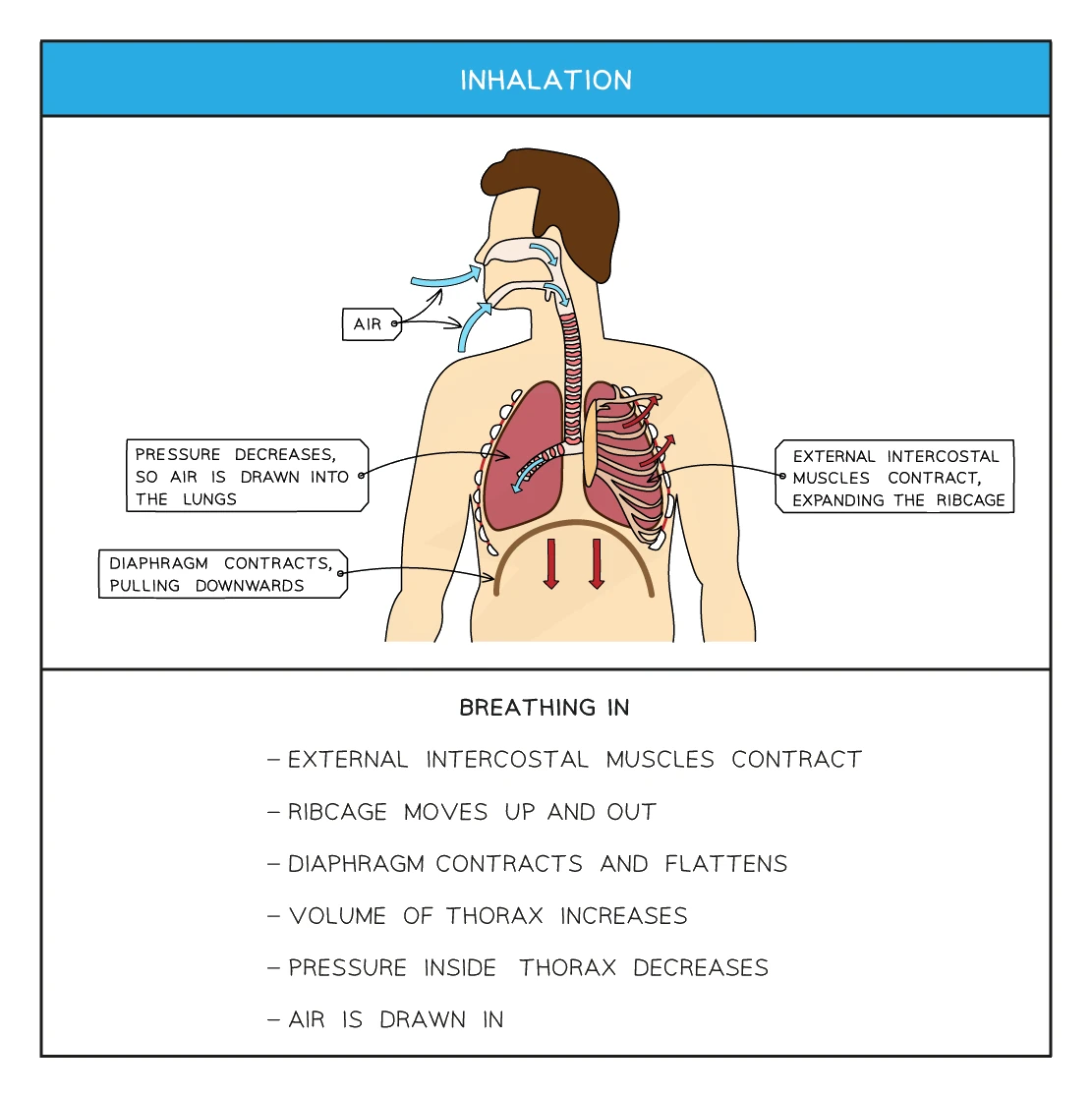
Muscles can only pull, never push. So breathing relies on two sets of muscles working as antagonistic pairs, plus the diaphragm, to change the volume of the thorax. Because gas pressure depends on volume, changing the volume forces air to flow in or out.
Inhalation (breathing in)
- The external intercostal muscles contract, pulling the rib cage up and out.
- The contracts, flattening from its dome shape downwards.
- Both of these increase the volume of the thorax.
- The pressure inside the lungs falls below atmospheric pressure.
- Air rushes in from the outside, down the trachea, through the bronchi and bronchioles, until it fills the alveoli.
Normal exhalation (breathing out)
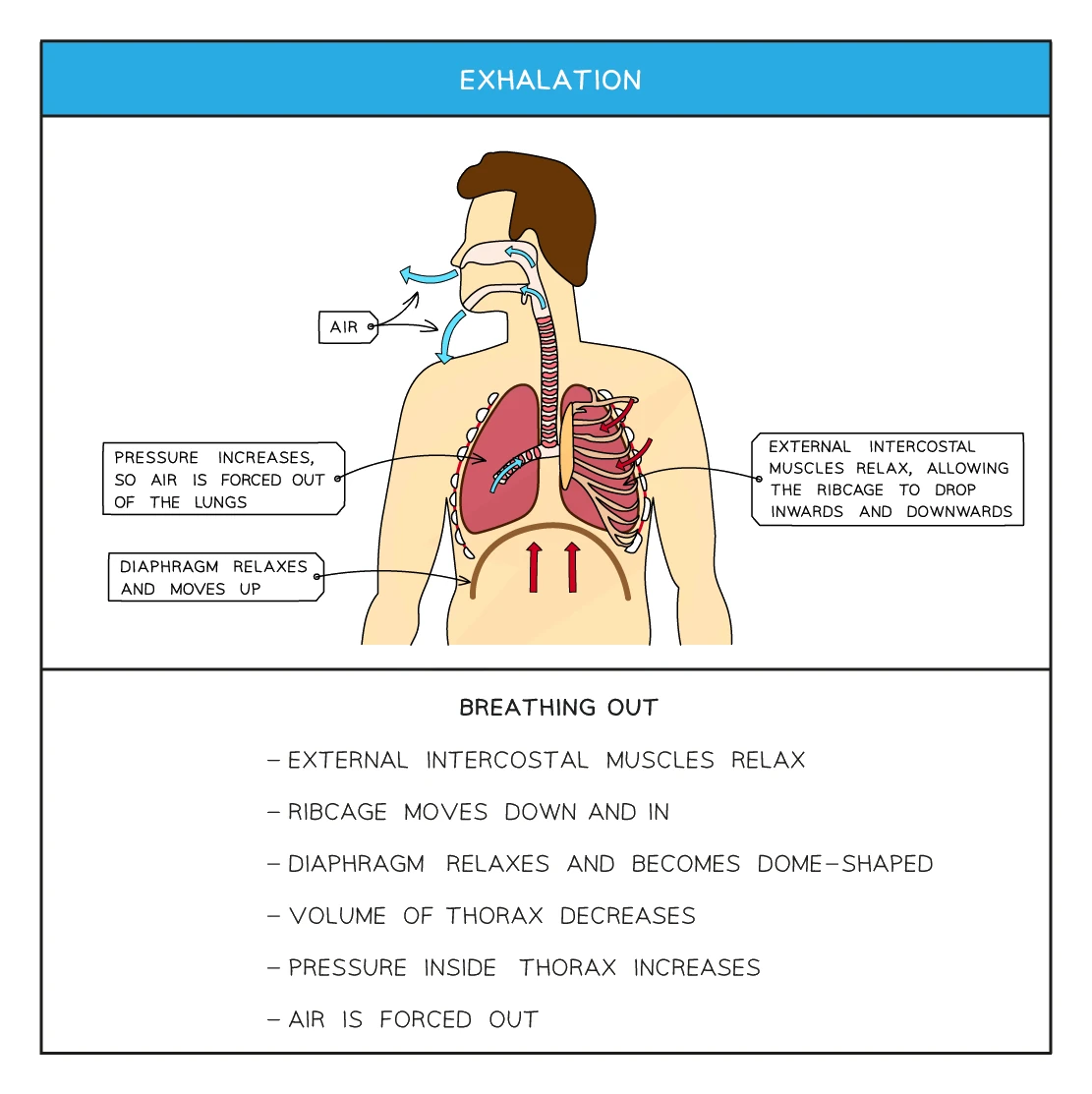
- The external intercostal muscles relax, so the rib cage drops down and inwards under its own weight.
- The diaphragm relaxes, returning to its dome shape pushing up into the thorax.
- The volume of the thorax decreases.
- The pressure inside the lungs rises above atmospheric pressure.
- Air is pushed out of the lungs along the same path in reverse.
Normal exhalation is passive, relying on the elastic recoil of the lungs and rib cage. The internal intercostal muscles do not contract during normal breathing.
Forced exhalation (during exercise)
During hard exercise, the body needs to clear CO₂ much faster. The internal intercostal muscles contract, actively pulling the rib cage further down and in. This reduces the thorax volume even more, forcing air out faster. The two intercostal muscle layers are working as antagonistic pairs: when one contracts the other relaxes.
| Stage | External intercostals | Diaphragm | Thorax volume | Air pressure in lungs | Air flow |
|---|---|---|---|---|---|
| Inhalation | Contract | Contract (flattens) | Increases | Decreases | In |
| Normal exhalation | Relax | Relaxes (domes up) | Decreases | Increases | Out |
| Forced exhalation | Relax (internal intercostals contract) | Relaxes more | Decreases more | Increases more | Out faster |