Respiration
Structures and Functions in Living Organisms · 7 question types
Showing that respiration produces carbon dioxide
Principle: living cells release carbon dioxide during respiration. Limewater (calcium hydroxide solution) turns cloudy white when carbon dioxide is bubbled through it, so it can be used to detect the CO₂ given off by a respiring organism.
Apparatus: three sets of boiling tubes, each containing a delivery tube that bubbles into a second boiling tube of limewater. The three test tubes hold:
- Tube A: 10 germinating peas on damp cotton wool (the test)
- Tube B: 10 boiled (dead) peas on damp cotton wool (control for whether the organism is alive)
- Tube C: 10 glass beads on damp cotton wool (control for whether the seed material itself matters)
Method:
- Set up the three identical test tubes as above, each sealed with a bung connected by a delivery tube to a fresh tube of limewater. Make sure each delivery tube dips below the limewater so any gas bubbles through it.
- Leave the whole apparatus in a warm place (25–30 °C) for several hours or overnight.
- Check each limewater tube for cloudiness.
Expected results:
| Tube | What's inside | Limewater result | Why |
|---|---|---|---|
| A | Germinating peas | Cloudy | The seeds are alive and respiring, releasing CO₂ |
| B | Boiled peas | Stays clear | Boiling killed the cells, so they cannot respire |
| C | Glass beads | Stays clear | No living material, no respiration |
The boiled-seed control rules out the possibility that the seed material (rather than living respiration) is releasing CO₂. The glass-bead control rules out the apparatus or air itself being responsible.
Comparing inhaled and exhaled air
Question: Name the solution that compares carbon dioxide in inhaled and exhaled air, explain the change in each tube, or explain why the gas percentages differ (1–3 marks per part).
Asked in 3 of the 23 papers. Name limewater or hydrogen carbonate indicator. Exhaled air goes through the tube that dips into the liquid; you could not inhale through it without sucking liquid up. That tube goes cloudy or milky (yellow with the indicator), while the inhaled-air tube stays clear (stays red or orange), or changes slowly, because exhaled air carries more carbon dioxide, made by respiration. Colours must match the solution named, "changes colour" scores nothing, and "cloudy in both" earns one mark at most. Inhaled air has less carbon dioxide, not none.
For gas percentages: oxygen diffuses into the blood and is used in respiration, carbon dioxide is produced by respiration, and nitrogen is not used. Exhaled air is also warmer and holds more water vapour.
Showing that respiration releases heat
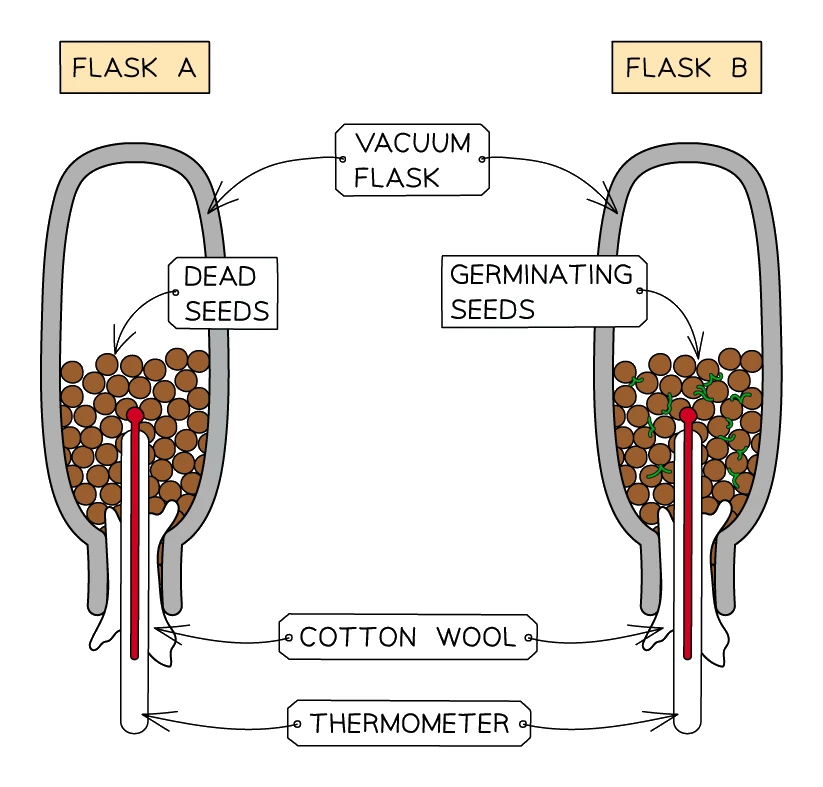
Principle: aerobic respiration releases energy, and not all of that energy is captured as ATP. A noticeable fraction is released as heat, which can be detected with a thermometer in a well-insulated container.
Apparatus: two vacuum flasks, each containing a thermometer and damp cotton wool. The flasks are inverted (mouth-down) so warm air does not simply float out. One flask holds germinating seeds, the other holds boiled (dead) seeds as a control.
Both the seeds and the flasks are first sterilised with weak bleach to kill any microbes. This step is crucial: without it, microbes growing on the seeds will respire themselves and produce heat, giving misleading results.
Method:
- Sterilise both flasks and both sets of seeds with weak bleach.
- Place boiled seeds in flask A and germinating seeds in flask B.
- Insert a thermometer into each flask with the bulb buried in the seeds.
- Plug the mouth of each flask with cotton wool (holds the thermometer in place and reduces heat loss).
- Invert the flasks and leave them in a place with constant room temperature for 2–3 days.
- Record the temperature inside each flask at the start and at the end.
Expected results: the temperature in the flask with germinating seeds rises by several degrees (e.g. 20 °C → 25 °C). The temperature in the flask with dead seeds stays the same as the room.
Explaining the effect of temperature on respiration rate
Question: Explain the effect of increasing the temperature on the rate of gas production by yeast, or on how far the bubble moves in a respirometer (3–4 marks).
Asked in 4 of the 23 papers, and the marks are enzyme marks. Warmer molecules have more kinetic energy and move faster, so enzyme and substrate collide more often and form more enzyme-substrate complexes, so the rate of respiration rises (in a respirometer more oxygen is used up, so the bubble moves further). Give the energy to the molecules, not to the bubble, and do not simply restate that the bubble moves more, which is not credited. Where the range runs past the optimum, or no range is given, add the third step: the active site changes shape, the substrate no longer fits and the enzyme denatures (the enzyme, never "the yeast"). Where the rise stops short of the optimum, the credited idea is that the enzymes are nearer their optimum temperature.