Respiration
Structures and Functions in Living Organisms · 7 question types
Each lung contains roughly 300 million , the tiny air sacs at the very end of each bronchiole. The alveoli are where oxygen actually crosses from the air into the blood, and where CO₂ goes the other way.
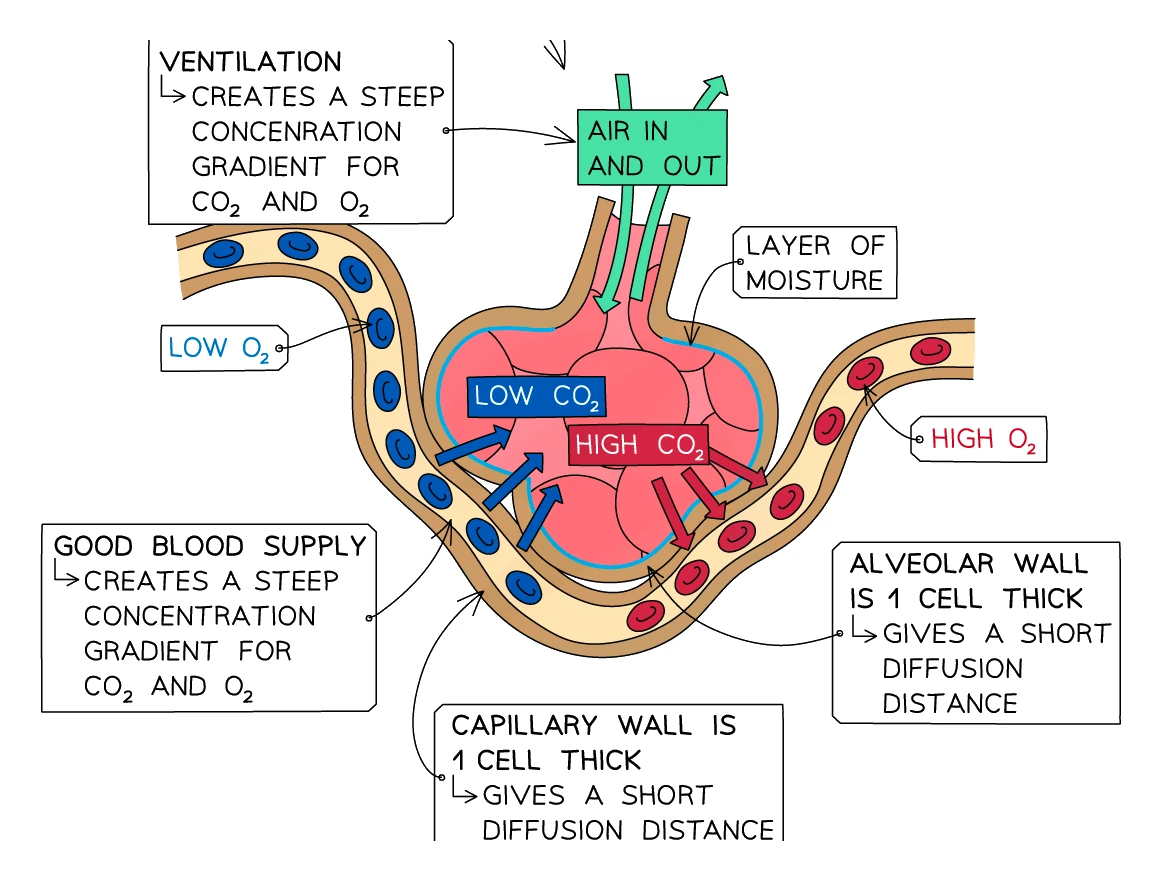
How the alveoli are adapted for gas exchange
Each adaptation matches one of the four general features of a good exchange surface:
- Large surface area: there are hundreds of millions of alveoli per lung. If you flattened all the alveolar walls of one human's lungs into a single sheet, the area would be around 70 m², about half a tennis court.
- Thin walls: each alveolus is just one cell thick, and so are the capillaries wrapped around it. The total diffusion distance from air to blood is therefore only about 0.5 μm.
- Steep concentration gradient: maintained by two things working together. The lungs are constantly ventilated with fresh air (rich in oxygen, low in CO₂), and the capillaries are constantly carrying blood away (taking the absorbed oxygen with it, replacing it with deoxygenated blood).
- Moist surface: each alveolus is lined with a thin film of fluid. Oxygen and CO₂ both dissolve in this fluid before crossing the cell wall.
Explain two ways a single alveolus is adapted for gas exchange
What comes up: a 4-mark "explain" question (marked in pairs) asks for two structural adaptations of an alveolus and the reason each adaptation helps gas exchange.
Write (four marks, mark in pairs — must give structure AND its function): (1) the alveolar wall (and surrounding capillary wall) is one cell thick / very thin membrane → so the diffusion distance is short, allowing rapid diffusion; (2) the alveolus has a rich blood / capillary supply → this maintains a steep concentration gradient by continuously removing absorbed oxygen and delivering CO₂. A third credited pair is: the inner surface is moist / lined with fluid → gases dissolve in the fluid so they can diffuse through the cell wall.
Watch out: the mark scheme awards the function mark only if the correct structure is named first — you cannot score the function mark alone. Importantly, the mark scheme explicitly ignores mentions of large surface area for this question (surface area is a feature of the whole lung, not a single alveolus) — focus on thin walls, blood supply, and moisture instead.
Direction of diffusion
- Oxygen moves into the blood, from a high concentration in the alveolar air to a lower concentration in the deoxygenated blood arriving in the capillaries.
- Carbon dioxide moves out of the blood, from a high concentration in the arriving blood to a lower concentration in the alveolar air, then is breathed out.