Homeostasis
Structures and Functions in Living Organisms · 4 question types
The three homeostatic systems covered here (or referenced from other topics) all use the same general structure:
| Variable | Receptor | Coordinator | Effector | Hormone(s) involved |
|---|---|---|---|---|
| Body temperature | Temperature receptors in skin and hypothalamus | Hypothalamus | Skin (sweat glands, arterioles, hair muscles), skeletal muscle (shivering) | None directly; nervous coordination |
| Blood glucose | Cells in the pancreas | Pancreas | Liver, muscles | Insulin (lowers), glucagon (raises) |
| Blood water content | Osmoreceptors in hypothalamus | Hypothalamus → pituitary gland | Kidneys (collecting ducts) | ADH |
In each case the principle is the same: detect the change, respond with the opposite, restore the norm. Once you understand this pattern, every homeostatic system in the body fits the same template.
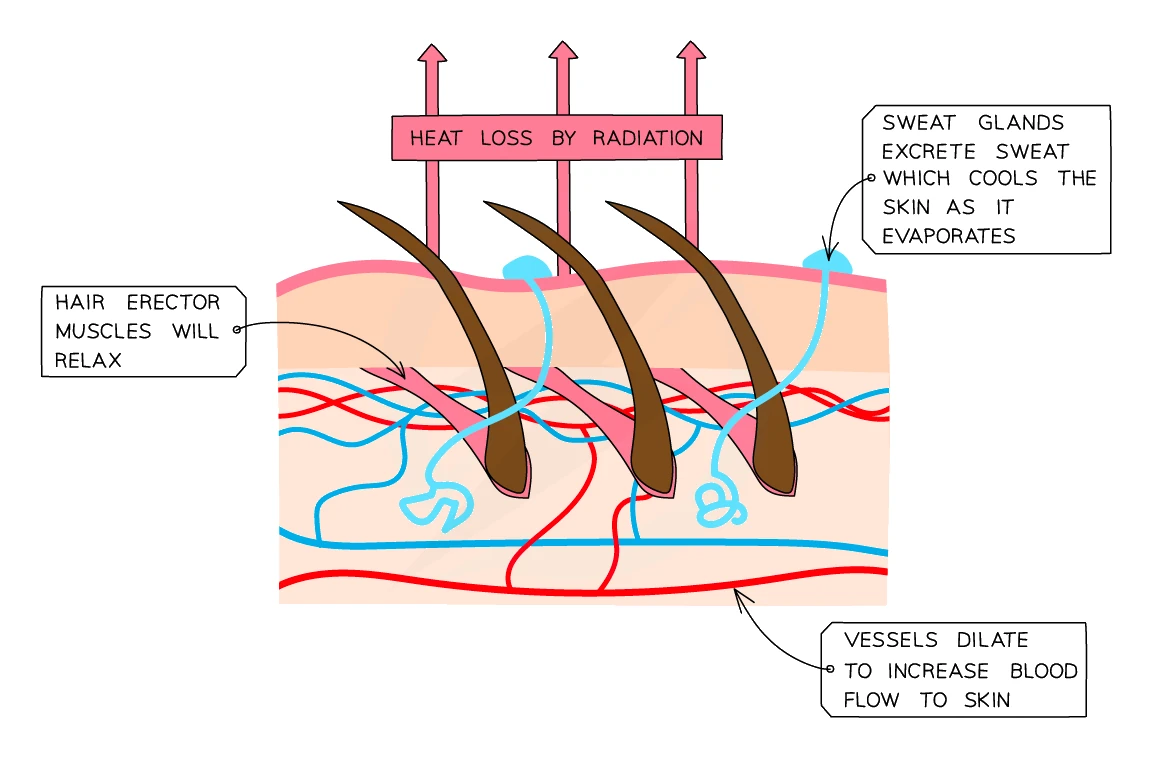
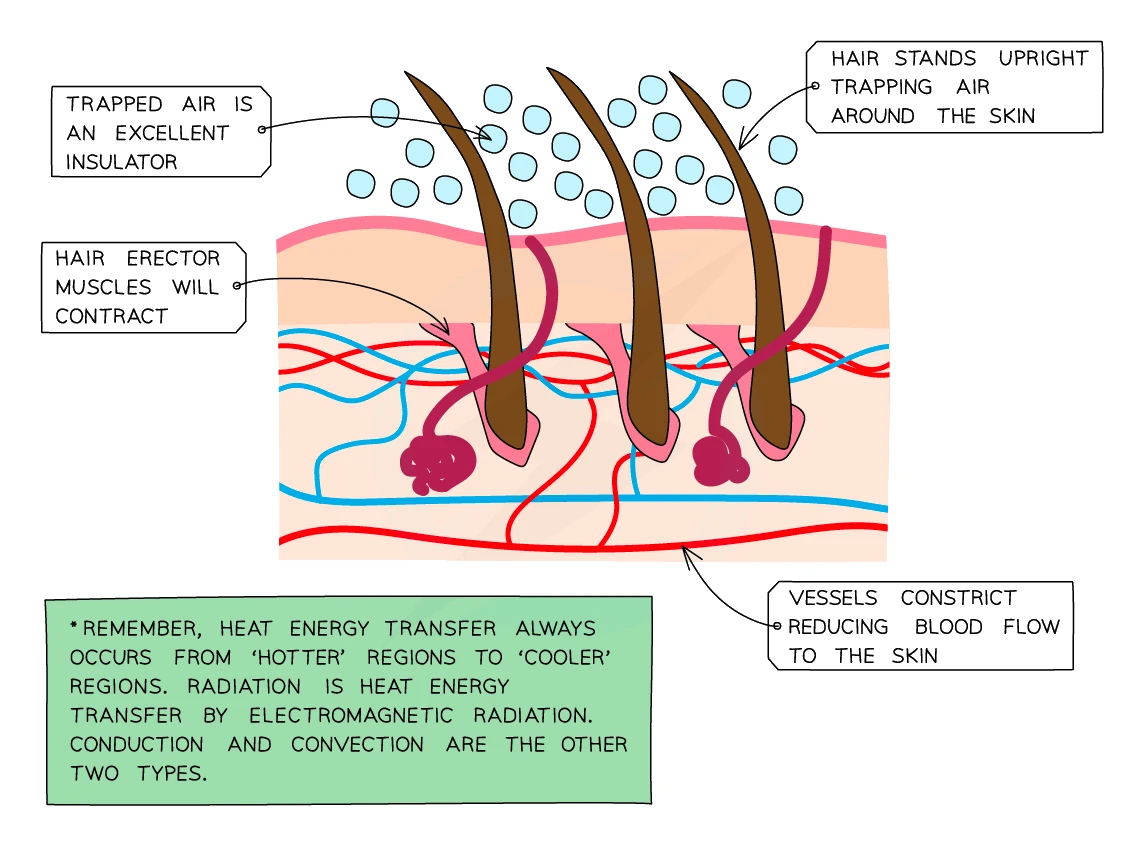
Describing how the skin responds to heat and cold
What comes up: describe the changes in skin blood vessels when a person moves into a hot environment (3 marks), or describe how the skin responds when entering a cold environment (4 marks).
Write — too hot (three marks, any three): (1) vasodilation occurs; (2) the arterioles supplying capillaries near the skin surface widen/dilate; (3) more blood flows near the skin surface; (4) more heat is lost (by radiation or convection).
Write — too cold (four marks, any four): (1) vasoconstriction occurs; (2) the arterioles supplying the skin capillaries narrow/constrict; (3) less blood flows to the skin surface; (4) hair erector muscles contract so hairs stand upright, trapping a layer of insulating air; (5) less heat is lost.
Watch out: the mark scheme rejects "capillaries dilate/constrict" — it is the arterioles that change diameter. It also rejects "blood vessels move to the surface" — blood vessels do not move; the change is in the width of the arterioles. For the cold response, the mark scheme ignores shivering (it is not credited for the skin-changes question).