Homeostasis
Structures and Functions in Living Organisms · 4 question types
Osmoregulation is the control of the water content and solute concentration of the body fluids, keeping them within a narrow range
Body cells only work properly when surrounded by tissue fluid with the right water concentration. If the surrounding fluid is too concentrated (too little water), water leaves cells by osmosis and they shrivel. If the surrounding fluid is too dilute (too much water), water enters cells by osmosis and they swell or burst.
The body's water balance therefore has to be tightly controlled in spite of the constant inputs and outputs of water:
| Water IN | Water OUT |
|---|---|
| Drinks | Urine |
| Food | Sweat (skin) |
| Aerobic respiration (a small amount) | Breath (lungs) |
| Faeces (a small amount) |
Most water inputs and outputs are roughly self-balancing: if you drink more, you produce more urine. But to keep blood water concentration steady from minute to minute, the body adjusts how much water the kidneys keep back from the urine.
The role of ADH
The hormone ADH (antidiuretic hormone), released by the pituitary gland in the brain, controls the kidney's water reabsorption. ADH was covered in detail in topic 9 (Excretion); the summary here is enough for the homeostasis perspective.
The negative feedback loop:
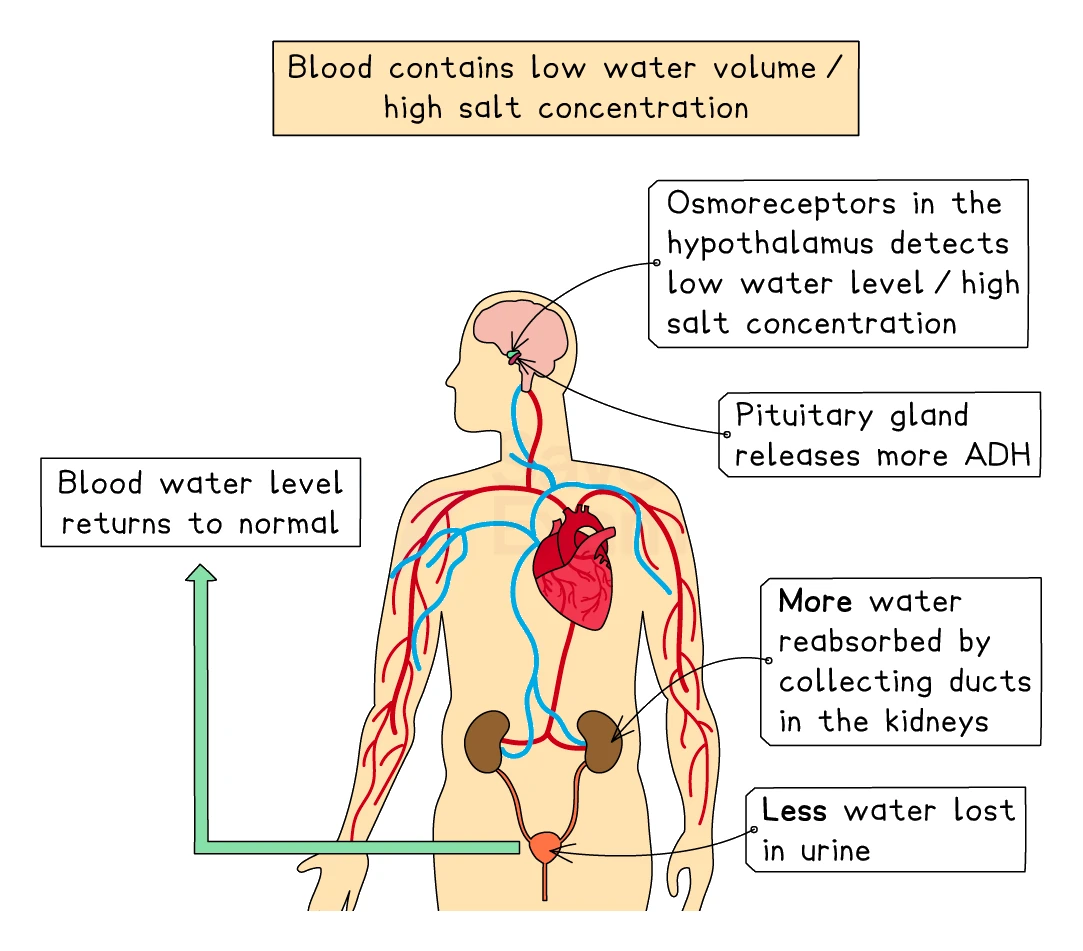
When blood water is too LOW (dehydrated, blood too concentrated):
- Osmoreceptors in the detect the increase in blood solute concentration.
- The hypothalamus signals the pituitary gland to release more ADH.
- ADH makes the kidney's collecting ducts more permeable to water.
- More water is reabsorbed from the filtrate back into the blood.
- A small volume of concentrated (dark) urine is produced.
- Blood water concentration rises back to normal.
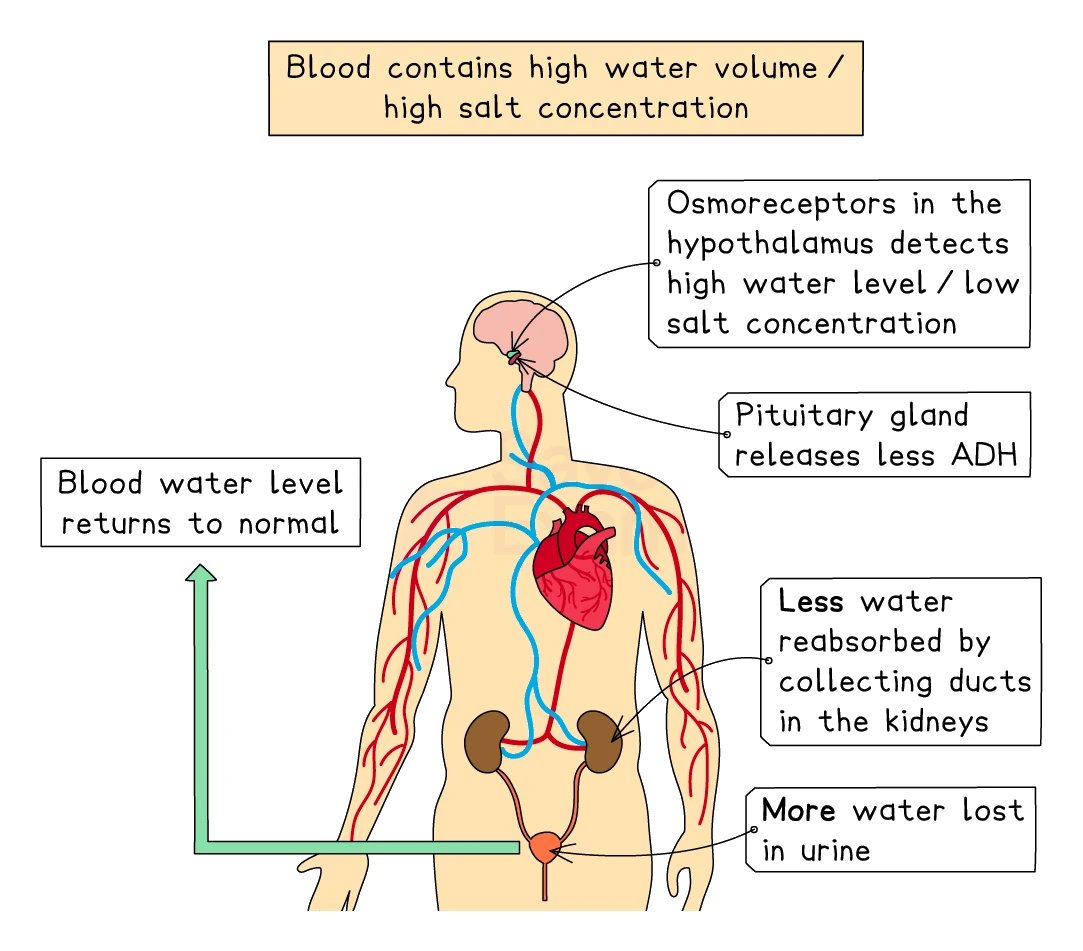
When blood water is too HIGH (over-hydrated, blood too dilute):
- Osmoreceptors detect the decrease in blood solute concentration.
- The pituitary releases less ADH.
- The collecting ducts become less permeable to water.
- Less water is reabsorbed; more stays in the filtrate.
- A large volume of dilute (pale) urine is produced.
- Blood water concentration falls back to normal.
You will also feel thirsty when blood water is low, prompting you to drink more water. The thirst response and the ADH response work together.
Why drinking very salty water makes you more thirsty
Sea water is much more concentrated than blood plasma. If you drink sea water, the salt enters your blood and raises the blood's solute concentration even further. The body responds as if dehydrated: it tries to produce concentrated urine to get rid of the extra salt, but to do so it has to use up even more of the body's water. The net effect is to make the body more dehydrated than before. This is why drinking sea water when stranded does not save you and can speed up your death from thirst.