Genetics & Inheritance
Reproduction and Inheritance
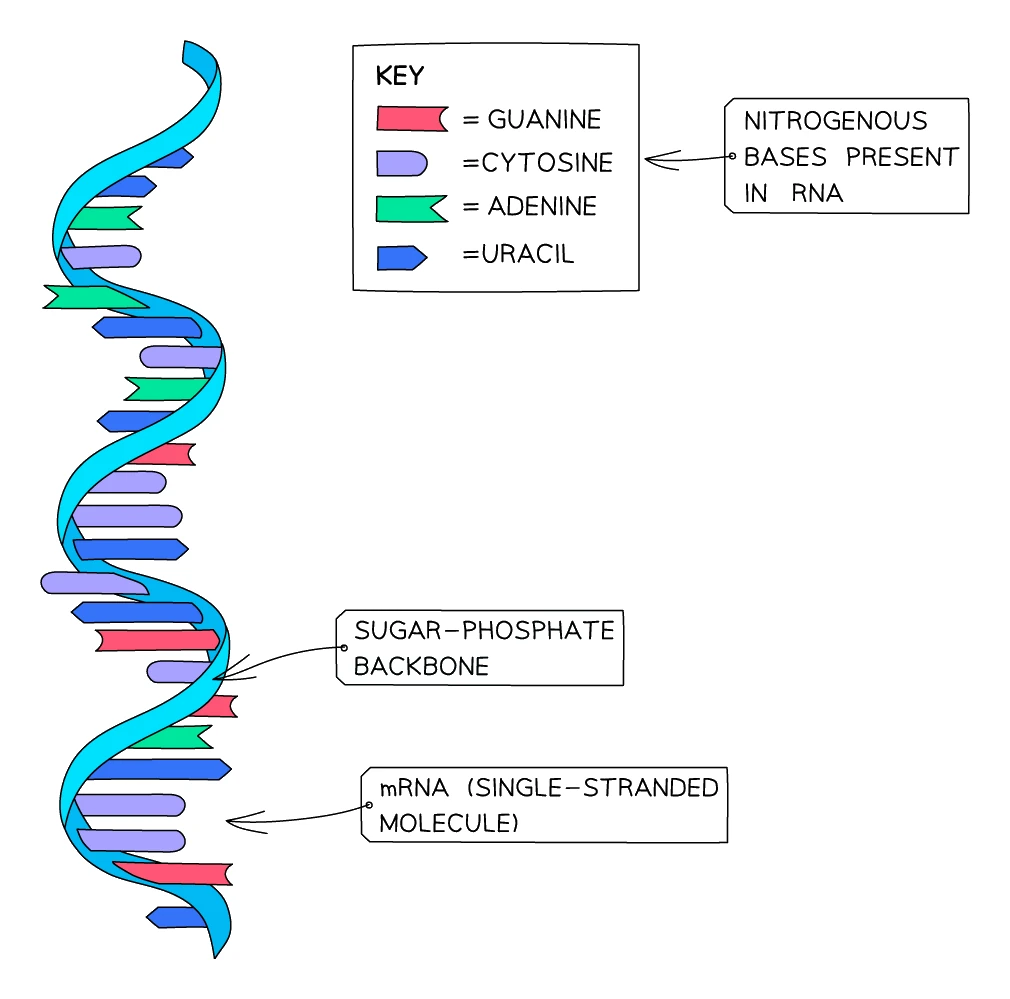
RNA (ribonucleic acid) is the messenger molecule that carries the instructions in a gene from the nucleus to the place where proteins are made. RNA is similar to DNA but with three important differences:
| Feature | DNA | RNA |
|---|---|---|
| Number of strands | Two (double helix) | One (single strand) |
| Sugar | Deoxyribose | Ribose |
| Bases used | A, T, G, C | A, U, G, C (uracil replaces thymine) |
| Length | Long (entire chromosomes) | Short (a copy of one gene) |
| Location | In the nucleus | Made in the nucleus, used in the cytoplasm |
In RNA, uracil (U) plays the role that thymine (T) plays in DNA, so the new pairing rules are:
- A pairs with U (in RNA-DNA pairing)
- G pairs with C
Common exam question
Writing a complementary DNA or mRNA sequence
Question: Give, or choose from four options, the base sequence of the other DNA strand, or of the mRNA made from a strand of DNA (1–2 marks).
Set in 4 of the 23 papers, always on Paper 2. Work base by base with the pairing rules: A with T and C with G across the two DNA strands, but A with U when the product is mRNA. When you write the sequence out for two marks, one wrong letter drops you to one mark, and so does writing T in an mRNA strand instead of U. The multiple-choice versions build their wrong options from exactly these slips (a DNA strand containing U, an RNA strand containing T, or a sequence that is simply not complementary), so check which molecule is asked for before you check the pairing. Three bases code for one amino acid, so a strand of nine bases codes for at most three.
There are several different types of RNA. The two most important for protein synthesis are:
- Messenger RNA (mRNA): a copy of a single gene that carries the code from the nucleus to a ribosome
- Transfer RNA (tRNA): brings the right amino acids to the ribosome in the right order