4BI1
Genetics & Inheritance
Reproduction and Inheritance · 6 question types
In most monohybrid crosses, one allele is dominant and the other is recessive. But sometimes both in a heterozygote show their effects in the phenotype. This is called .
The ABO blood group system
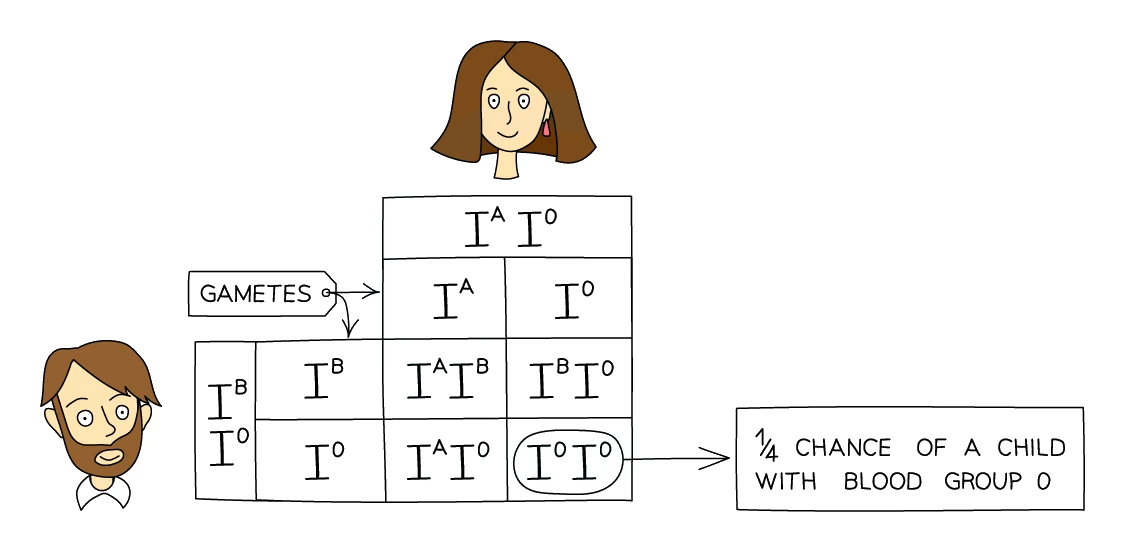
The classic example is the inheritance of human blood groups. The ABO gene has three alleles (not two):
| Allele | What it codes for |
|---|---|
| I^A | Production of antigen A on red blood cells |
| I^B | Production of antigen B on red blood cells |
| I^O | No antigen produced (no A and no B) |
The rules of dominance are:
- I^A and I^B are codominant with each other. If you have one of each, both antigens appear on your red blood cells.
- Both I^A and I^B are over I^O.
This gives four possible phenotypes (blood groups A, B, AB, O) from six possible genotypes:
| Genotype | Phenotype (blood group) |
|---|---|
| I^A I^A | A |
| I^A I^O | A |
| I^B I^B | B |
| I^B I^O | B |
| I^A I^B | AB (codominance: both A and B antigens) |
| I^O I^O | O |