Genetics & Inheritance
Reproduction and Inheritance
DNA (deoxyribonucleic acid) is the molecule that stores all the genetic information in every living cell. Its structure was worked out in 1953 by Watson, Crick, Franklin and Wilkins.
The double helix
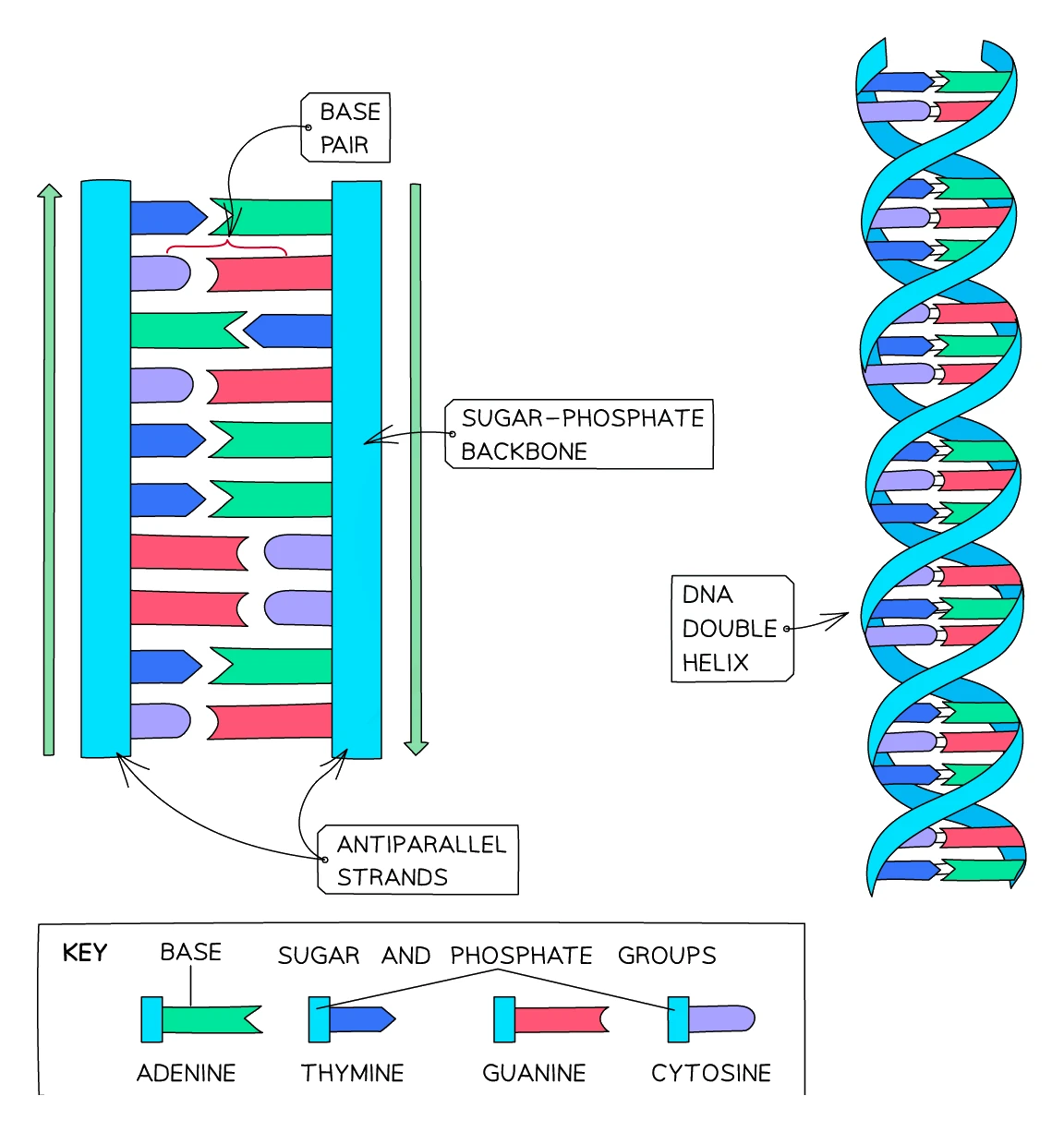
DNA is built as a double helix: two long strands wound around each other in a regular spiral, like a twisted ladder. Each strand is made of a chain of smaller units called nucleotides.
A nucleotide has three parts:
- A phosphate group (forms part of the strand backbone)
- A deoxyribose sugar (also part of the backbone)
- A nitrogenous base (the variable part)
The phosphates and sugars alternate along the outside of each strand, forming the sugar-phosphate backbone. The bases stick inwards from the strands and form the rungs of the ladder.
The four bases and how they pair
DNA has only four different bases:
- A (adenine)
- T (thymine)
- G (guanine)
- C (cytosine)
On the two strands of the helix, the bases pair up across the middle of the ladder by following strict complementary base-pairing rules:
- A always pairs with T
- G always pairs with C
This means that if you know the order of bases on one strand, you can work out the order on the other. For example, if one strand reads A-T-G-C-A, the partner strand must read T-A-C-G-T.
The two strands are held together by hydrogen bonds between the paired bases. These are weak enough to be broken easily (so the strands can separate during DNA replication and protein synthesis) but strong enough in total to keep the helix stable.
Genes are sections of DNA
A gene is just a length of DNA that codes for one specific protein. A typical human chromosome contains thousands of genes, each separated from the others by non-coding regions.
The sequence of bases in a gene determines the sequence of amino acids in the protein it codes for. The genetic code works in groups of three bases: every group of three bases (a triplet) codes for one specific amino acid.