4BI1
Genetics & Inheritance
Reproduction and Inheritance · 6 question types
The process of using a gene to build a protein has two main stages:
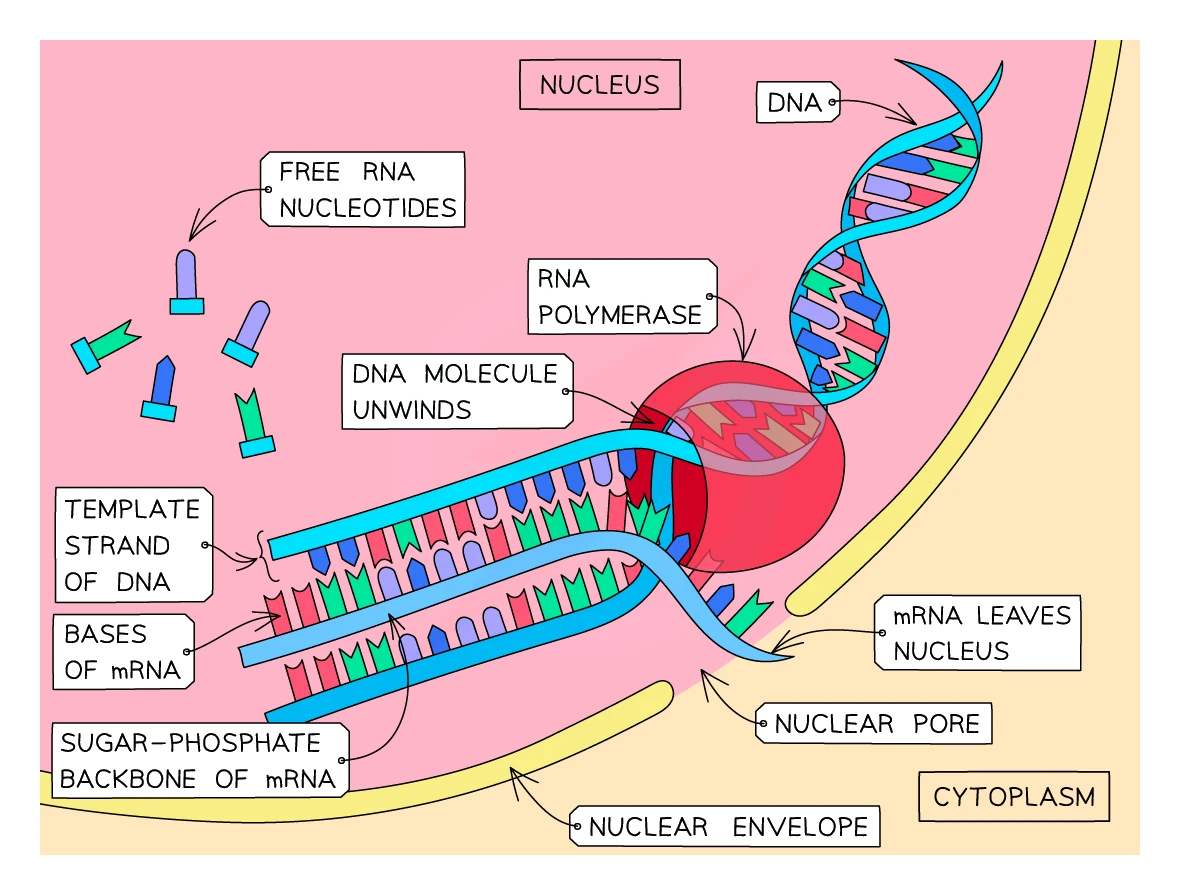
- Transcription: the DNA code of the gene is copied into an mRNA molecule, inside the nucleus.
- Translation: the mRNA molecule is read by a ribosome, which uses the code to build the corresponding chain of amino acids in the cytoplasm.
Transcription (in the nucleus)
- The relevant section of DNA unwinds as hydrogen bonds between the complementary bases break.
- One strand of the gene acts as the template strand.
- Free RNA nucleotides in the nucleus line up against the template strand according to the complementary base-pairing rules (A pairs with U, T pairs with A, G pairs with C, C pairs with G).
- The RNA nucleotides are joined together into a single-stranded mRNA molecule.
- The mRNA detaches from the DNA, which rewinds back into a double helix.
- The mRNA molecule leaves the nucleus through a pore in the nuclear envelope.
So transcription produces an mRNA copy of the gene that can travel out of the nucleus to the protein-building machinery.
Translation (in the cytoplasm)
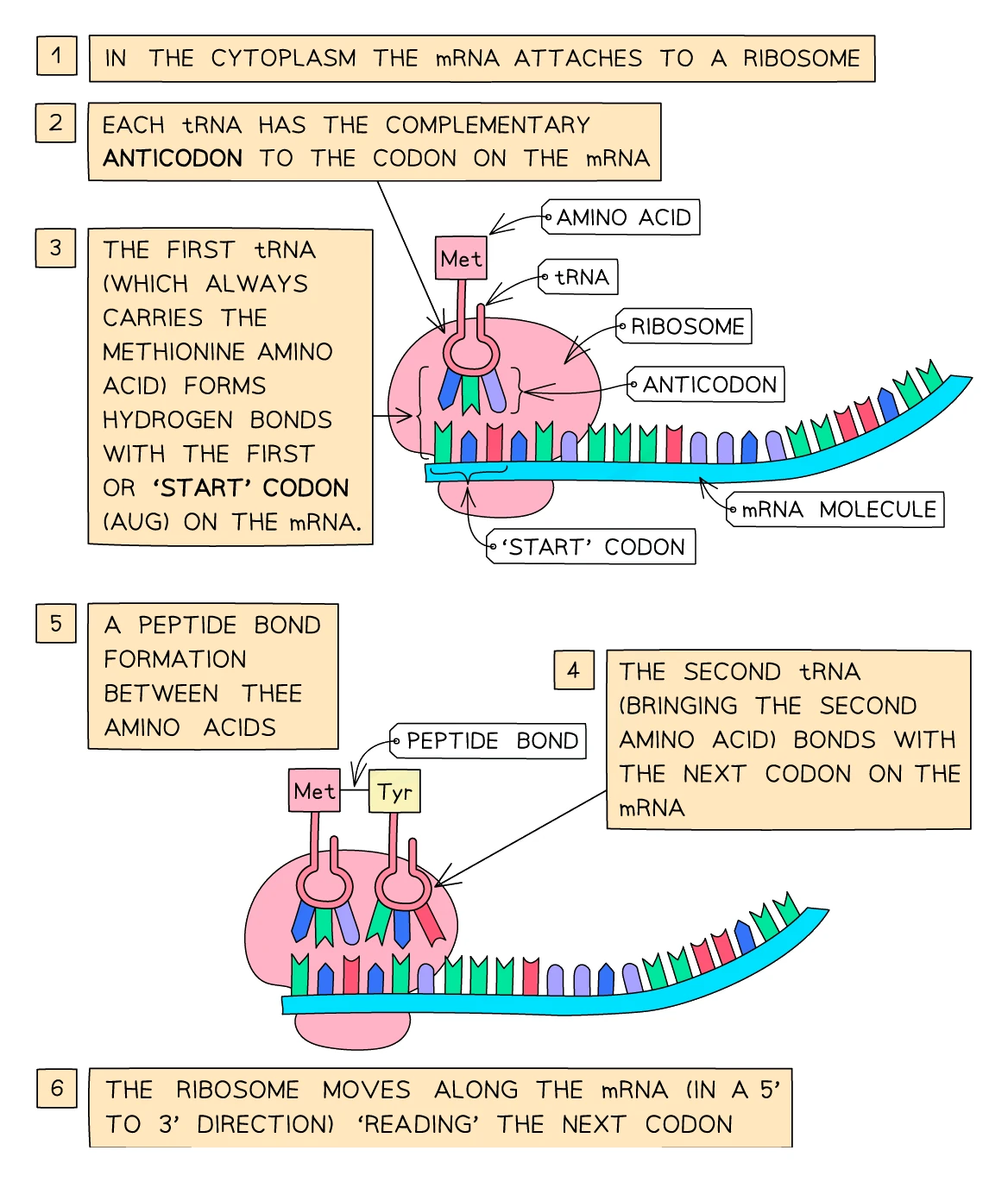
- The mRNA molecule arrives at a ribosome in the cytoplasm.
- The ribosome reads the mRNA three bases at a time. Each group of three bases is a and codes for one specific amino acid.
- In the cytoplasm, many free tRNA molecules are floating around. Each tRNA carries a specific amino acid at one end and has a triplet of bases () at the other end.
- A tRNA whose anticodon matches the first codon on the mRNA binds to it. Then a second tRNA binds to the next codon. The two amino acids carried by these tRNAs are joined together by a peptide bond.
- The ribosome moves along the mRNA one codon at a time. Each time, a new tRNA brings the matching amino acid, which is added to the growing chain.
- When the ribosome reaches a stop codon, translation stops. The completed chain of amino acids is released.
- The chain folds up into the specific 3D shape of the finished protein, which can now do its job (e.g. as an enzyme, antibody or structural protein).
The big picture
Gene (DNA) → mRNA (transcription, in the nucleus) → Protein (translation, on the ribosome)
The sequence of bases in DNA → determines the sequence of bases in mRNA → determines the sequence of amino acids in the protein → determines the shape and function of the protein → determines the characteristic of the organism.