Genetics & Inheritance
Reproduction and Inheritance
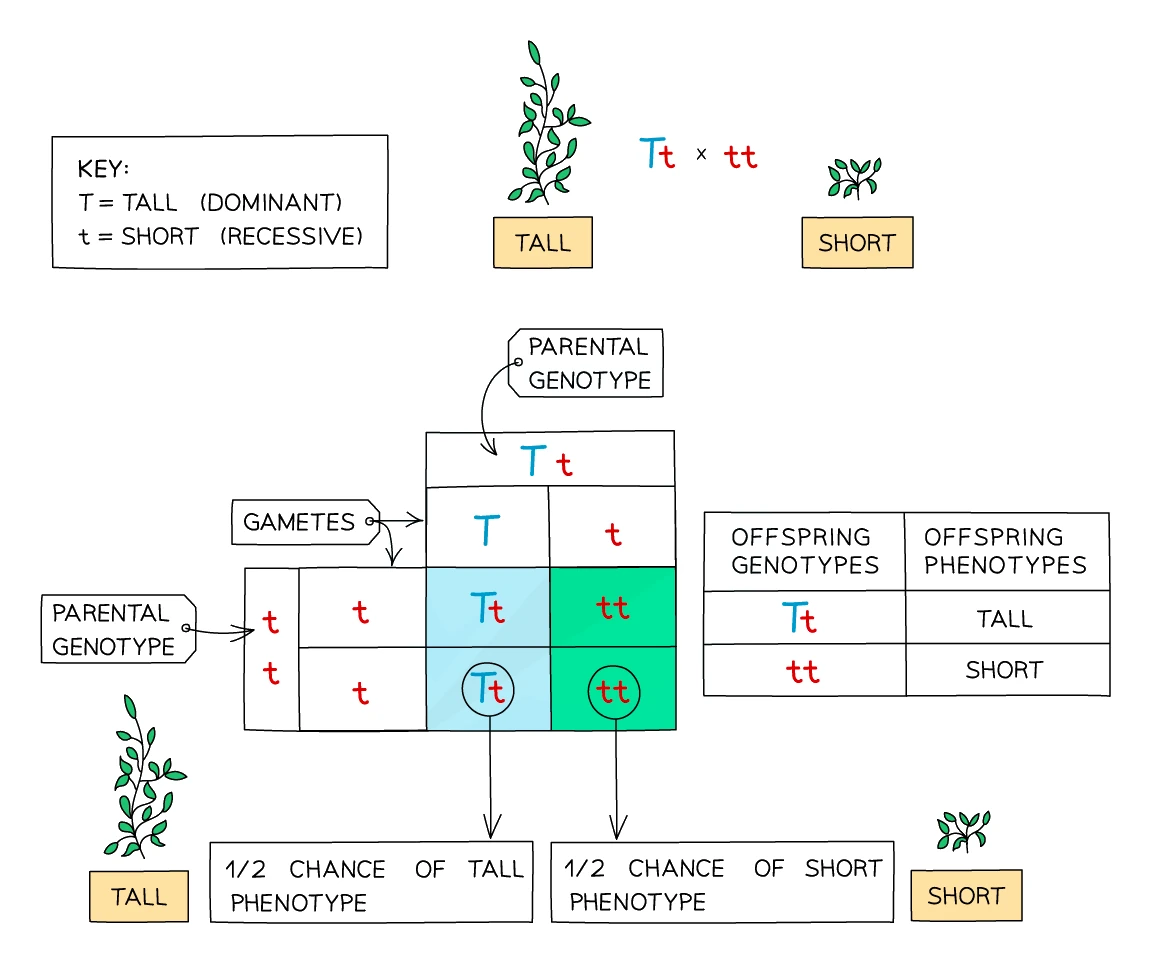
A monohybrid cross is a cross between two individuals looking at one gene with two alleles. The standard tool for predicting the outcome of a monohybrid cross is a .
How to set up a Punnett square
- Identify the parent genotypes. Use a clear letter for the gene, with the capital for the dominant allele and the lowercase for the recessive (e.g. T and t, or B and b; avoid letters like C/c and S/s where the case is hard to tell apart in handwriting).
- Split each parent's into the two gametes they can produce.
- Draw a 2×2 grid. Put one parent's possible gametes along the top, the other parent's possible gametes down the side.
- Fill in the four boxes of the grid by combining the alleles at the top and side of each box. These are the possible offspring genotypes.
- Work out the phenotype for each genotype using the dominant/recessive rules.
- State the ratio of phenotypes.
Common exam question
Drawing a genetic diagram for a monohybrid cross
Question: Draw a genetic diagram for the cross described, showing both parents' genotypes, their gametes, and the offspring genotypes and phenotypes (3–4 marks).
Asked in 11 of the 23 papers. Read the stem first: if parents with different phenotypes produce offspring that all look alike, the offspring show the dominant characteristic and are heterozygous (asked once for two marks: name it, then say all the offspring show it). Use one letter as capital and lower case (Rr): every scheme accepts it, some refuse two different letters, and none accepts X and Y. Most schemes give a mark each for the parental genotypes, gametes and offspring genotypes; four-mark versions add one for the offspring phenotypes (stated, or as a ratio) or for the probability asked for. A Punnett square earns them too; when phenotypes are asked for, label each genotype with its phenotype. With wrong parents, error carried forward usually earns one or two later marks, so finish the diagram.
From ratio to probability
Each new offspring is an independent event. The ratio from a Punnett square tells you the probability of each outcome for any single offspring.
For example, with Tt × Tt:
- Probability of a tall offspring = 3/4 = 0.75 = 75%
- Probability of a short offspring = 1/4 = 0.25 = 25%
If the parents have four offspring, the ratio will not always come out exactly 3:1. You might get 4 tall and 0 short, or 2 tall and 2 short. The 3:1 ratio only emerges accurately over many offspring. This is why pea plants are useful for these experiments, because a single plant can produce hundreds of seeds.
Common exam question
Comparing an observed ratio with the expected 3 : 1
Question: Calculate the offspring ratio in the form n:1, then explain why it differs from the expected ratio, or comment on results against the expected results (2–4 marks).
Set in 2 of the 23 papers. For the ratio, subtract to find the second group, write the unsimplified ratio (one mark on its own), then divide both sides by the smaller number to reach n:1, to one or two decimal places. For the explanation, state the expected ratio first (3:1 from two heterozygous parents, 1:1 for male to female), then that fertilisation is random, so which gametes fuse is down to chance (one mark each; "random fertilisation" alone earns both); a further mark comes from fewer of one type surviving or germinating. When comparing results, turn the counts into a ratio or percentage and set them beside the expected values: raw numbers alone earn nothing, while "close to 3:1, slightly fewer of one type than expected" earns the comparison marks.
Worked example
Genetic diagram for two heterozygous parents
Two plants are both heterozygous for stem length. The allele for long stem (W) is dominant over the allele for short stem (w). Both parents have genotype Ww. Predict the genotypes and phenotypes of their offspring.
Solution:
- Parental genotypes: Ww × Ww
- Parental gametes: W or w (from each parent)
- Punnett square:
| W | w | |
|---|---|---|
| W | WW | Ww |
| w | Ww | ww |
- Offspring genotypes: 1 WW : 2 Ww : 1 ww
- Offspring phenotypes: 3 long stem (WW and Ww) : 1 short stem (ww)
- Phenotype ratio = 3:1