Movement & Position
Forces & Motion
Reading the slope
- A velocity-time graph plots an object's velocity (y-axis) against the time elapsed since the start of the motion (x-axis)
- The slope of the line tells you about the acceleration:
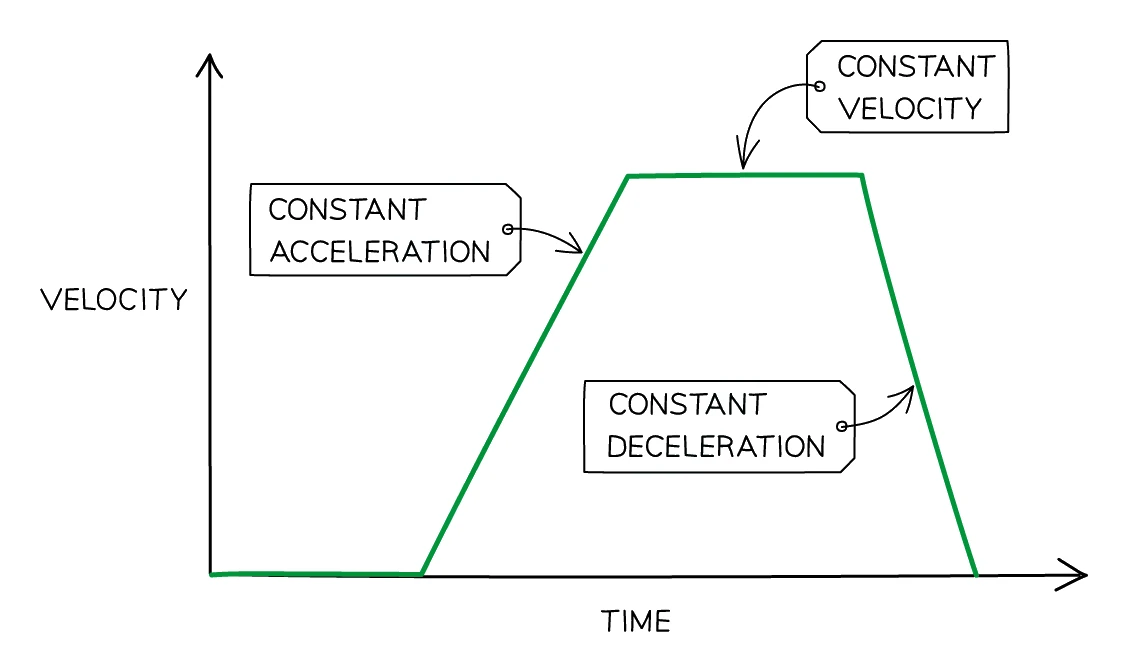
- A straight line with a positive gradient means constant acceleration, with velocity climbing at a steady rate
- A straight line with a negative gradient means constant deceleration, with velocity falling at a steady rate
- A steep line signals a large magnitude of acceleration; a gentle line signals a small one
- A flat horizontal line means zero acceleration, so the velocity stays at a single fixed value (a constant velocity)
Gradient = acceleration
- The of an object equals the of its velocity-time graph:
a = Δy / Δx = Δv / Δt
- For a straight-line section, the gradient is the same everywhere, so draw a large gradient triangle and divide the rise by the run, taking care to read the axes in their stated units (m/s and s)
Common exam question
Acceleration from the gradient of a velocity–time graph
Question: Use the velocity–time graph to calculate the acceleration, or determine it by drawing a tangent to a curved line (3–4 marks).
Asked in 7 of the 24 papers. The three marks are the idea that acceleration = gradient (or the acceleration equation), stated or clearly used; a substitution with values read from the line, any two points on it with the matching time interval; and the evaluation, in the graph's units (cm/s gives cm/s²). For a curve, draw a tangent at the stated time and take its gradient; the tangent attempt is a mark on its own and the answer is accepted within a range.
A falling velocity gives a negative gradient: one scheme for a braking car ignored the sign, but one for an object thrown upwards rejected a positive answer, so keep the minus sign.
Explaining a constant acceleration needs both points: the gradient is the acceleration, and it is constant. The area gives the distance.