Movement & Position
Forces & Motion
Aim
- Measure the of an everyday falling object by timing how long it takes to fall through a known distance
- Suitable objects: a paper cone, a ping-pong ball, a small ball of cotton wool. The object must be light enough that air resistance keeps the speed slow enough to time by hand
Variables
- Independent variable: drop height, d (in m)
- Dependent variable: time taken to fall, t (in s)
- Control variables: the same object used in every drop, released from rest, dropped from the same starting position with the room's air kept still
Apparatus
| Equipment | Purpose | Resolution |
|---|---|---|
| Metre rule (or longer tape) | Mark out the drop heights | 1 mm |
| Stopwatch | Time each fall | 0.01 s |
| Falling object (paper cone or ball) | The motion to be investigated | — |
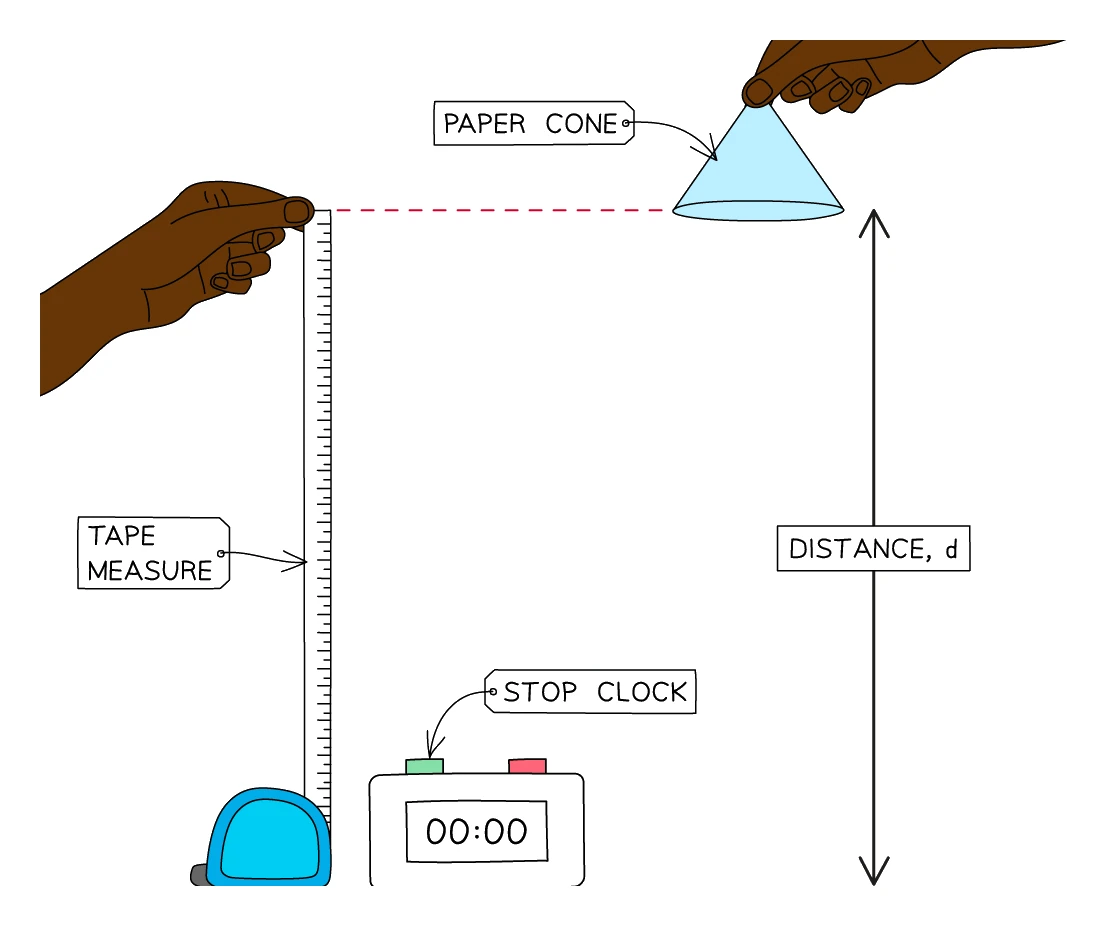
Method
- Mark a starting drop height of 0.5 m above the landing point using a metre rule clamped to a retort stand
- Hold the object level with the mark, with the stopwatch ready in your other hand
- Release the object from rest and start the stopwatch the instant it leaves your fingers
- Stop the stopwatch as soon as the object touches the mat; record the time
- Repeat the drop a further two times from the same height; take the mean of the three readings
- Repeat steps 1–5 from heights of 0.9 m, 1.3 m, 1.7 m and 2.0 m
Common exam question
Describing how to measure the speed of a moving object
Question: Describe a method to determine the speed of a vehicle passing two markers a known distance apart, or of a marble rolling across a bench (3 marks).
Set in 2 of the 24 papers. For the marble the three marks were the distance, the time and the equation; for the markers, a known distance apart, they were the time, the instrument and the equation, so make all four points. Say that the distance is known or measured (between the markers, or along the bench), say that the time taken to cover it is measured and name the instrument (a stopwatch, a stop clock or light gates), then say that the speed is calculated as distance ÷ time; any subject of the equation is accepted. Light gates connected to a data logger are credited as the alternative route: position them so that the object cuts the beams, and the timing then starts and stops without a person's reaction time.
Analysis
- For each drop height, calculate the from:
average speed = drop height / mean time
- A taller drop gives a longer fall time and a larger average speed, because gravity has more distance over which to speed the object up
- Plotting average speed against drop height shows whether the relationship is linear or curved within the experimental range
Common exam question
Testing whether results fit distance = constant × time²
Question: Use the data in the table to deduce whether the results support the relationship distance ÷ time² = constant (3–4 marks).
Set in 2 of the 24 papers, both times for a ball rolling down a slope. Work out distance ÷ time² for two different rows of the table, showing each division and its value; then compare the two values in a sentence or an expression, and give the conclusion that follows from your comparison. The marks are one for each constant, then one or two for the comparison and the conclusion, and on the four-mark version the comparison mark was allowed even when the two values came out unequal, with the conclusion mark for a verdict consistent with that comparison. Use the table's numbers: constants worked out from a graph were ignored.
Sources of error
- Systematic error, reaction time. A human takes roughly 0.25 s to start the stopwatch and another 0.25 s to stop it; that is a sizeable fraction of a 0.5 s fall. Reduce this either by using longer drops (so reaction time is a smaller percentage of the total) or by replacing the stopwatch with light gates wired to a trapdoor release, which starts and stops the timer automatically
- Systematic error, parallax. When you set each drop height, line your eye up squarely with the mark so the reading is not skewed by viewing the scale from above or below
- Random error, air movement. Even a small draught will deflect a paper cone or cotton ball mid-fall; close doors and windows and ensure nobody is walking past during a drop
Safety
- Place a soft mat or padded tray at the landing point so the falling object does not bounce, break or roll into walkways